
Selection Guide
Compression Cam Latches: How to Select the Right Type for Your Enclosure
Compression cam latch selection guide: hidden vs exposed, adjustable vs fixed, keyed vs tool-operated. IP65-IP67 sealing data, clamp-range chart, and industry-specific picks for server racks, EV cabinets & food equipment. Factory direct, OEM available.
Quick Answer
A compression cam latch converts rotational input into linear pulling force via an angled cam, compressing a gasket to seal your enclosure. Choose a hidden (flush) cam latch for clean panels with tool access, an exposed lever type for heavy gaskets needing tool-free operation, an adjustable-stroke model when gasket thickness varies across your product line, or a keyed compression cam when you need sealing + security. Skip to the 4 types comparison table.
1. What Is a Compression Cam Latch?
A compression cam latch — also called a compression fastener, plane lock, or flush compression lock — is a locking mechanism that does two jobs simultaneously: it holds the door or panel shut, and it compresses a gasket to create a dust-tight or waterproof seal around the enclosure perimeter.
The defining feature is the angled cam profile. Unlike a standard cam lock whose flat tongue simply blocks the door from opening, a compression cam latch has a precisely machined cam that rides over a strike plate or keeper, progressively pulling the door toward the frame as the operator rotates the mechanism. This axial pull is what compresses the gasket.
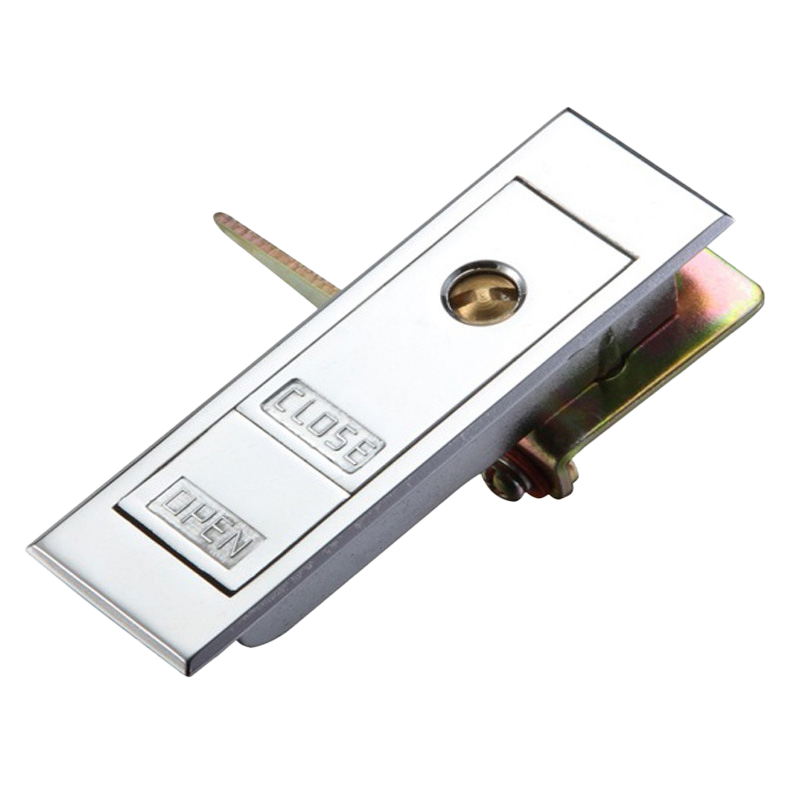
Compression cam latches are standard hardware on sealed electrical panels, server rack containment doors, outdoor telecom cabinets, EV charging stations, food processing enclosures, and any application requiring an IP or NEMA environmental rating. They are manufactured by Hengchieh in zinc alloy die-cast, 304 stainless steel, 316 stainless steel, and engineering plastics — with over 33 models covering virtually every industrial use case.
2. How the Cam Mechanism Creates Compression
Understanding the cam mechanics helps you select the right stroke length and force profile for your gasket. The compression cam latch operates in three distinct stages:
Stage 1 — Engagement. The operator inserts a key, tool, or grips the handle and begins rotating the latch body. The cam on the back side of the panel starts to approach the strike plate. At this stage, there is no compression force — the cam is simply moving into position.
Stage 2 — Progressive compression. As the cam rotates past the strike plate edge, its angled surface begins pulling the door toward the frame. The compression force increases progressively with rotation angle. For a typical quarter-turn (90°) compression cam latch with a 3 mm stroke, the force curve looks like this:
- 0°–30°: Cam engages strike, 0–20% of max force
- 30°–60°: Progressive compression, 20–70% of max force
- 60°–90°: Final compression, 70–100% of max force (gasket fully compressed)
Stage 3 — Locked position. At full rotation, the cam detent (click) holds the latch in the compressed position. The gasket is now compressed to its target percentage (typically 20–30% of free height for EPDM), creating a continuous seal around the door perimeter. The detent prevents the cam from walking back under vibration.
The cam stroke (total linear travel) is the single most important specification. It must match your gasket's required compression distance. Too little stroke means inadequate sealing; too much stroke makes the latch hard to operate and can over-compress the gasket, causing permanent set (the gasket stops bouncing back).
3. Four Types of Compression Cam Latches
All compression cam latches share the same basic cam-and-strike mechanism, but they differ in how the operator interacts with them and where the body sits relative to the panel surface. These four categories cover the full range of industrial applications:
| Type | Profile | Stroke | Max Force | Locking | Best For |
|---|---|---|---|---|---|
| Hidden (Flush) Cam | Fully recessed | 1–3 mm | 200–500 N | Tool/key operated | IT racks, clean panels, anti-vandal |
| Exposed Lever Cam | Handle protrudes | 2–5 mm | 500–1,500 N | Tool-free, optional key | Large enclosures, heavy gaskets |
| Adjustable-Stroke Cam | Flush or semi-flush | 2–8 mm (variable) | 300–1,200 N | Tool/key/lever | Multi-product OEM, varying gaskets |
| Keyed Compression Cam | Flush, key cylinder | 1–4 mm | 200–800 N | Flat/tubular/dimple key | Utility, telecom, EV charging |
Hidden (Flush-Mounted) Compression Cam Latches
The entire latch body sits within or below the panel surface when locked. Nothing protrudes. The operator engages the latch via a coin slot, screwdriver slot, triangular insert (Caeleb triangle), or square insert on the latch face. This is the most common type for electrical distribution panels, IT enclosures, and any application where a smooth exterior is required for cleaning, aesthetics, or safety (no snag points).
Hidden compression cam latches typically require a rectangular or D-shaped panel cutout (commonly 30×65 mm or 32×68 mm). Because the operator cannot exert much torque through a coin slot, these latches are designed for lighter gaskets and lower compression forces — adequate for IP54 through IP65 in most configurations.
Popular Hengchieh models: MS703 (quarter-turn, zinc), MS713 (keyed flush, zinc), MS728 (flush, compact body).
Exposed Lever Compression Cam Latches
A hinged lever or T-handle provides mechanical advantage for higher compression forces. The lever folds flat against the panel when locked (maintaining a near-flush profile) and swings out for operation. This design excels on larger enclosure doors with heavy EPDM or silicone gaskets where the compression force exceeds what a hidden latch can deliver.
Lever compression cam latches are common on NEMA 4X enclosures, outdoor telecom cabinets, and food processing equipment housings where daily access by technicians requires comfortable, tool-free operation. The lever design is also ergonomically superior for enclosures accessed while wearing gloves (cold storage, chemical plants).
Popular Hengchieh models: MS708 (button lever, zinc+steel), MS717 (flush lever, zinc), MS726 (button lever, keyed).
Adjustable-Stroke Compression Cam Latches
Adjustable-stroke models have a cam whose effective throw can be set during installation — typically by rotating a threaded component or swapping cam inserts. This allows one latch model to work across multiple enclosure designs with different gasket thicknesses or panel gap tolerances.
For OEM enclosure manufacturers, adjustable-stroke compression cam latches are a procurement win: one part number covers your entire product range, one panel cutout, one supplier relationship. The adjustment range is typically 2–8 mm of linear travel, covering gaskets from 4 mm to 12 mm cross-section.
The trade-off is slightly higher unit cost (more machined parts) and the need for a trained installer to set the correct stroke during assembly. In high-volume production, this step adds 15–30 seconds per unit to the assembly time.
Keyed Compression Cam Latches
These integrate a lock cylinder directly into the compression cam mechanism, providing both environmental sealing and access security in a single device. Available in flat key (most economical), tubular key (higher pick resistance), and dimple key (highest security) configurations.
Keyed compression cam latches are required for any publicly accessible or utility-grade enclosure: street-side telecom cabinets, EV charging stations, transformer substations, parking meters, and outdoor kiosks. They are also standard on data center cabinets where compliance frameworks (SOC 2, HIPAA, PCI-DSS) require physical access logging.
Hengchieh offers keyed-alike, keyed-different, and master-keyed configurations for compression cam latches. For multi-site deployments, we maintain key databases across batches to ensure consistency — an installer ordering 500 latches this month and 500 next quarter gets the same key profile.
Popular models: MS713 (keyed flush, zinc), MS726 (keyed lever, zinc+brass), MS729 (keyed flush, high-security).
4. IP Rating & Sealing Performance Comparison
The whole point of using a compression cam latch instead of a simple cam lock is achieving an environmental seal. The table below maps each compression cam latch type to its achievable IP range, the gasket parameters that enable that rating, and the NEMA equivalent.
| IP Rating | NEMA Equiv. | Gasket Compression | Latch Spacing | Recommended Cam Type | Material Requirement |
|---|---|---|---|---|---|
| IP54 | NEMA 12 | 15–20% | ≤ 350 mm | Hidden flush, 1–2 mm stroke | Zinc alloy, any gasket |
| IP65 | NEMA 4 | 20–25% | ≤ 300 mm | Hidden or lever, 2–3 mm | Zinc or 304 SS, EPDM gasket |
| IP66 | NEMA 4X | 20–30% | ≤ 200 mm | Lever or adjustable, 3–5 mm | 304/316 SS, EPDM or silicone |
| IP67 | NEMA 6 | 25–30% | ≤ 150 mm | Lever, adjustable, 4–6 mm | 316 SS, silicone gasket |
| IP69K | — | 25–35% | ≤ 150 mm | Hygienic lever, 4–8 mm | 316L SS electropolished, FDA silicone |
Key insight from 35 years of manufacturing: The single most common failure mode we see is customers specifying the right latch but using too few of them. A single compression cam latch on a 600×400 mm door might achieve IP54 at the latch point, but the corners leak because the gasket is not compressed there. For IP65+, you need at least four latches on a door this size — one at each corner zone — or a multi-point rod system. See our swing handle & multi-point rod guide for large-door solutions.
5. Clamp Range & Panel Thickness Chart
The clamp range (also called grip range) is the range of total panel + gasket + strike plate thickness that the compression cam latch can accommodate. Specifying a latch with the wrong clamp range means either the cam cannot reach the strike (too far) or it bottoms out before compressing the gasket (too close).
| Panel Thickness | Recommended Cam Stroke | Body Depth Behind Panel | Typical Application |
|---|---|---|---|
| 0.8–1.5 mm | 1–2 mm | 22–28 mm | Sheet metal enclosures, IT equipment |
| 1.5–3.0 mm | 2–4 mm | 28–40 mm | Standard electrical panels, HVAC housings |
| 3.0–5.0 mm | 3–6 mm | 35–50 mm | Heavy-duty outdoor enclosures, transformer boxes |
| 5.0–8.0 mm | 5–8 mm | 45–60 mm | Insulated panels, sandwich panels, cold storage |
OEM tip: If your product line includes enclosures with multiple panel thicknesses (e.g., 1.2 mm for indoor models and 2.5 mm for outdoor models), consider an adjustable-stroke compression cam latch. One part number, one cutout dimension, one purchasing PO — and your assembly team adjusts the cam during installation. Hengchieh’s adjustable models cover a 2–8 mm stroke range, accommodating panels from 0.8 mm to 8.0 mm with proper cam selection.
6. Industry-Specific Selection Matrix
The environment where the enclosure operates determines every aspect of the compression cam latch specification. The matrix below maps six major industries to their specific requirements and our recommended approach.
| Industry | Cam Type | Material | IP / NEMA | Special Requirement |
|---|---|---|---|---|
| Data Centers / Server Racks | Hidden flush, quarter-turn | Zinc + satin chrome | IP54–IP65 | Zero aisle intrusion, keyed access, LOTO |
| EV Charging / BESS | Keyed lever, multi-point | 304/316 SS | IP66 / NEMA 4X | Anti-vandal, UV + salt spray, UL 2594 |
| Food Processing / Washdown | Hygienic lever, adjustable | 316L SS electropolished | IP66–IP69K | Crevice-free, FDA silicone, 3-A Sanitary |
| Telecom Outdoor Cabinets | Keyed flush or T-handle | 304 SS or powder-coated zinc | IP66 / NEMA 4 | Master-key system, anti-drill cylinder |
| HVAC / Machine Enclosures | Lever or hidden, fixed stroke | Zinc + chrome | IP54–IP65 | Vibration-resistant, detented cam |
| Medical Equipment | Hidden flush, compact | 304 SS or powder-coated zinc | IP54 | IPA-resistant finish, smooth geometry |
For application-specific deep dives, read our compression latch applications guide which covers server racks, washdown, outdoor, HVAC, and genset enclosures in detail with material/stroke/MOQ specs per application.
7. Compression Cam Latch vs Cam Lock vs Toggle Latch
Engineers and procurement teams often confuse these three latch families. The key differentiator is whether the mechanism provides compression force and, if so, how:
| Criteria | Compression Cam Latch | Standard Cam Lock | Toggle / Draw Latch |
|---|---|---|---|
| Compression force | 200–1,500 N | 0 N (no compression) | 100–5,000 N |
| Gasket sealing | IP54–IP67 | None | Limited (IP54 max) |
| Mounting | Flush (panel cutout) | Flush (round hole) | Surface-mounted |
| Security | Key available | Key standard | Rarely keyed |
| Vibration resistance | Excellent (detented cam) | Poor | Good (over-center) |
| Panel aesthetics | Clean, flush | Clean, flush | Visible hardware |
| Price (OEM, qty 1000) | $2–$25 | $0.50–$5 | $1–$15 |
| Ideal application | Sealed hinged doors | Drawers, filing cabinets | Lids, covers, flight cases |
Decision rule: If your enclosure needs environmental sealing (any IP rating above IP20) with a flush-mount, panel-cutout design, specify a compression cam latch. For non-sealed indoor applications, a standard cam lock is simpler and cheaper. For heavy clamping on lids and removable covers, use a toggle or draw latch. For large enclosure doors with heavy gaskets, consider a paddle latch or swing handle with multi-point rods.
8. Gasket Force Calculation Guide
Getting the gasket compression right is the difference between an enclosure that passes IP testing and one that leaks at the first rain. Here is the engineering calculation method we use at Hengchieh when helping customers specify latches:
Step 1: Determine Gasket Properties
- Cross-section diameter: Measure the gasket’s free (uncompressed) height. Common sizes: 4 mm, 6 mm, 8 mm, 10 mm.
- Material: EPDM (most common), silicone (high-temp/FDA), Viton (chemical resistance), neoprene (economy).
- Shore A hardness: 40–60A for most industrial gaskets. Higher hardness = more force needed.
Step 2: Calculate Required Compression Distance
For IP65, target 20–25% compression. For IP66+, target 25–30%.
Example: 6 mm EPDM gasket, target IP65 (25% compression). Compression distance = 6 mm × 0.25 = 1.5 mm. This becomes your minimum cam stroke.
Step 3: Calculate Total Force Required
Force per unit length for EPDM at 25% compression: typically 3–7 N/cm (varies by hardness and cross-section). Measure your gasket perimeter: for a 600×400 mm door, perimeter = 2,000 mm = 200 cm. Total force = 200 cm × 5 N/cm = 1,000 N.
Step 4: Select Number of Latches
For IP65 with 300 mm max spacing: 2,000 mm ÷ 300 mm = 6.7, round up to 8 latches (include corners). Force per latch = 1,000 N ÷ 8 = 125 N. Apply 1.5× safety factor: 125 × 1.5 = 188 N minimum per latch.
Even a basic hidden flush compression cam latch (rated 200–500 N) handles this easily. The challenge comes with large doors and IP66+ requirements where total force can reach 3,000+ N — that is where lever-operated or multi-point systems become necessary.
For complete gasket compression engineering data, see our compression latch master guide and waterproof enclosure lock IP65 guide.
9. OEM Specification & Ordering
Hengchieh manufactures 33 compression cam latch models (marketed as “plane locks” in our catalog) covering the full range of applications described in this guide.
- MOQ: 500 pcs for catalogue items with standard finish. 2,000 pcs for custom key codes, cam lengths, or finishes.
- Sample lead time: 7 days from stock.
- Production lead time: 25–35 days depending on finish and material.
- Custom tooling: 30–45 days, quoted separately. We retain and maintain the tool for the customer.
- Materials: Zinc alloy (Zamak 3/5), 304 SS, 316 SS, 316L SS, PA66 (glass-filled nylon).
- Finishes: Bright chrome, satin chrome, black powder coating (RAL matching), nickel, electropolish.
- Certifications: IATF 16949, ISO 9001, CE, RoHS, REACH.
For a custom specification or to request samples, contact our engineering team with your enclosure dimensions, target IP/NEMA rating, gasket type, and panel thickness. We provide DXF cutout templates and gasket compression data for every model.
For sourcing tips and supplier evaluation criteria, read our guide to sourcing industrial hardware from China. For material selection help, see zinc alloy vs stainless steel comparison.
10. Frequently Asked Questions
What is a compression cam latch and how does it differ from a regular cam lock?
A compression cam latch converts rotational input (key turn, handle rotation, or tool operation) into linear pulling force via an angled cam profile. This pulls the door toward the frame, compressing a gasket to create an environmental seal (IP54 to IP67). A regular cam lock simply rotates a flat tongue to hold a door shut with no compression force and no sealing ability. If your enclosure needs dust or water protection, you need a compression cam latch, not a cam lock.
What IP rating can a compression cam latch achieve?
Compression cam latches can achieve IP54 (dust-protected, splash-proof) through IP67 (dust-tight, temporary submersion at 1 m for 30 minutes). The actual rating depends on three factors: gasket material and cross-section, compression percentage (20-30% optimal), and latch spacing around the door perimeter (every 200-300 mm for IP65, 150-200 mm for IP66+). With 316 stainless steel and silicone gaskets, IP67 / NEMA 4X is routinely achieved.
What is the difference between a hidden (flush) and exposed compression cam latch?
A hidden (flush-mounted) compression cam latch sits entirely within or below the panel surface when locked. The operator uses a coin slot, screwdriver, triangular insert, or key to engage it. An exposed compression cam latch has a visible handle (T-handle, lever, or paddle) that protrudes from the panel surface. Hidden latches provide better aesthetics, easier cleaning, and snag-free surfaces but require a tool for operation. Exposed latches allow tool-free access and provide more leverage for heavier gaskets.
How do I calculate the compression force needed for my enclosure gasket?
Step 1: Determine the gasket cross-section (e.g., 6 mm round EPDM). Step 2: Target 20-25% compression for IP65 (compress 6 mm gasket to 4.5-4.8 mm). Step 3: Measure the total gasket perimeter length. Step 4: Multiply by the force-per-unit-length for your gasket (typically 3-7 N/cm for EPDM). Step 5: Divide total force by number of latch points. Step 6: Apply 1.5x safety factor. Example: a 600x400 mm door with 2 m of gasket needing 5 N/cm = 1,000 N total. With 4 latches, each needs 250 N x 1.5 = 375 N minimum compression force.
Can compression cam latches be keyed alike across multiple enclosures?
Yes. Key-locking compression cam latches are available in keyed-alike (all latches open with one key number), keyed-different (each latch has a unique key), and master-keyed (individual keys plus a master) configurations. This is critical for multi-cabinet installations like telecom sites, server farms, and EV charging stations where a technician needs one key for all enclosures. Hengchieh maintains key databases across production batches to ensure consistency for repeat orders.
Related Guides
Compression Latches: Complete Guide
33 models, IP ratings, gasket compression, sizing
Compression Latch by Application
Server racks, washdown, telecom, HVAC, genset
Compression vs Quarter-Turn Latch
Sealing force, panel depth & cost compared
Paddle Latch Hardware Applications
Locking paddle latches for every industry
Cam Lock Guide
Types, sizes, keying options
Browse All Plane Locks (33 Models)
Full product catalog with specs & images
Compression Latch Manufacturer — OEM & Factory Direct
Selection guide table, IP ratings, materials, MOQ & OEM options
Need Compression Cam Latches for Your Enclosure?
35+ years of precision die casting. IP66/IP67 rated. Custom keying. MOQ 500 pcs. Free samples.