
Application Guide
EV Charging Cabinet Hardware: Latches, Locks & Enclosure Solutions
Complete EV charging cabinet hardware guide: compression latches, multi-point locks, vandal-resistant handles for Level 2 & DC fast chargers. UL 2594, IEC 61851, NEMA 4X compliant. IP66/IP67 rated. BESS battery enclosure security. Factory direct, MOQ flexible. Get quote →
Quick Answer
EV charging cabinets need 316 stainless steel compression latches (IP66+) for the main enclosure, multi-point rod latch systems for tall doors over 1.2m, anti-vandal handles with concealed fixing, and padlock-ready mechanisms for LOTO compliance. DC fast chargers run at 400–1000V DC — unauthorized access is a lethal risk. A single charger contains $500–$2,000 in copper. Key standards: UL 2594, IEC 61851, NEMA 4X. Total hardware cost: $80–$400 per charger unit.
1. Why Hardware Matters for EV Charging Infrastructure
The global EV charging market is projected to reach $200+ billion by 2030, with over 30 million public chargers needed worldwide. Every charging station is essentially an unattended electrical cabinet sitting outdoors 24/7 — exposed to weather, vandalism, and copper thieves.
Yet in our experience supplying hardware to EV charging OEMs, the enclosure hardware is often an afterthought. Engineering teams spend months perfecting power electronics and software, then specify generic locks and latches in the final week. This leads to field failures: gasket leaks that corrode electronics, latches that jam in sub-zero temperatures, and locks that a $3 screwdriver can defeat.
The cost of getting hardware wrong: A single field service call to replace a failed latch costs $500–$1,000 (technician dispatch + downtime). A water ingress event from a failed gasket seal can destroy $5,000–$20,000 in power electronics. Copper theft from an inadequately secured charger costs $2,000–$10,000+ including cable replacement and lost revenue. Against these risks, specifying the right hardware from day one is the most cost-effective engineering decision on the project.
2. Hardware Requirements by Charger Type
| Charger Type | Voltage | Cabinet Size | IP Rating | Lock Type | Security Level |
|---|---|---|---|---|---|
| Level 2 AC (Wall) | 240V AC | Small (300×200mm) | IP54–IP65 | Cam lock or quarter-turn | Basic |
| Level 2 AC (Pedestal) | 240V AC | Medium (600×400mm) | IP65–IP66 | Compression latch | Medium |
| DC Fast (50 kW) | 400V DC | Large (1200×600mm) | IP66 | Multi-point compression | High |
| DC Ultra-Fast (150–350 kW) | 800–1000V DC | XL (1800×800mm) | IP66–IP67 | 5-point rod latch | Maximum |
| BESS Cabinet | 48–1000V DC | XL (2000×800mm+) | IP55–IP67 | Multi-point + fire release | Maximum + fire safety |
3. Compression Latches for EV Charging Enclosures
Compression latches are the primary locking mechanism for EV charging cabinet doors. Unlike simple cam locks, compression latches actively pull the door against the gasket as they lock, creating the environmental seal needed for outdoor installations.
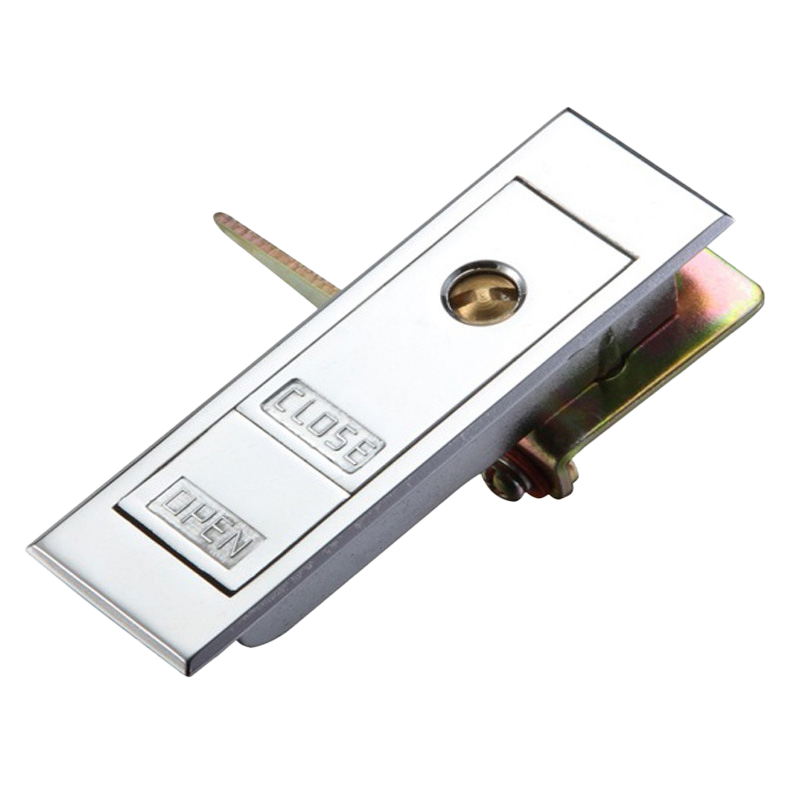
Why Compression Latches, Not Cam Locks?
We see EV charging OEMs making this mistake regularly: specifying basic cam locks on enclosures that need IP66 sealing. A cam lock simply rotates a tongue to hold the door closed — it provides zero compression force on the gasket. After a few months of thermal cycling (-40°C to +60°C), the gasket settles, the door gaps, and water enters.
A compression latch provides 1–3mm of active compression travel, maintaining gasket contact even as materials expand and contract. For EV charging cabinets, specify:
- Material: 316 stainless steel (1,000+ hour salt spray resistance per ASTM B117)
- Gasket: EPDM or silicone, 20–25% compression for IP66
- Operation: Key-locking with restricted keyway (not CH751 — too common)
- Compression force: 300–800 N per latch
- Temperature range: -40°C to +85°C continuous
Browse our full compression latch catalog for models suitable for EV charging applications.
4. Multi-Point Latch Systems for Tall Cabinets
DC fast charger cabinets are typically 1.2–1.8m tall. A single-point latch at mid-height cannot maintain gasket compression at the top and bottom of the door — the door “pillows” outward at the corners, breaking the seal. The solution is multi-point locking.
How Multi-Point Rod Latch Systems Work
A single swing handle or T-handle operates connecting rods that run vertically (and sometimes horizontally) to locking points at the top, middle, and bottom of the door. When the handle is closed, all points compress the gasket simultaneously, providing uniform sealing across the entire door perimeter.
| Door Height | Locking Points | Rod Type | Typical Application |
|---|---|---|---|
| Under 600 mm | 1 (single point) | N/A | Level 2 wall-mount, small enclosures |
| 600–1200 mm | 2 (top + bottom) | 8mm ø steel rod | DC fast charger (50 kW) |
| 1200–1800 mm | 3 (top + mid + bottom) | 10mm ø steel rod | DC ultra-fast (150–350 kW) |
| 1800 mm+ | 5 (full perimeter) | 10–12mm ø rod | BESS cabinet, transformer |
Hengchieh supplies 18 rod control lock models and swing handle locks specifically designed for multi-point locking applications. For detailed rod sizing and compression calculations, see our swing handle & multi-point rod latch guide.
Developing an EV charger enclosure?
Send us your cabinet dimensions and target IP rating — we’ll recommend the complete hardware package (latches, locks, hinges, gaskets) with 3D models and DXF cutout drawings. Free engineering consultation.
Get a Hardware Recommendation5. Anti-Vandal & Anti-Theft Lock Solutions
Public EV chargers are high-value, unattended assets. Copper theft alone cost the US EV charging industry an estimated $100+ million in 2025. Hardware security must address three threat levels:
Level 1: Opportunistic Theft (most common)
- Threat: Standard tools (screwdriver, pliers, pry bar)
- Solution: Security screws (pin-in-Torx, snake-eye) on all external fasteners, locks with anti-pry shoulders, concealed mounting
- Cost: Minimal (~$5–$15 per charger in upgraded fasteners)
Level 2: Targeted Theft (organized)
- Threat: Angle grinder, bolt cutters, lock picking tools
- Solution: Anti-drill lock cylinders with hardened steel inserts, restricted keyways (keys not duplicatable at standard locksmiths), 3mm+ stainless steel strike plates, tamper-detect micro-switches
- Cost: $30–$80 per charger
Level 3: Critical Infrastructure Protection
- Threat: Sophisticated attack, internal threat
- Solution: Electronic locks with audit trails, RFID/biometric access, GPS-tracked keys, real-time door-open monitoring integrated with the charger management system
- Cost: $100–$500 per charger (electronic lock system)
For most public charging deployments, Level 2 security is the sweet spot — it stops 95%+ of theft attempts at reasonable cost. Level 3 is reserved for critical infrastructure (fleet depots, emergency service stations, grid-scale BESS).
6. BESS Battery Enclosure Security
Battery Energy Storage Systems present unique challenges beyond standard EV charger cabinets. The primary concern is not theft — it’s fire safety.
Thermal Release Mechanisms
During a thermal runaway event, battery cells can reach 800°C+ and produce toxic, flammable gases. Firefighters must access the enclosure quickly — but the enclosure must also contain the event to prevent fire spread. This creates contradictory requirements: the lock must be secure against unauthorized access but instantly releasable in an emergency.
Solution: Thermal release locks incorporate a fusible link (typically rated at 150°C or 165°C) that automatically disengages the latch when the internal temperature exceeds the threshold. The door can then be pushed open without tools. When not triggered, the lock functions as a normal high-security multi-point system.
NFPA 855 Requirements
NFPA 855 (Standard for the Installation of Stationary Energy Storage Systems) requires:
- Emergency disconnect switches accessible without opening locked panels
- Fire department access provisions (Knox Box or equivalent key system)
- Ventilation openings that cannot be blocked by the locking mechanism
- Locks that remain operable after exposure to smoke and heat
Multi-Point Locking for BESS
Large BESS cabinets (2m+ tall, 800mm+ wide) require 5-point or 7-point locking systems. Hengchieh’s rod control lock series provides the multi-point compression needed for these installations, with optional thermal release integration.
7. Hinges, Gaskets & Accessories
Latches and locks are only part of the hardware package. EV charging enclosures also need:
Hinges
- Concealed hinges for tamper resistance — no exposed hinge pins that can be removed to bypass the lock
- 316 stainless steel for outdoor corrosion resistance
- Minimum 10,000 cycle fatigue life (maintenance access frequency)
- Opening angle limiters (120°–135°) to prevent door damage from wind gusts
For hinge selection, see our complete hinge types guide and concealed hinge catalog.
Gasket Systems
- EPDM for standard outdoor applications (good UV and ozone resistance, -40°C to +120°C)
- Silicone for extreme temperature applications (-60°C to +230°C) or where FDA compliance is needed
- Closed-cell sponge for IP54–IP65 where lower compression force is preferred
- Compression ratio: 20–25% for IP66, 25–30% for IP67
Additional Hardware
- Door stays — hold the door open during maintenance (prevents wind-slam injuries)
- Cable glands — IP68-rated for power cable entry points
- Ventilation louvers — with rain shields and insect mesh, maintaining IP rating
- Grounding studs — bonding the door to the frame ground (critical for EMC compliance)
8. Standards & Compliance Matrix
| Standard | Scope | Hardware Requirement | Market |
|---|---|---|---|
| UL 2594 | EV Supply Equipment | Locked access panels, tool-required opening | North America |
| IEC 61851 | EV Conductive Charging | Enclosure protection per IEC 62208 | International |
| NEMA 250 (4X) | Enclosure Ratings | Watertight, corrosion-resistant hardware | North America |
| IEC 60529 (IP66/67) | Ingress Protection | Compression latches maintaining seal over cycles | International |
| NFPA 855 | Energy Storage Systems | Fire department access, thermal release | North America |
| UL 9540 | Energy Storage Equipment | Fire-rated enclosure hardware | North America |
| NEC Article 625 | EV Charging Systems | Accessible disconnecting means | North America |
Hengchieh provides material certifications (RoHS, REACH), salt spray test reports (ASTM B117), IP test reports, and dimensional inspection records to support your compliance documentation. For NEMA enclosure rating details, see our NEMA enclosure types guide.
9. Material Selection for Outdoor EV Cabinets
| Component | Level 2 (Indoor Garage) | Level 2 (Outdoor) | DC Fast (Outdoor) | Coastal / Marine |
|---|---|---|---|---|
| Main latch body | Zinc alloy | 304 SS | 316 SS | 316L SS |
| Lock cylinder | Brass | Nickel-plated brass | 316 SS / brass | 316 SS |
| Hinge | Zinc alloy | 304 SS | 304 SS | 316 SS |
| Gasket | Neoprene | EPDM | EPDM / Silicone | Silicone |
| Fasteners | Zinc-plated steel | 304 SS | 316 SS / pin-Torx | 316 SS / pin-Torx |
| Salt spray life | 120 hrs | 500 hrs | 1,000+ hrs | 2,000+ hrs |
For a detailed material comparison, see our zinc alloy vs stainless steel guide. The 30–40% cost premium for 316 stainless steel over 304 is always justified for outdoor EV charger hardware — the 2–4x improvement in salt spray resistance means the hardware outlasts the 15-year service life of the charger without replacement.
10. Hardware Cost Analysis
Total hardware cost per EV charger unit, based on Hengchieh OEM pricing at production quantities (500+ units):
| Hardware Package | Level 2 | DC Fast | BESS Cabinet |
|---|---|---|---|
| Main latch(es) | $5–$15 | $15–$40 | $30–$80 |
| Multi-point rod system | N/A | $20–$50 | $40–$100 |
| Internal panel locks | $3–$8 | $10–$25 | $15–$40 |
| Hinges (set) | $5–$15 | $15–$40 | $25–$60 |
| Gaskets + accessories | $5–$10 | $10–$25 | $20–$50 |
| Security upgrade | $5–$15 | $30–$80 | $50–$100 |
| Total per unit | $23–$63 | $100–$260 | $180–$430 |
Context: A Level 2 charger costs $1,500–$5,000. A DC fast charger costs $30,000–$150,000. Hardware represents 0.3–1% of total unit cost — yet it determines whether the enclosure maintains its IP rating, resists theft, and survives 15 years outdoors. Specifying premium hardware is the highest-ROI engineering decision on the project.
11. Frequently Asked Questions
What hardware do EV charging cabinets need?
What is a multi-point latch for EV charging cabinets?
What IP rating do EV charger enclosures need?
What standards apply to EV charging locks?
Level 2 vs DC fast charger hardware differences?
How do BESS locks differ from standard cabinet locks?
How do I prevent EV charger copper theft?
Need EV Charger Cabinet Hardware?
35+ years of precision hardware manufacturing. Compression latches, multi-point locks, rod systems, hinges & gaskets — all from one factory. IATF 16949 certified.
Related Guides
Multi-Point Latch for EV Charging Cabinets
Detailed BESS security & multi-point locking
Compression Latches Complete Guide
Types, IP/NEMA ratings, gasket compression
Swing Handle & Multi-Point Rod Latches
Rod sizing, compression calculations, installation
NEMA Enclosure Types Guide
NEMA 1 through 4X ratings explained
Waterproof Enclosure Locks (IP65/IP67)
IP-rated lock selection for outdoor use
Draw Latches Guide
Types, load ratings & industrial applications