
Application Guide
Paddle Latch Hardware: Application Guide for Every Industry
Paddle latch hardware for toolboxes, enclosures, trucks & cabinets. Locking paddle latch vs non-locking, flush vs pop-out, stainless vs zinc. Cutout sizing chart, NEMA ratings, 19 models. Industrial grade, factory direct pricing.
Quick Answer
Paddle latch hardware is a flush-mount latching system where the handle sits recessed in the door — nothing protrudes when closed. Choose a locking paddle latch for truck toolboxes, electrical panels, and any public-access enclosure. Choose non-locking for frequently accessed HVAC panels and server rack side doors. 304 stainless steel for outdoor, 316 SS for marine/food, zinc alloy for indoor cost savings. Skip to the industry selection matrix.
1. What Is Paddle Latch Hardware?
Paddle latch hardware is the complete latching assembly used to secure doors on industrial enclosures, truck toolboxes, electrical panels, and equipment cabinets. The defining feature is the recessed paddle handle — a flat, rectangular handle that sits inside a pocket machined into the door panel, creating a completely smooth exterior surface when closed.
A complete paddle latch hardware assembly includes:
- Paddle body — the recessed handle mechanism that mounts through a rectangular cutout
- Cam or rod — the backend mechanism that engages the strike plate when the paddle is rotated
- Strike plate / keeper — mounted on the frame, receives the cam
- Mounting gasket — seals the cutout opening against dust and water ingress
- Key cylinder (optional) — integrated into locking paddle latch models
- Fasteners — retention nuts, clips, or screws for secure mounting
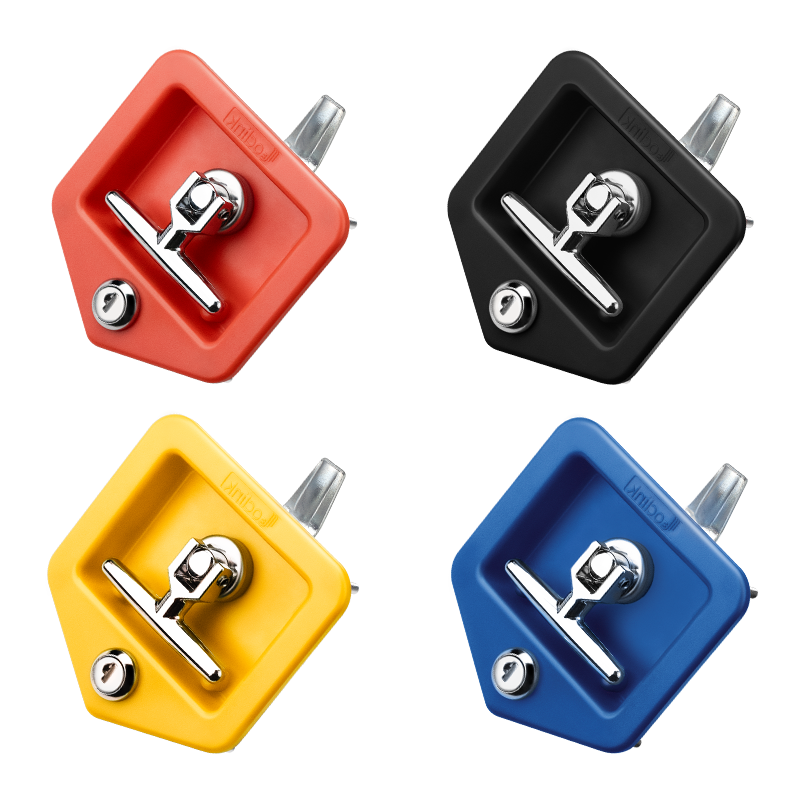
The flush profile serves three engineering purposes: it eliminates snag points in tight spaces (server rooms, truck beds), it reduces water collection surfaces (improving IP ratings), and it provides a clean, professional appearance for visible installations. This is why paddle latch hardware has become the default choice for modern truck toolboxes, replacing the older protruding T-handle design.
Hengchieh manufactures 19 paddle latch models in zinc alloy, 304 stainless steel, 316 stainless steel, and ABS/nylon — covering everything from budget indoor enclosures to marine-grade IP67 applications.
2. Locking Paddle Latch vs Non-Locking: When to Specify Each
The first design decision for paddle latch hardware is whether the latch needs a key lock. This decision is driven by regulation, security requirements, and access frequency.
When You Need a Locking Paddle Latch
- Electrical panels: OSHA 29 CFR 1910.305 requires lockable access to energized parts. Locking paddle latches with LOTO (lockout-tagout) padlock provisions are mandatory for MCC panels, switchgear, and distribution boards. See our electrical panel lock types guide for NEC compliance details.
- Truck toolboxes: Tools and equipment worth $1,000–$10,000+ require keyed security. Most fleet operators specify keyed-alike locking paddle latches so drivers use one key for all compartments on the truck.
- Telecom cabinets: Field cabinets housing fiber, copper, or wireless equipment need anti-vandal locking paddle latches with tamper-resistant key cylinders (anti-drill, anti-pick). Master-key systems allow technicians fleet-wide access.
- EV charging stations: UL 2594 and IEC 61851 require lockable enclosures for high-voltage components. Locking paddle latches with IP66 rating are standard. Read our EV charging cabinet hardware guide.
- Public-access kiosks: Vending machines, ATMs, parking meters, and any unattended equipment in public spaces.
When Non-Locking Paddle Latches Are Appropriate
- Frequently accessed panels: HVAC access doors, server rack side panels, and maintenance hatches opened dozens of times per day. A keyed lock here slows operations and increases the chance of lost keys.
- Internal compartments: Doors inside a already-locked outer enclosure (e.g., internal partitions in a multi-compartment cabinet) where the outer door provides the security perimeter.
- Generator enclosures: Access panels on gensets typically use non-locking paddle latches with spring-loaded retention — the vibration-dampening gasket and detented cam hold the door closed, but no key is needed for rapid maintenance access.
| Criteria | Locking Paddle Latch | Non-Locking Paddle Latch |
|---|---|---|
| Security level | Keyed access, LOTO capable | Physical retention only |
| Access speed | 5–10 seconds (find key, insert, turn) | 1–2 seconds (pull and turn) |
| Regulatory compliance | OSHA, NEC, UL 2594 | No specific mandate |
| Price premium | +20–40% over non-locking | Base price |
| Key management | Required (spare keys, master keys) | Not needed |
| Typical application | Toolboxes, utility, telecom, EV | HVAC, server racks, gensets |
3. Paddle Latch Types: Flush, Pop-Out, Folding & Compression
Within the paddle latch family, four distinct mechanism types address different operational requirements:
Flush Paddle Latches
The paddle sits perfectly flat in its recess when closed. To operate, the user inserts a finger into a relief notch at the paddle edge, pulls it out of the pocket, then rotates it to disengage the cam. This is the lowest-profile design, ideal for tight spaces and applications where protrusion must be zero (truck beds where cargo slides over the surface, server racks where aisle clearance is critical).
The trade-off: flush paddle latches require slightly more effort to operate because the user must dig a finger into the recess. Not ideal for operators wearing thick gloves.
Pop-Out Paddle Latches
A spring mechanism pushes the paddle slightly above the panel surface (3–5 mm) when the latch is released, making it easy to grip. When locked, the paddle is held flush by the key or cam detent. This is the preferred design for server rack doors and maintenance panels where technicians access the enclosure frequently.
Pop-out paddle latches are also popular on high-end truck toolboxes because the spring assist makes one-handed operation easy — important when the other hand is holding a power tool.
Folding T-Handle Paddle Latches
These combine a T-shaped handle with a paddle recess. The T-handle folds down into the recess when not in use, sitting flush or near-flush. When pulled up, the T-handle provides significant leverage for operating heavy compression mechanisms or multi-point rod latches. This is the standard hardware on heavy-duty truck toolboxes, equipment cases, and large industrial enclosures.
The MS858 series (a widely used model number in the Chinese industrial lock convention) is a folding T-handle paddle latch. See our MS-series model number guide for details on the MS858, MS858A, MS858B, and related variants.
Compression Paddle Latches
A hybrid design that combines the flush paddle profile with a compression cam mechanism. When the paddle is rotated to the locked position, the cam progressively pulls the door toward the frame, compressing a gasket. This achieves IP65+ sealing while maintaining the snag-free paddle profile.
Compression paddle latches are used on outdoor enclosures, food processing equipment, and any application requiring both flush aesthetics and environmental sealing. For a deep dive on compression mechanisms, see our compression cam latch selection guide.
| Type | Profile | IP Rating | Locking | Effort | Best For |
|---|---|---|---|---|---|
| Flush Paddle | 0 mm protrusion | IP54–IP65 | Key optional | Medium | Truck beds, tight spaces |
| Pop-Out Paddle | 3–5 mm (released) | IP54–IP65 | Key or tool | Low | Server racks, frequent access |
| Folding T-Handle | 1–3 mm (closed) | IP54–IP66 | Key standard | Low (leverage) | Heavy-duty toolboxes, large doors |
| Compression Paddle | 0–2 mm | IP65–IP67 | Key or tool | Medium-High | Outdoor sealed, food processing |
4. Material & Finish Selection
The material of your paddle latch hardware determines its corrosion resistance, achievable IP rating, cost, and aesthetic appearance. Here is the decision framework our engineering team uses when advising customers:
| Material | Salt Spray (hrs) | Max IP | OEM Price | Best Environment |
|---|---|---|---|---|
| Zinc alloy + bright chrome | 96–200 | IP54 | $2–$6 | Indoor industrial, climate-controlled |
| Zinc alloy + powder coat | 300–500 | IP65 | $3–$8 | Sheltered outdoor, light weather |
| 304 stainless steel | 500–1,000 | IP66 | $8–$18 | Outdoor, food processing, marine (mild) |
| 316 stainless steel | 1,000–2,000 | IP67 | $12–$30 | Marine, chemical, NEMA 4X, coastal |
| Glass-filled nylon (PA66) | N/A (immune) | IP65 | $2–$5 | Non-conductive, lightweight, corrosive gas |
Material selection rule of thumb: Start with the cheapest material that survives the environment. Indoor with no moisture → zinc alloy chrome. Indoor with condensation or occasional cleaning → zinc powder coat. Any outdoor exposure → 304 SS minimum. Coastal, marine, chemical, food processing → 316 SS. High-voltage isolation needed → PA66 nylon.
For a detailed comparison of zinc alloy vs stainless steel for industrial locks, see our zinc alloy vs stainless steel guide. For a broader material comparison including brass and aluminum, see our industrial lock materials guide.
5. Cutout Sizing & Panel Thickness Chart
Paddle latch hardware is mounted through a rectangular cutout in the door panel. Getting the cutout dimensions right is critical — too small and the paddle won’t fit, too large and you lose gasket compression and IP rating.
| Paddle Size | Cutout (mm) | Panel Thickness | Corner Radius | Application |
|---|---|---|---|---|
| Compact | 64 × 32 | 0.8–2.0 mm | R3 | Small equipment, electronics |
| Standard | 92 × 42 | 1.0–3.0 mm | R5 | Enclosures, toolboxes, most industrial |
| Large | 120 × 92 | 1.0–5.0 mm | R5 | Heavy-duty, large T-handle, multi-point |
| Truck standard | 108 × 76 | 1.2–3.0 mm | R5 | UWS/Weather Guard compatible |
Critical installation note: All cutout dimensions have a tolerance of +0.5 / −0 mm (cutout can be up to 0.5 mm oversize but never undersized). Use a CNC punch or laser cutter for clean edges — hand-cut openings with angle grinders leave rough edges that tear gaskets and compromise sealing over time. Hengchieh provides free DXF cutout templates for every paddle latch model.
6. Six Industries That Depend on Paddle Latch Hardware
1. Truck Toolboxes & Fleet Vehicles
Paddle latch hardware has largely replaced T-handle locks on modern truck toolboxes. The flush profile eliminates the protruding handle that catches on cargo straps, tarps, and workers’ clothing. Major toolbox brands (UWS, Weather Guard, Delta, Buyers Products) have standardized on paddle latch designs for underbody, crossover, and side-mount models.
Specification: Folding T-handle paddle latch, 304 stainless steel (road salt resistance), keyed-alike across all compartments, standard truck cutout (108×76 mm). Vibration resistance is critical — road vibration can rattle loose latches over time, so specify detented cam mechanisms that positively lock in the closed position.
For a complete comparison of all truck toolbox lock types, read our toolbox lock guide.
2. Electrical Panels & Switchgear
Electrical panels represent the single largest market segment for paddle latch hardware. OSHA requires restricted access to energized electrical components, which means locking paddle latches with LOTO provisions. The flush profile prevents cable snags when doors are open in cramped electrical rooms.
Specification: Flush or pop-out paddle latch, zinc alloy with chrome or powder coat, integrated key cylinder with padlock hasp for LOTO, IP54 minimum (IP65 for outdoor panels), 1.0–2.5 mm panel thickness. For NEC and UL 508A compliance details, see our enclosure lock guide for electrical panels.
3. Telecom & IT Infrastructure
Field-deployed telecom cabinets (street-side, cell tower base stations, fiber distribution) need paddle latch hardware that combines weather sealing, anti-vandal security, and master-key fleet management. IT server racks in data centers prefer pop-out paddle latches for the fastest access time.
Specification: Keyed flush paddle (outdoor telecom: 304 SS, IP66, anti-drill cylinder, master-key system) or pop-out paddle (indoor server racks: zinc chrome, IP54, keyed or keyless). For data center physical security requirements, see our server rack lock guide.
4. EV Charging & Battery Energy Storage (BESS)
EV charging stations and battery storage enclosures face extreme outdoor conditions: UV degradation, temperature cycling (−40°C to +85°C), rain, snow, road salt, and potential vandalism. The hardware must meet UL 2594 and IEC 61851 standards.
Specification: Locking compression paddle latch, 316 stainless steel, IP66 minimum, anti-vandal key cylinder (tamper-resistant), multi-point rod system for tall doors. Read our EV charging cabinet hardware guide for the complete specification matrix.
5. Food Processing & Pharmaceutical (Washdown)
Washdown environments demand paddle latch hardware that survives daily high-pressure cleaning (up to 1,450 psi / 100 bar at 80°C for IP69K). The paddle recess must be designed to drain completely — no crevices where bacteria can harbor. FDA-compliant materials are mandatory.
Specification: Compression paddle latch, 316L stainless steel electropolished, silicone gasket (FDA-grade), IP66–IP69K, crevice-free recess design, 3-A Sanitary Standards compliant. This is the most expensive paddle latch configuration but critical for food safety compliance.
6. HVAC, Generator & Machine Enclosures
HVAC access panels, generator enclosures, and machine housings need paddle latch hardware that withstands temperature cycling, resists vibration fatigue, and maintains retention over years of thermal expansion. Non-locking, spring-loaded paddle latches are preferred for fast maintenance access.
Specification: Non-locking flush or pop-out paddle, zinc alloy or PA66 nylon (for HVAC where non-conductivity matters), detented cam for vibration resistance, IP54 minimum. For genset enclosures, the acoustic gasket compression is as important as weather sealing — the latch must maintain consistent preload against the sound-dampening seal.
7. Paddle Latch vs T-Handle vs Compression Latch
Three competing latch families serve overlapping applications. Here is how they compare:
| Feature | Paddle Latch | T-Handle Lock | Compression Latch |
|---|---|---|---|
| Profile | Flush (zero protrusion) | Protruding (15–30 mm) | Flush or semi-flush |
| Max IP rating | IP67 | IP65 | IP67 |
| Compression force | Low–Medium | High (lever advantage) | High (cam designed) |
| Anti-snag | Excellent | Poor (protruding) | Good |
| Locking options | Key, padlock, LOTO | Key, padlock | Key, padlock |
| One-handed operation | Yes (pop-out types) | Yes | Sometimes (lever types) |
| Price range (OEM) | $2–$30 | $3–$20 | $2–$25 |
| Best application | Toolboxes, panels, cabinets | Large enclosures, sheds | Sealed enclosures, server racks |
When to choose which: Paddle latch for flush aesthetics and anti-snag safety. T-handle for maximum leverage on heavy doors. Compression latch for the tightest environmental sealing. Some applications benefit from a compression paddle latch that combines the flush profile of a paddle with the gasket compression of a compression latch.
8. Installation Best Practices
Proper installation of paddle latch hardware ensures correct operation, maximum IP rating, and long service life. Follow these steps:
- Mark the cutout position using the DXF template provided with the latch. Center the paddle at a comfortable operating height (typically 900–1,200 mm from floor for standing-height enclosures, centered on lid for toolboxes).
- Cut the panel opening using a CNC punch, laser cutter, or nibbler. Avoid angle grinders — they leave rough edges that damage gaskets and compromise sealing.
- Deburr all cut edges thoroughly. Rough edges will progressively cut into the mounting gasket over thermal cycling, eventually causing IP failure.
- Test-fit the paddle body before applying gaskets. The body should insert smoothly without force-fitting (which distorts the housing).
- Apply the supplied gasket around the paddle body or into the door cutout channel. Ensure no wrinkles, gaps, or overlapping material. The gasket must sit flat with consistent cross-section all the way around.
- Insert the latch and secure with the retaining nut, U-clip, or mounting screws. Finger-tighten first, then torque to specification (typically 1.5–3.0 Nm for zinc alloy, 2.0–4.0 Nm for stainless steel). Over-tightening can crack the housing or deform the gasket channel.
- Set the strike plate position on the frame. Adjust for proper cam engagement — the cam should fully engage the strike with a positive detent click, with 18–25 mm grip range depending on panel thickness.
- Test operation at least 50 cycles. Verify smooth paddle action (no binding), positive cam engagement (audible click), and uniform gasket compression around the paddle pocket perimeter.
- Verify key operation (for locking models). Test lock/unlock 20 times. If keyed-alike across multiple latches, verify all locks accept the same key before final installation.
For detailed installation instructions specific to each paddle latch type and NEMA compliance requirements, read our paddle latch NEMA ratings & installation guide.
9. OEM Customization & Ordering
Hengchieh manufactures 19 paddle latch hardware models and offers full OEM customization for orders of 500+ pieces:
- Custom key systems: Proprietary key profiles, master-key hierarchies, keyed-alike groups across multiple enclosure models and production batches.
- Branding: Laser-engraved logos on the paddle face, custom color powder coating (RAL color matching), etched part numbers.
- Material modifications: 316L for extreme corrosion, aluminum for weight-critical applications, PEEK for high-temperature.
- Cutout adaptation: Custom mounting dimensions to match your existing panel tooling (retooling your punch is expensive — we adapt the latch instead).
- Integrated accessories: Built-in micro-switches for door-open detection, LED status indicators, padlock adapters, dust caps.
Lead times: Catalogue items with standard finish: 15–20 days. Custom key codes or finishes: 25–35 days. New tooling for a custom body: 30–45 days (quoted separately). We retain and maintain all custom tooling for the customer.
MOQ: 500 pcs for catalogue items, 2,000 pcs for custom specifications. Free samples from stock models shipped in 7 days.
Contact our engineering team with your enclosure dimensions, target IP/NEMA rating, locking requirements, and panel thickness for a detailed quote with DXF cutout templates. For sourcing guidance, see our guide to sourcing industrial hardware from China.
10. Frequently Asked Questions
What is paddle latch hardware?
Paddle latch hardware refers to flush-mount latching mechanisms where a flat, rectangular paddle handle sits recessed in a pocket cut into the door panel. When the paddle is flush (closed), nothing protrudes from the surface. To open, the operator pulls the paddle out of its recess and rotates it, which engages a cam or rod mechanism on the back side to release the door. Paddle latch hardware includes the paddle body, mounting gasket, strike plate, cam or rod, and optional key cylinder.
What is a locking paddle latch and when do I need one?
A locking paddle latch integrates a key cylinder into the paddle body, requiring a key to open the latch. You need one when: (1) the enclosure contains valuable tools or equipment, (2) safety regulations require restricted access (electrical panels per OSHA LOTO, EV charging cabinets), (3) the enclosure is publicly accessible, or (4) insurance or compliance mandates key-controlled access. Available in keyed-alike, keyed-different, and master-keyed configurations.
What is the standard cutout size for paddle latch hardware?
The three most common cutout sizes are: Standard (92 x 42 mm) for most industrial enclosures and truck toolboxes, Large (120 x 92 mm) for heavy-duty applications, and Compact (64 x 32 mm) for small panels. The cutout is rectangular with rounded corners (typically R3 or R5). Always follow the manufacturer datasheet exactly — even 1 mm error compromises the gasket seal. Hengchieh provides DXF cutout templates for every model.
What is the difference between a flush paddle latch and a pop-out paddle latch?
A flush paddle latch sits perfectly flat in its recess when closed — the operator must insert a finger or tool into a slot to pull it out. A pop-out paddle latch has a spring mechanism that pushes the paddle 3-5 mm above the surface when released, making it easier to grip. Flush paddles provide the lowest profile and best sealing. Pop-out paddles are preferred for frequently accessed panels. Both can achieve IP65+ with proper gasket design.
Can paddle latch hardware achieve IP66 or NEMA 4X ratings?
Yes. Requirements: (1) 304 or 316 stainless steel body, (2) EPDM or silicone gasket with 20-30% compression, (3) a compression cam mechanism, and (4) a sealed paddle pocket that prevents water pooling. NEMA 4X additionally requires 316 stainless steel for salt spray corrosion resistance per ASTM B117. Hengchieh manufactures NEMA 4X paddle latches for telecom and food processing markets.
Related Guides
Paddle Latches: Complete Guide
Flush-mount, locking & NEMA 4X types
Paddle Latches: NEMA & Installation
Detailed NEMA compliance & step-by-step install
Compression Cam Latches Guide
IP66 rated, 4 types compared, gasket calc
Types of Toolbox Locks
T-handle, paddle, cam & compression compared
T-Handle Locks Guide
Types, applications & how to choose
Browse All Panel Locks (19 Models)
Full product catalog with specs & images
Paddle Latch Manufacturer — OEM & Factory Direct
Selection guide, NEMA ratings, materials, MOQ & pricing
Need Paddle Latch Hardware for Your Project?
35+ years of precision die casting. 19 paddle latch models. Custom keying, IP66 rated, MOQ 500 pcs. Free samples.