
Technical Guide
Swing Handle & Multi-Point Rod Latch Guide
How to specify swing handle locks and 2-point or 3-point rod latch systems for server racks, telecom cabinets, EV charging enclosures and gensets: cutouts, rod sizing, gasket compression, insert types, IP ratings and MOQ.
Quick Answer
Pick by door height: <600 mm single cam lock, 600–1,200 mm single-point swing handle, 1,200–1,800 mm 2-point rod, >1,800 mm 3-point rod. Drop each threshold by ~300 mm if the enclosure is IP-rated. Use 8 mm rod for 2-point, 10 mm for 3-point, with a rod guide every 500–600 mm. Specify a compression swing handle for anything IP55 or above. Jump to the latching point table or rod sizing.
1. The Problem Multi-Point Latching Solves
A cabinet door is a large, thin, flat plate held at one edge by hinges. Latch it at a single point in the middle of the opposite edge and the door behaves exactly like a beam loaded at its centre: the top and bottom corners bow outward. On a 2-metre server cabinet door, we routinely measure 3–6 mm of corner gap with only a single-point latch and a standard EPDM gasket — more than enough to lose an IP55 rating, admit dust into a variable frequency drive, or let rain into a roadside telecom cabinet.
That gap is invisible when the cabinet is new and sitting square on a factory floor. It appears eighteen months later, on a slightly twisted concrete pad, after the gasket has taken a compression set. By then the enclosure is in the field and the fix is expensive.
Multi-point rod latching distributes the clamping load to the top and bottom of the door, so the sealing force is roughly even along the whole gasket perimeter. This is why every serious rack, switchgear and outdoor cabinet standard converges on the same architecture — a swing handle driving vertical rods.
2. Anatomy of a Swing Handle Rod System
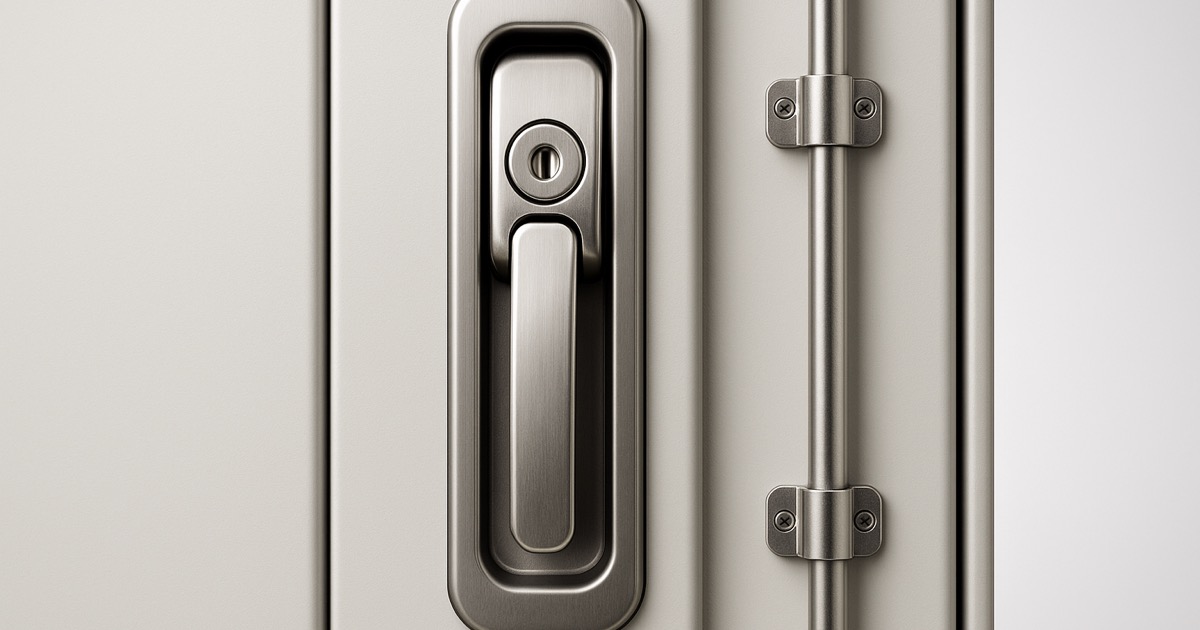
The system has five parts, and understanding which one you are actually specifying prevents most quotation confusion:
| Component | Function | Typical material |
|---|---|---|
| Handle body / escutcheon | Mounts in the door cutout, houses the pivot | Zinc alloy die cast, aluminium, or stainless |
| Handle | Folds flush, swings out to give torque leverage | Zinc alloy or steel, powder coated |
| Lock insert / cylinder | Prevents unauthorised handle rotation | Zinc alloy body, brass key |
| Spindle & gearbox hub | Converts handle rotation into rod travel | Steel, zinc plated |
| Rods, guides & end fittings | Carry the latching motion to top and bottom | Steel rod, white zinc plated; polymer or steel guides |
On our rod control lock range, a representative build is a zinc alloy body and handle with a steel latch tongue and rods and a brass key — grey powder coat on the body, black powder coat on the handle, white zinc plating on the tongue, rods and internals, nickel on the key. That plating split is deliberate: powder coat gives the visible surfaces UV and impact resistance, while zinc plating on the moving internals keeps friction low and avoids the paint chipping that jams mechanisms.
Handle rotation is normally 90° on quarter-turn designs and 180° on some heavy rod systems, which matters for door-to-frame clearance in narrow aisles — a 180° handle needs swing room a 90° handle does not.
3. How Many Latching Points Do You Need?
| Door height | Latching points | Recommended hardware | Typical use |
|---|---|---|---|
| Under 600 mm | 1 (cam) | Cam lock or quarter-turn | Small control boxes, junction boxes |
| 600–1,200 mm | 1 (swing handle cam) | Single-point swing handle | Wall-mount panels, half-height racks |
| 1,200–1,800 mm | 2 (top + bottom rod) | Swing handle + 8 mm rods | Server cabinets, MCC sections, telecom |
| Over 1,800 mm | 3 (top + centre + bottom) | Swing handle + 10 mm rods + guides | Full-height racks, switchgear, gensets |
| Any height, IP55+ | Add compression | Compression swing handle | Outdoor, washdown, dusty environments |
The IP correction is the part most specifications miss. These thresholds assume an unsealed or lightly sealed door. A gasketed door needs continuous compression force to seal, and gasket resistance actively pushes the door open between latching points. Our rule of thumb: if the enclosure carries an IP55 or higher rating, move to the next latching level about 300 mm earlier than the table suggests. A 1,100 mm IP66 outdoor cabinet should get 2-point latching, not single-point.
Wide doors deserve the same caution. Anything over roughly 800 mm wide begins to twist rather than bow, and twist is not fixed by more vertical points — it is fixed by a stiffer door skin, an internal stiffener, or a three-sided latching layout. If your door is wider than it is tall, talk to us before finalising the design.
Not sure whether you need 2-point or 3-point?
Send us your door height, width, panel thickness, gasket type and IP target. We will recommend a latching layout and rod length free of charge.
Get a Latching Recommendation4. Swing Handle Types Compared
| Type | Profile | Drives | Best for | Relative cost |
|---|---|---|---|---|
| Flush swing handle | Sits level with door skin | Cam or rods | Server racks, aisles with clearance limits | Baseline |
| Recessed / pocket swing handle | Handle recessed in a pan | Cam or rods | Vehicles, transport, anti-snag areas | +10–20% |
| Compression swing handle | Flush, adds axial pull | Rods + gasket compression | IP55+ outdoor and washdown | +20–35% |
| Insert-type (half-cylinder) | Handle takes a swappable insert | Cam or rods | Fleets needing field-changeable keying | +5–15% |
| T-handle / folding T | Fold-out T for high torque | Cam or rods | Gensets, special vehicles, heavy doors | Varies |
| Padlockable swing handle | Hasp or shackle provision | Cam or rods | LOTO, utility, shared-access sites | +10–25% |
The insert-type deserves particular attention for anyone running a fleet of cabinets. Because the lock insert is a separate part from the handle body, you can standardise on one handle across the whole build and change only the insert per customer, per site, or per security policy. It is the cheapest way to offer keying variety without multiplying part numbers — and it means a compromised key series is a five-minute field swap rather than a handle replacement.
For the fold-out T variants and how they compare with paddle latches, see our T-handle lock guide and paddle latch guide.
5. Compression Swing Handles & Gasket Sealing
A standard swing handle holds the door closed. A compression swing handle actively pulls it in. The mechanism is an eccentric or axial cam integrated into the spindle that, in the final 20–30° of handle travel, draws the door a further 1.5–3 mm toward the frame.
Why that matters: a closed-cell EPDM enclosure gasket needs roughly 25–40% deflection of its free height to seal reliably. A 5 mm gasket therefore needs 1.25–2 mm of compression, held evenly, for the life of the enclosure. Without a compression mechanism, that deflection comes only from how accurately the door, frame and latch were built — and from a gasket that has not yet taken a set. Both assumptions fail with age.
| Sealing target | Latch type | Gasket | Notes |
|---|---|---|---|
| IP44 / indoor | Standard swing handle | Optional foam | Dust management only |
| IP54 | Standard swing handle, 2-point | EPDM 4–5 mm | Even door flatness required |
| IP55–IP65 | Compression swing handle | EPDM closed cell | Compression strongly recommended |
| IP66 / NEMA 4 | Compression, 3-point | EPDM or silicone | Compression mandatory in practice |
| Washdown / IP69K | Compression, stainless | Silicone, FDA grade | 316L, no crevices, tool-less preferred |
Gasket material also sets your temperature envelope: EPDM covers roughly −40 °C to +120 °C with excellent UV and ozone resistance, silicone runs to +200 °C and is preferred for washdown and food contact, and neoprene sits between them with better oil resistance. Our compression latch guide covers the compression mechanism in more depth, and the IP65/IP66/IP67 lock guide covers sealing-chain design.
6. Cutouts, Inserts & Panel Thickness
The cutout is the one decision you cannot reverse. Once the sheet metal is punched, the lock has to fit it.
Insert cutouts
The most widely used rectangular insert cutout in enclosure construction is nominally 39.5 × 20.5 mm, which most European and Asian swing handle inserts and half-cylinders are built around. If your existing cabinets use that cutout, you have a very large compatible supply base. Larger one-piece swing handles use proprietary cutouts, typically in the 90–150 mm length range, and those are genuinely manufacturer-specific.
Panel thickness
| Application | Typical panel thickness | Handle grip range needed |
|---|---|---|
| Server / network racks | 1.2–1.5 mm | 1.0–2.0 mm |
| Electrical distribution cabinets | 1.5–2.0 mm | 1.0–2.5 mm |
| Outdoor telecom cabinets | 2.0–3.0 mm | 1.5–3.0 mm |
| Switchgear / MCC | 2.0–3.0 mm | 1.5–3.0 mm |
| Genset & special vehicle enclosures | 2.0–4.0 mm | 2.0–4.0 mm |
A handle specified for 1.0–2.0 mm and fitted to 3 mm sheet will not clamp; the escutcheon rocks, the gasket under it leaks, and within a year the die-cast body cracks at the mounting boss. This is one of the most common warranty claims in the category and it is entirely a specification error, not a manufacturing one. Always state your panel thickness on the enquiry.
7. Rod Sizing, Cutting & Guides
| System | Rod diameter | Rod material | Guides required |
|---|---|---|---|
| 2-point, door <1,800 mm | 8 mm round | Steel, white zinc plated | 1–2 per rod |
| 3-point, door >1,800 mm | 10 mm round | Steel, white zinc plated | 2–3 per rod |
| Shallow-depth doors | 12–20 mm flat | Steel strip | 2–3 per rod |
| Corrosive / outdoor | 8–10 mm | 304 or 316 stainless | Polymer guides preferred |
Rod length is normally cut to order and costs nothing in tooling — specify the door height and the distance from the handle centreline to each latching point and the factory cuts and threads to match. If you prefer to cut on your own line, order rods long and cut on assembly; just make sure the thread length at the end fitting is long enough to allow ±5 mm of adjustment, because door and frame tolerances stack up.
Rod guides are the part people delete to save money and then regret. An unguided 8 mm rod spanning 900 mm will flex under the axial load of a compressed gasket and can buckle instead of engaging. Fit at least one guide every 500–600 mm. Polymer guides (POM or nylon) are quieter and self-lubricating; steel guides are used where temperature or fire rating demands it.
Finally, check rod-to-latch engagement depth. The rod end should engage the frame roller or keeper by at least 8–10 mm at full travel. Less than that and normal thermal movement or a door strike can pop the rod out of engagement while the handle still reads “locked” — the most dangerous failure mode in this category, because nothing looks wrong.
8. Materials, Finishes & Corrosion Data
| Material | Neutral salt spray (ASTM B117) | Relative cost | Best for |
|---|---|---|---|
| Zinc alloy, bright chrome | 48–96 h | Baseline | Indoor, clean environments |
| Zinc alloy, powder coated | 200–400 h | +10–20% | Indoor industrial, sheltered outdoor |
| Aluminium alloy, powder coated | 400–600 h | +30–50% | Outdoor transformer and substation cabinets |
| 304 stainless steel | 500+ h | +80–150% | General outdoor, food-adjacent |
| 316 stainless steel | 1,000+ h | +150–250% | Coastal, marine, chemical, washdown |
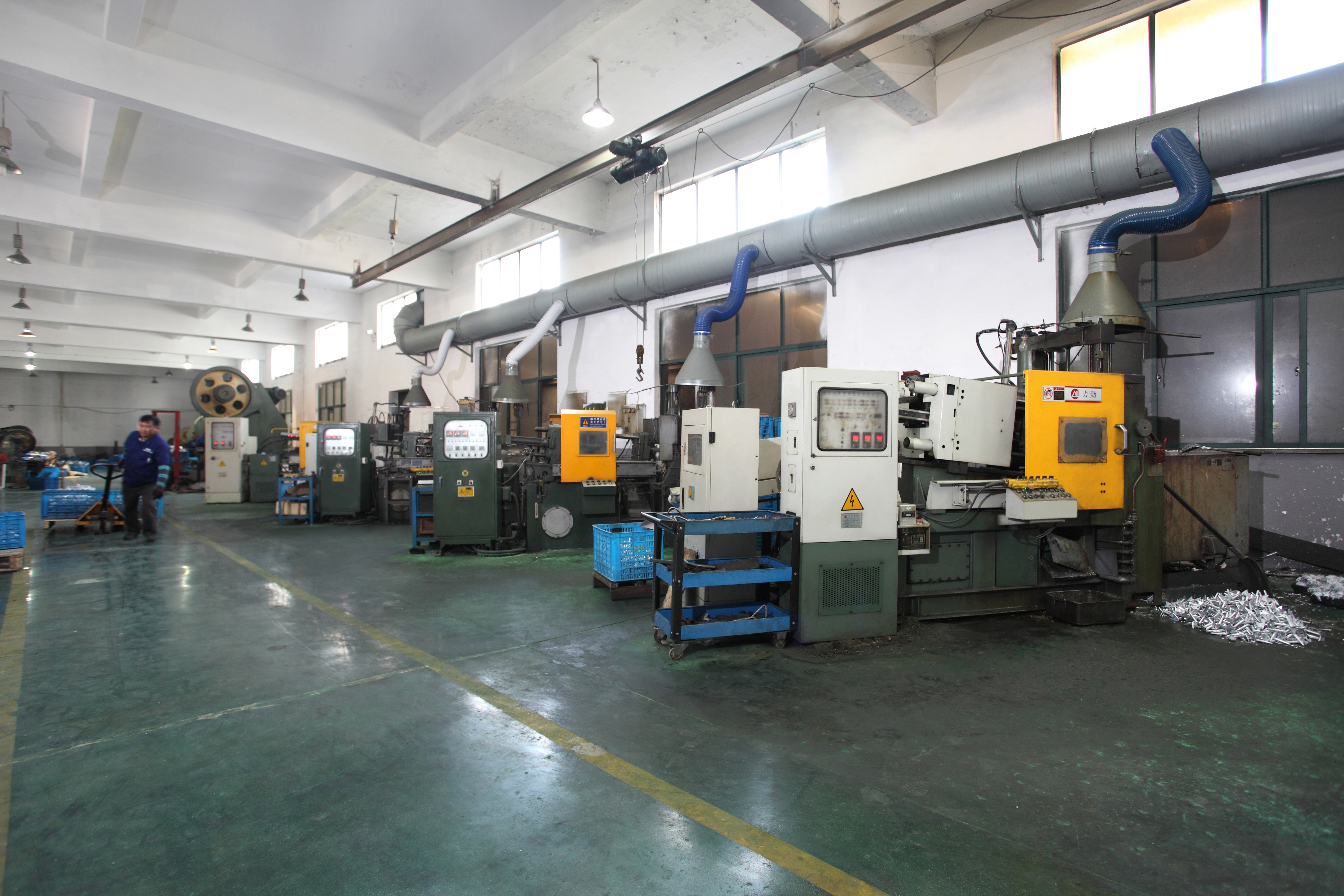
Two manufacturing notes from our own die casting and plating lines. First, zinc alloy is not the problem — the finish is. Zamak die castings hold tight tolerances and take load well; it is the 8–12 µm of decorative chrome that fails in salt fog. A powder-coated zinc handle outperforms a chrome-plated one by a factor of four or more in salt spray at a fraction of the cost of stainless.
Second, mixing materials in a sealed door creates galvanic problems. A 316 stainless handle bolted through an aluminium door with a steel rod is three metals in a wet electrical path. Either match the family or isolate with polymer washers and guides. We see this most often on outdoor telecom and EV charging cabinets where the enclosure and hardware were sourced separately. Our lock material comparison and zinc alloy vs stainless steel guide cover the trade-offs in full.
9. Key Systems, Inserts & Access Control
| Keying scheme | How it works | Best for | MOQ impact |
|---|---|---|---|
| Keyed alike | One key opens the whole order | Single-owner sites, internal racks | None |
| Keyed different | Unique code per lock | Multi-tenant colocation | Moderate |
| Master keyed | Site key + service master | Utilities, facility management | 2,000–3,000 pcs |
| Utility inserts (triangular, double-bit, square) | Standard service tool, no key management | Power distribution, street cabinets | None |
| Padlockable | Handle accepts a shackle | LOTO, shared-access sites | None |
| Electronic / IoT | Card, Bluetooth or networked control | Data centres, EV charging, vending | Project-specific |
A blunt observation from thirty-five years of supplying this market: a very large share of industrial cabinets in the field share a handful of key codes. That is convenient for a service technician and a genuine security exposure for the asset owner. If your cabinets contain revenue-generating equipment — EV chargers, vending, telecom radios, metering — specify a dedicated key series or move to an electronic insert. The cost difference is measured in cents per lock; the exposure is measured in equipment.
For networked access management, our IoT smart locks support card and remote control, and the EV charger and battery enclosure security guide covers the retrofit path from mechanical to electronic.
10. Application Guide by Industry
| Application | Recommended configuration | Material | Why |
|---|---|---|---|
| Data centre / server racks | Flush swing handle, 2-point, insert-type | Zinc alloy, powder coated | Aisle clearance, per-tenant keying, no sealing requirement |
| Outdoor telecom cabinets | Compression swing handle, 3-point | 304 SS or coated aluminium | IP55–IP66, UV, vandal exposure |
| EV charging enclosures | Compression 2-point, or IoT insert | 304 SS | Public access, revenue equipment, weather |
| Switchgear / MCC | 3-point rod, padlockable | Zinc alloy, powder coated | Tall doors, LOTO compliance |
| Genset enclosures | Folding T-handle, 2-point | 304 SS | High torque, vibration, outdoor |
| Transformer / substation | Rod control, utility insert | Aluminium alloy | Outdoor, standard service tool access |
| Food processing / washdown | Compression, tool-less where allowed | 316L SS | IP66–IP69K, chemical cleaning |
For panel and enclosure work generally, our electrical panel lock types guide compares swing handles against quarter-turn, compression, cam and rod options in one table, and the NEMA enclosure types guide maps NEMA ratings to required hardware. For rack-specific security, see the server rack lock guide.
11. Five Field Failures We See Most Often
- Grip range mismatch. Handle rated 1–2 mm fitted to 3 mm sheet. The escutcheon rocks, the mounting boss cracks. Fix: state panel thickness on the enquiry, every time.
- Missing rod guides. Long unguided rods flex under gasket load and buckle instead of engaging. Fix: one guide per 500–600 mm.
- Insufficient engagement depth. Rod ends engage the keeper by 3–4 mm instead of 8–10 mm, so a door strike disengages a “locked” door. Fix: check engagement at full handle travel during first-article inspection.
- Bright chrome outdoors. 48–96 hours of salt spray on a coastal site means visible corrosion within one season. Fix: powder coat, or move to 304/316 stainless.
- Gasket set with no compression mechanism. The enclosure passes IP testing at the factory and fails at eighteen months. Fix: specify a compression handle for anything IP55 and above.
Four of those five are specification decisions made before anything is manufactured. That is why we ask for door height, door width, panel thickness, gasket type and IP target on every enquiry — it is faster to get the specification right than to diagnose it in the field.
12. MOQ, Tooling & Lead Time
| Scenario | Typical MOQ | Tooling cost | Lead time |
|---|---|---|---|
| Catalogue handle, standard finish | 500–1,000 pcs | None | 25–35 days |
| Custom rod length | 500–1,000 pcs | None | 25–35 days |
| Custom finish or logo | 1,000–2,000 pcs | None to low | 30–40 days |
| Custom key code / master system | 2,000–3,000 pcs | None | 35–45 days |
| New die-cast handle body | 5,000 pcs | USD 3,000–8,000 | 30–45 d tooling + 30 d production |
Rod length customisation is the cheapest specification lever available in this category — it costs no tooling and does not raise MOQ, so there is no reason to compromise on latching geometry to fit a stock length.
We manufacture swing handle and rod control locks in-house across zinc and aluminium die casting, stamping, CNC machining, plating and powder coating, with our own tooling shop, under IATF 16949 and ISO 9001. For the sourcing process end to end, see our China hardware sourcing guide, and for build-to-print projects our OEM manufacturing guide. If you are matching an existing part number, our MS-series model number guide explains how MS3xx and MS8xx numbering maps to swing handle and rod control families.
13. Frequently Asked Questions
When do I need a multi-point rod latch instead of a single cam lock?
The practical threshold is door height. Under about 600 mm a single cam lock is fine. From 600–1,200 mm a single-point swing handle is usually adequate. Above roughly 1,200 mm the door corners bow away from the frame under gasket load, so a 2-point rod system is needed; above 1,800 mm use 3-point. If the enclosure carries an IP or NEMA sealing rating, drop each threshold by about 300 mm — sealing failure shows up long before the door visibly deflects.
What is the difference between a swing handle and a compression swing handle?
A standard swing handle rotates a spindle to drive a cam or rods; sealing depends entirely on how well the door already sits against the gasket. A compression swing handle adds an axial cam that pulls the door 1.5–3 mm further inward at the end of the handle stroke, actively compressing the gasket. For IP55 and above, or any outdoor or washdown enclosure, specify compression. It adds roughly 20–35% to handle cost and removes most gasket-related field failures.
What rod diameter should I use for a 2-point or 3-point latch?
For enclosure doors, 8 mm round steel rod covers most 2-point systems and doors up to about 1,800 mm. Use 10 mm rod for 3-point systems, doors over 1,800 mm, or any door carrying a heavy mounting plate. Flat rod (12–20 mm wide) is used where depth is limited. The rod itself is rarely the failure point — rod guides are. Fit at least one guide every 500–600 mm or the rod will buckle before it latches.
What is the standard cutout for an insert-type swing handle?
The most widely used rectangular insert cutout in enclosure construction is nominally 39.5 × 20.5 mm, which most European and Asian swing handle inserts and half-cylinders are built around. Larger one-piece swing handles use proprietary cutouts, commonly in the 90–150 mm length range. Because insert standards vary by manufacturer, always confirm against the specific 2D drawing before punching sheet metal — a wrong cutout cannot be undone.
Can swing handle locks be supplied keyed alike or master keyed?
Yes. Three levels are normally available: keyed alike within an order, keyed different with a master key, and standard utility codes such as triangular, double-bit or square inserts where a common service tool is intentionally used. Custom key codes and master systems typically raise MOQ to 2,000–3,000 pieces and add 5–10 days to lead time.
Which material should I choose for outdoor swing handle locks?
For coastal, marine or chemical exposure use 316 stainless steel (1,000+ hours neutral salt spray per ASTM B117). For general outdoor use 304 stainless (500+ hours). Powder-coated zinc alloy is fine for sheltered outdoor and indoor industrial use and is significantly cheaper, but bright chrome over zinc clears only 48–96 hours and should not go on an exposed door. Aluminium alloy is standard for outdoor transformer and substation cabinet locks.
What is the MOQ and lead time for custom swing handle and rod locks?
A catalogue model in a standard finish is typically 500–1,000 pieces with a 25–35 day lead time. Custom finish, logo or key code moves MOQ to 1,000–3,000 pieces. Rod length is normally cut to order at no tooling cost. A new die-cast handle body requires tooling at roughly USD 3,000–8,000, 30–45 days tooling plus 30 days production, and a 5,000-piece first order.
Browse Swing Handle & Rod Control Locks
Swing Handle Locks
21 models
Rod Control Locks
18 models
Transformer Locks
Aluminium alloy
Plane Locks
Flush mount
Panel Locks
Paddle & T-handle
IoT Smart Locks
Card & remote access
Related Guides
Need Swing Handle or Multi-Point Rod Locks?
35+ years of die casting, stamping and in-house tooling. Rod lengths cut to order, custom key systems, IATF 16949 and ISO 9001 certified. Send your door height, panel thickness and IP target for a latching recommendation. MOQ from 500 pcs.