
Technical Comparison
Compression vs Quarter-Turn Latch Compared
Compression latch vs quarter-turn latch: cam stroke, gasket compression %, installation depth, vibration performance & real unit cost compared. Factory test data + selection table. Industrial grade, OEM available.
Quick Answer
Both turn 90°. The difference is axial stroke. A quarter-turn latch swings a flat cam behind the frame and stops — zero inward pull. A compression latch converts that same rotation into 2–8 mm of inward travel, squeezing the door gasket to 25–40% of its free height. Gasket in the door → compression latch. No gasket, indoor, shallow panel → quarter-turn. Expect a compression latch to cost 1.8–3× more per unit but need fewer points per door. Jump to the specification table.
This is the question we field most often from enclosure engineers, and it is almost always asked the wrong way round. Buyers ask “which latch is better?” when the question that actually decides the answer is “does my door have a gasket, and how much do I need to squeeze it?”
Confusion is understandable. Many catalogues — including some from large Western brands — list compression latches under the quarter-turn category, because a compression latch is a quarter-turn actuation. That naming shortcut hides the one mechanical difference that determines whether your enclosure passes an IP66 test or fails it.
We have been die casting and assembling both types in Ningbo since 1988, and we run cam stroke and salt spray tests on every production lot. Below is how we actually specify them.
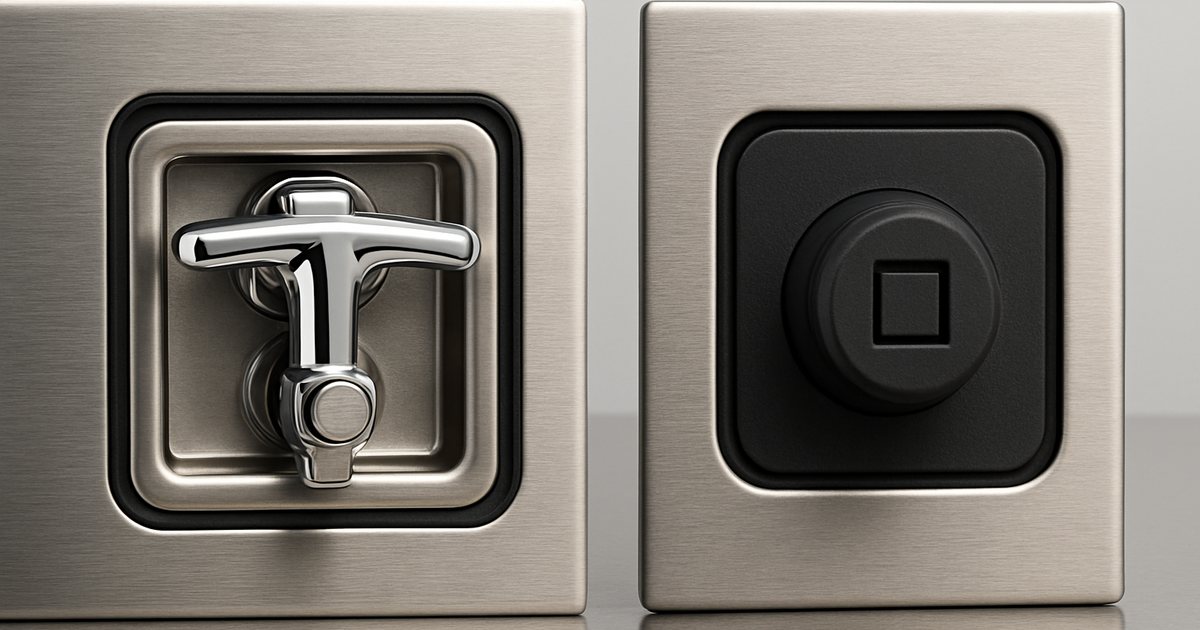
1. The Real Difference: Axial Stroke
Strip away the handle styles, the key cylinders and the finishes, and one number separates these two families:
| Property | Quarter-Turn Latch | Compression Latch |
|---|---|---|
| Rotation to lock | 90° | 90° |
| Axial (inward) stroke | 0 mm | 2–8 mm |
| Cam geometry | Flat cam, single plane | Ramped or eccentric cam |
| Clamp load on gasket | None (door rests at standoff) | Continuous preload |
| Realistic sealing ceiling | IP42 – IP54 with a soft seal | IP65 / IP66, NEMA 4 / 4X |
A quarter-turn holds a door closed. A compression latch holds a door sealed. Those are different engineering jobs, and a gasket does not care how many quarter-turns you fit — without inward travel, the door simply rests on the uncompressed seal and water tracks straight past it.
2. How Each Mechanism Works
Quarter-turn
The shaft carries a flat cam (sometimes called a tongue). Rotating the handle 90° sweeps that cam behind the frame return. The cam sits in one plane the whole way through the arc, so the door position never changes — it is held wherever the frame stop and the door skin happen to leave it. Retention comes purely from the cam blocking the door’s outward path. Our quarter-turn lock guide covers the variants in detail, and quarter-turn panel fasteners (Dzus/Camloc style) are the captive-stud cousin of the same idea.
Compression
The cam is either machined eccentric to the shaft axis or rides a helical ramp cast into the latch body. As the handle rotates through the final 40–50°, the cam’s contact face migrates toward the latch body. Because the cam is trapped behind the frame, the door has to come with it. That is the compression stroke.
Three sub-types matter commercially:
- Fixed compression — stroke set by the cam ramp, typically 3–4 mm. Cheapest, most repeatable, best for high-volume OEM lines where panel tolerance is controlled.
- Adjustable compression — a threaded cam or shim stack lets the installer set stroke over a range, commonly 2–8 mm. Essential when gaskets take a set over time or when panel thickness varies between suppliers.
- Multi-point compression — the handle drives vertical rods to 2 or 3 latch points. Required above roughly 600 mm door height; see our swing handle and rod latch guide.
Not sure which stroke your gasket needs?
Send us your gasket cross-section, door size and panel thickness. We will calculate required compression and recommend fixed or adjustable — no charge, no obligation. Ask an engineer →
3. Head-to-Head Specification Table
These are the ranges we quote across our own panel lockand plane lock lines. Individual models vary, but the pattern holds across the industry.
| Specification | Quarter-Turn | Compression | Winner |
|---|---|---|---|
| Axial stroke | 0 mm | 2–8 mm | Compression |
| Behind-panel depth | 14–22 mm | 28–45 mm | Quarter-turn |
| Cam swing radius needed | 18–25 mm | 22–32 mm | Quarter-turn |
| Panel thickness (grip) range | 1.0–3.0 mm | 1.0–4.0 mm (adjustable to 6 mm) | Compression |
| Typical operating torque | 0.6–1.2 N·m | 2–5 N·m | Quarter-turn |
| Achievable IP rating | IP42–IP54 | IP65–IP66 (IP67 with double seal) | Compression |
| NEMA equivalent | NEMA 1/2/12 (limited) | NEMA 4, 4X, 12 | Compression |
| Vibration retention | Poor without detent | Excellent (gasket preload) | Compression |
| Cycle life (our lot testing) | 50,000–100,000 | 50,000–100,000 | Tie |
| Points needed on a 1200 mm door | 4–6 | 2–3 (or 1 handle + rods) | Compression |
| Relative unit cost (zinc, chrome) | 1.0× baseline | 1.8–3.0× | Quarter-turn |
Read that table as two clusters. Quarter-turn wins on space, torque and unit price. Compression wins on everything to do with sealing and staying shut. There is no model that wins both, because the axial stroke that produces the seal is exactly what consumes the depth and the torque.
4. Sealing Math: Why 30% Compression Matters
Elastomer seals do not seal by touching — they seal by being squashed. The governing number for a closed-cell EPDM or solid silicone door gasket is 25–40% compression of free height. Below roughly 20% you have contact but no reliable sealing line; above about 50% you crush the cell structure and the gasket takes a permanent set, so the seal degrades within months.
The required stroke is straightforward:
Required stroke = (Gasket free height × target compression %) + door-to-frame gap
Worked example from a customer’s outdoor telecom cabinet: a 6 mm free-height EPDM gasket, target 33% compression, with a measured 1.5 mm door-to-frame gap at the latch position.
Required stroke = (6 × 0.33) + 1.5 = 3.5 mm.
A quarter-turn delivers 0 mm and the cabinet failed its IP65 spray test on the first attempt. A fixed 4 mm compression latch put the gasket at 41% — over-compressed, heavy to close, and the gasket had taken a visible set after 90 days in the field. An adjustable latch set to 3.5 mm passed IP65 and was still passing at the 12-month re-test. This is the practical argument for adjustable stroke: the correct number is rarely a catalogue number.
| Gasket free height | Target 30% compression | Stroke needed (1.5 mm gap) | Latch type |
|---|---|---|---|
| 3 mm | 0.9 mm | 2.4 mm | Low-profile compression |
| 5 mm | 1.5 mm | 3.0 mm | Fixed 3 mm compression |
| 6 mm | 1.8 mm | 3.3 mm | Adjustable compression |
| 8 mm | 2.4 mm | 3.9 mm | Adjustable compression |
| 10 mm (foam) | 3.0 mm | 4.5 mm | Adjustable or multi-point |
One caveat engineers miss: compression is not uniform along the door. At the latch you get full stroke; midway between two latch points on a flexible door skin you may get 60% of it. That is why point count matters as much as stroke — seeour full compression latch guide for point spacing rules.
5. Installation Depth & Cutout Compatibility
Depth is where compression latches get designed out of projects, usually late and expensively. Budget these dimensions:
| Dimension | Quarter-turn | Standard compression | Low-profile compression |
|---|---|---|---|
| Body behind panel | 14–22 mm | 28–45 mm | 22–28 mm |
| Cam swing clearance (radius) | 18–25 mm | 22–32 mm | 20–26 mm |
| Available stroke | 0 mm | 3–8 mm | 2–3 mm |
| Handle protrusion (closed) | 3–12 mm | 0 mm (flush T) to 18 mm | 0–8 mm |
The clearance trap: people dimension for the latch body and forget the cam sweeps an arc. Your internal component — a busbar, a DIN rail end, a fan shroud — has to clear the cam’s full 90° path, not its parked position. We see returned samples every month where the latch fits and the cam fouls.
Cutout compatibility is good news. Both families are largely built on the same cutouts: the 19.1 mm round hole and the 20 × 20 mm and 21 × 21 mm squares dominate. So a quarter-turn → compression upgrade often needs no new tooling on the door, only depth verification. If you are decoding an existing part to find its cutout, ourMS-series model number guide explains the numbering.
6. Vibration, Rattle & Service Life
A plain quarter-turn holds the door at whatever standoff geometry gives it, with no preload. Every bit of clearance in the cam-to-frame interface is free play, and free play under vibration is a wear machine: the cam and the frame return polish each other, clearance grows, rattle gets worse, and eventually the cam can walk out of engagement entirely.
A compression latch loads the joint against the gasket. The gasket behaves as a spring that keeps the cam seated against its frame return through the whole vibration cycle. In practice this is why every vehicle-mounted, genset, rail and off-highway enclosure we supply uses compression — the sealing is often secondary to simply not rattling apart.
On our own lot testing both families reach 50,000–100,000 cycles before the cam or detent wears out of spec, so cycle life is not a differentiator. What differs isdegradation mode: a worn quarter-turn rattles and eventually releases; a worn compression latch loses stroke and quietly stops sealing. The second failure is more dangerous because it is invisible — which is the argument for adjustable models on any enclosure with a maintenance schedule, since a technician can dial the stroke back in rather than replace the latch.
Material choice compounds this. Zinc alloy bodies are fine indoors and in sheltered outdoor use; for coastal, washdown or chemical exposure the corrosion resistance of 304 or 316 stainless is what keeps the cam mechanism moving at year five. We break the numbers down inzinc alloy vs stainless steel locks.
7. Real Cost at Door Level
Per unit, the compression latch loses: it needs a ramped cam, a bearing surface on the shaft, and a body O-ring where a quarter-turn needs none of them. Typical FOB Ningbo pricing at 1,000 pcs for a chrome-plated zinc alloy latch:
| Latch | FOB unit price (1,000 pcs) | Points per 1200 mm door | Hardware cost per door | Cutouts to punch |
|---|---|---|---|---|
| Quarter-turn, zinc/chrome | $1.10–$2.20 | 4–6 | $4.40–$13.20 | 4–6 |
| Fixed compression, zinc/chrome | $2.40–$4.80 | 2–3 | $4.80–$14.40 | 2–3 |
| Adjustable compression, zinc/chrome | $3.60–$6.50 | 2–3 | $7.20–$19.50 | 2–3 |
| Compression, 304 stainless | $5.80–$11.00 | 2–3 | $11.60–$33.00 | 2–3 |
| Swing handle + 3-point rods | $9.50–$22.00 | 1 handle | $9.50–$22.00 | 1 |
Prices are indicative for zinc alloy die cast bodies at 1,000 pcs, MOQ 500 pcs, and move with zinc and stainless input costs — treat them as a planning range, not a quote.
The point of the table is the third and fifth columns. Hardware cost per door isroughly comparable between quarter-turn and fixed compression, because compression needs fewer points. Then add the costs that never appear on a BOM line: each extra cutout is punch time, each extra latch is assembly labour, and each extra penetration through a gasketed door is another leak path you have to seal. On a sealed enclosure, four quarter-turns are four opportunities to fail an IP test. Two compression latches are two.
Where compression genuinely costs more is stainless and multi-point. If your enclosure is under 400 mm, indoor, and non-gasketed, paying 2.5× for compression is waste.
8. Decision Guide by Application
| Application | Recommended | Why |
|---|---|---|
| Outdoor telecom / 5G cabinet | Adjustable compression, 304 SS | IP65 required; gasket set over service life needs re-adjustment |
| Indoor server rack door (perforated) | Quarter-turn or swing handle | Airflow doors are not gasketed; sealing is irrelevant |
| Data centre sealed containment door | Compression, multi-point | Hot/cold aisle containment needs an air seal |
| Food processing / washdown | Compression, 316 SS, IP66/IP69K | High-pressure hot wash; 316 resists chlorides and CIP chemistry |
| HVAC control cabinet (outdoor rooftop) | Compression, fixed 3–4 mm | Rain and thermal cycling; controlled panel tolerance |
| Genset / power pack enclosure | Compression, detented cam | Vibration is the design driver, not water |
| EV charging cabinet | Compression or multi-point rod | Outdoor IP54–IP65 plus tamper resistance on a tall door |
| Machine guarding / interior access panel | Quarter-turn fastener | Frequent removal, no seal, shallow depth |
| Instrument / 19" rack front panel | Quarter-turn captive fastener | Tool-free removal, thin panel, no gasket |
| Truck / vehicle body compartment | Compression paddle latch | Vibration plus road spray; see paddle latch guide |
9. Five Specification Mistakes We See Weekly
- Specifying IP65 on the enclosure and a quarter-turn on the door. The enclosure body rating means nothing if the door does not compress its seal. The lock is almost always the weakest link in the sealing chain — ourIP65/IP66/IP67 lock guidecovers how to verify this properly.
- Taking an IP rating from the latch datasheet alone. A latch is rated installed, in a defined panel thickness, with a defined gasket. Ask for the test report with your panel thickness. We supply IEC 60529 test data with production lots on request.
- Choosing fixed compression when panel thickness varies. If you buy sheet metal from two suppliers with different tolerance bands, fixed stroke will over-compress one and under-compress the other. Adjustable costs about $1.20 more and removes the problem.
- Ignoring cam swing clearance. Covered above, and still the single most common cause of a rejected first article.
- Under-pointing a tall door. Above roughly 600 mm of door height, a single centre latch lets the corners bow outward and the gasket loses contact at the extremes. Go to two points, or to a rod system.
10. FAQ
What is the difference between a compression latch and a quarter-turn latch?
Both rotate 90 degrees, but a quarter-turn latch only swings a flat cam behind the frame to hold the door closed — it applies no inward pull. A compression latch uses a ramped or eccentric cam that converts the same 90-degree rotation into 2–8 mm of axial travel, actively drawing the door against its gasket. That axial stroke is what creates a sealed, IP65/NEMA 4X-rated closure. If your enclosure has a gasket, you need compression; if it does not, a quarter-turn is cheaper and adequate.
How does a compression latch work?
Turning the handle 90 degrees rotates a cam that rides up a ramp (or is machined off-centre on the shaft). Because the cam is no longer in a single plane, its contact point with the frame moves toward the latch body, pulling the door inward by a fixed stroke — typically 2–8 mm depending on the model. That stroke squeezes the door gasket to 25–40% of its free height, which is the compression range at which EPDM and silicone seals actually block water and dust. Adjustable compression latches let you tune the stroke on site to compensate for panel tolerance or gasket set.
What is the minimum installation depth for a compression latch?
Behind-panel depth for a single-point compression latch generally runs 28–45 mm including cam swing clearance, versus 14–22 mm for a plain quarter-turn. Low-profile compression models exist down to roughly 22 mm behind-panel, but they buy that space by cutting cam stroke to 2–3 mm, which limits you to soft, thin gaskets. Always dimension for cam swing radius as well as body depth: the cam sweeps a circle, so you need clearance for the full arc, not just the retracted position.
Can I retrofit a compression latch into an existing quarter-turn cutout?
Often yes. Both types are commonly built around the same industry cutout standards — the 19.1 mm round hole and the 20 × 20 mm / 21 × 21 mm square cutouts are shared across most manufacturers. The two things that break a retrofit are behind-panel depth (a compression body is 10–25 mm deeper) and cam reach, since the door now has to travel inward and the existing frame return may foul the cam. Send us the existing cutout dimension and panel thickness and we can confirm fit before you commit.
Do quarter-turn latches loosen under vibration?
Yes, this is their main failure mode. A plain quarter-turn holds the door at a fixed standoff with no preload, so any clearance in the cam-to-frame interface becomes rattle. Under vibration that clearance grows as the cam and frame return wear each other. A compression latch preloads the joint against the gasket, and the gasket acts as a spring that keeps the cam seated. For vehicle-mounted, genset, and rail enclosures we specify compression latches with a detented cam almost without exception.
Is a compression latch more expensive than a quarter-turn latch?
Per unit, yes — a zinc alloy compression latch typically runs 1.8 to 3 times the cost of a comparable quarter-turn, because it needs a ramped cam, a shaft bearing surface, and a body O-ring. But it is usually the cheaper system. A quarter-turn enclosure that needs to seal has to reach the same clamp load through more latch points, so a 1200 mm door might need four quarter-turns where two compression latches would do, plus four cutouts and four installations. Count cost at door level, not part level.
When is a quarter-turn latch the better choice?
Use a quarter-turn when the enclosure is indoor and non-gasketed (IP20 to IP42), when behind-panel depth is under 22 mm, when the door is small and light enough that a single point holds it flat, or when the panel is removed frequently and speed matters more than sealing — for example instrument racks, interior access covers and equipment skins. Quarter-turn fasteners are also the correct choice for thin removable panels where a captive stud system is preferred.
Related Guides
Compression Latches: Complete Guide
Types, IP ratings, gasket compression force, materials
Compression Latches by Application
Server racks, washdown, HVAC, genset & EV cabinets
Quarter Turn Lock Guide
How they work, types and industrial applications
Waterproof Enclosure Locks
IP65 vs IP66 vs IP67 selection and testing
Compression Latch Manufacturer — 33 Models, OEM Available
Selection guide, IP ratings, materials, MOQ & factory direct pricing
Need the Right Stroke for Your Gasket?
35+ years die casting compression and quarter-turn latches in Ningbo. Fixed, adjustable and multi-point options, zinc or 304/316 stainless, IEC 60529 test data on request. MOQ 500 pcs, samples in 7 days.