
Comparison
Swing Handle vs Compression Latch: Which One Does Your Enclosure Door Need?
They're usually quoted as alternatives, but they answer different questions. A compression latch decideshow hard one point of the door is pulled onto the gasket. A swing handle decides how manypoints move when someone turns one handle. Here's how to pick, with the gasket arithmetic most suppliers skip.
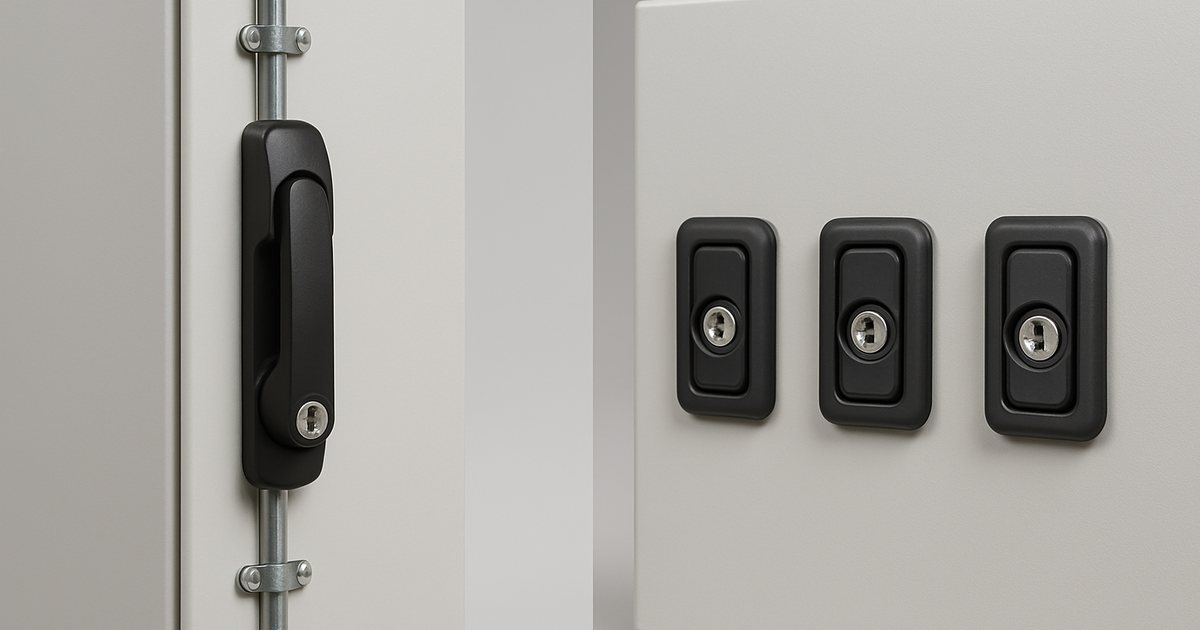
Quick answer
Use compression latches on sealed doors up to about 900 mm tall. One or two of them at $2.40–$6.50 each FOB is the cheapest way to reach IP65/IP66. Above that, use acompression swing handle with 2-point rods, and 3-point above about 1,500 mm. The gasket needs 390–910 N per point on a typical 1,800 mm door, and with a stiff gasket that pushes separate latches into the $8–$25 lever class. A swing handle system closes every point with one turn for $9.50–$22.00.
Key takeaways
- The latch edge of a hinged door carries exactly half the gasket load. That load is gasket N/cm × (width + height).
- A standard quarter-turn compression latch gives 200–500 N. On a stiff 7 N/cm gasket, that isn't enough at any point in our four worked examples.
- On an 1,800 × 800 mm IP66 door, three lever-type compression latches cost $24–$75. One compression swing handle system costs about $11–$30.
- Independent latches fail by being left partly closed. Rod systems fail by shallow rod engagement (under 8–10 mm).
1. Why They Aren't Really Opposites
We've made enclosure locks in Ningbo since 1988, and this comparison shows up in RFQs every month: a buyer asks us to quote “swing handle or compression latch” for the same cabinet. The two names describe different layers of the hardware:
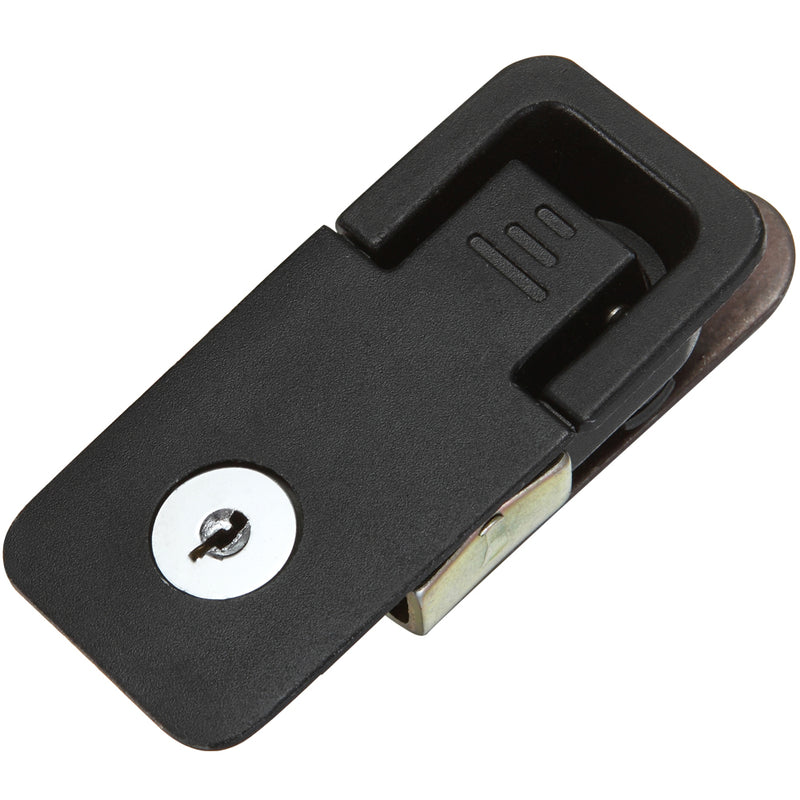
- A compression latch is a mechanism. A ramped or eccentric cam turns a quarter turn of the insert into 1–4 mm of inward travel. It squeezes the gasket at the one point where it's mounted.
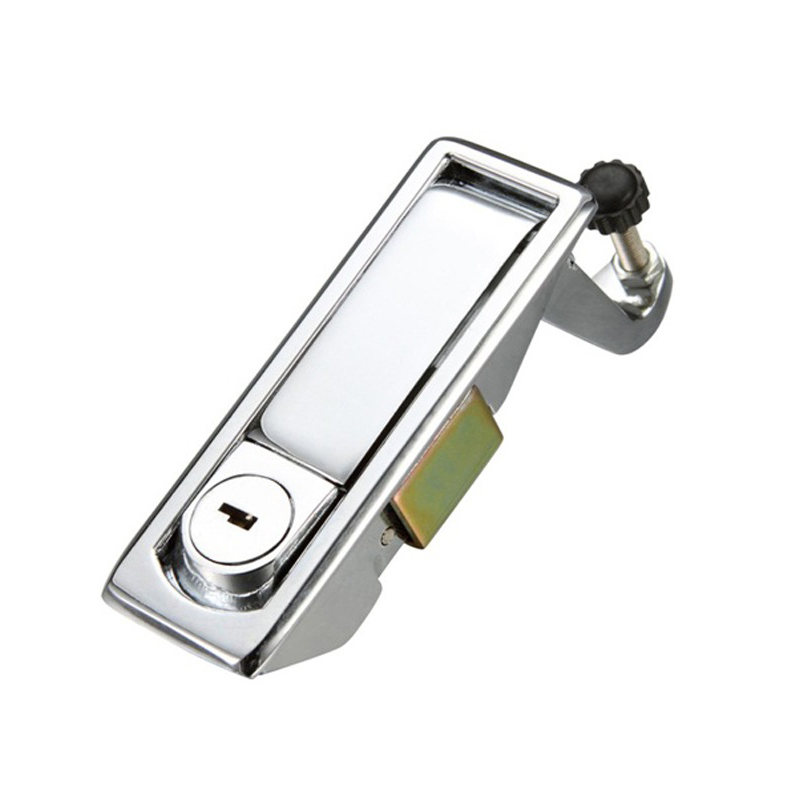
- A swing handle is an actuator. A fold-out handle turns a spindle. That spindle drives either a single cam or a gearbox that pushes rods to the top and bottom of the door.
The overlap is the compression swing handle. It adds an eccentric cam that draws the door a further 1.5–3 mm in the last 20–30° of handle travel. A plain swing handle without that cam onlyholds the door. Some catalogue listings say so in as many words: “does not compress.”
So the real decision on a sealed door is this: several independent compression latches, or one handle that moves several points at once? The rest of this article answers that with numbers.
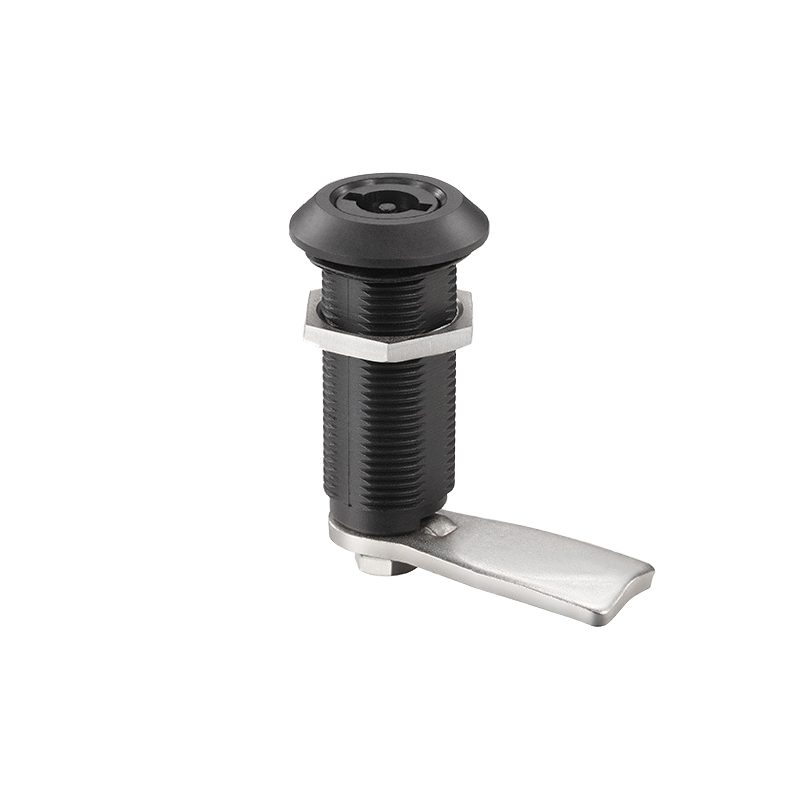
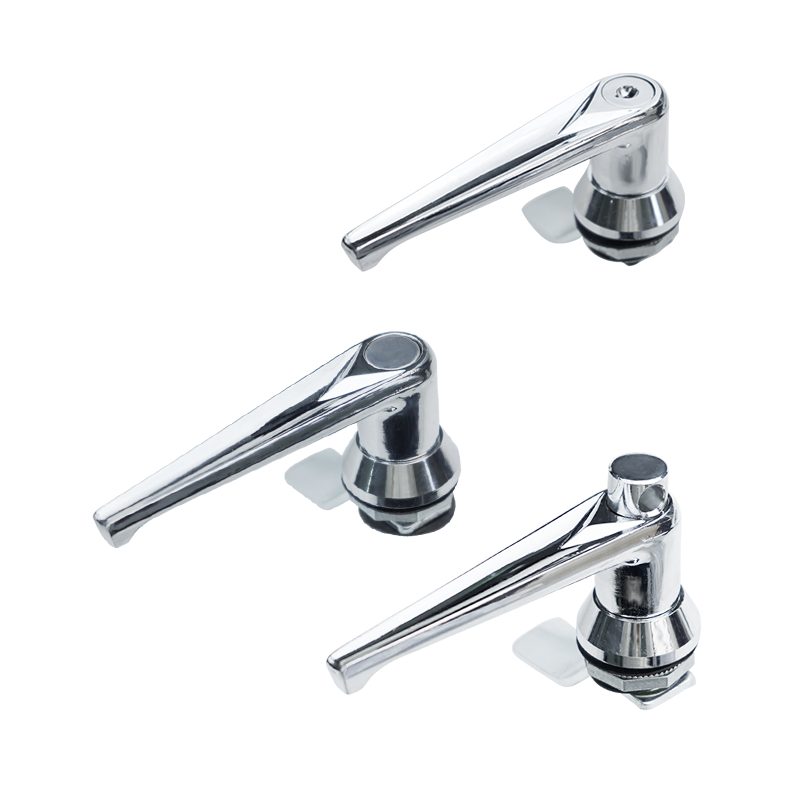
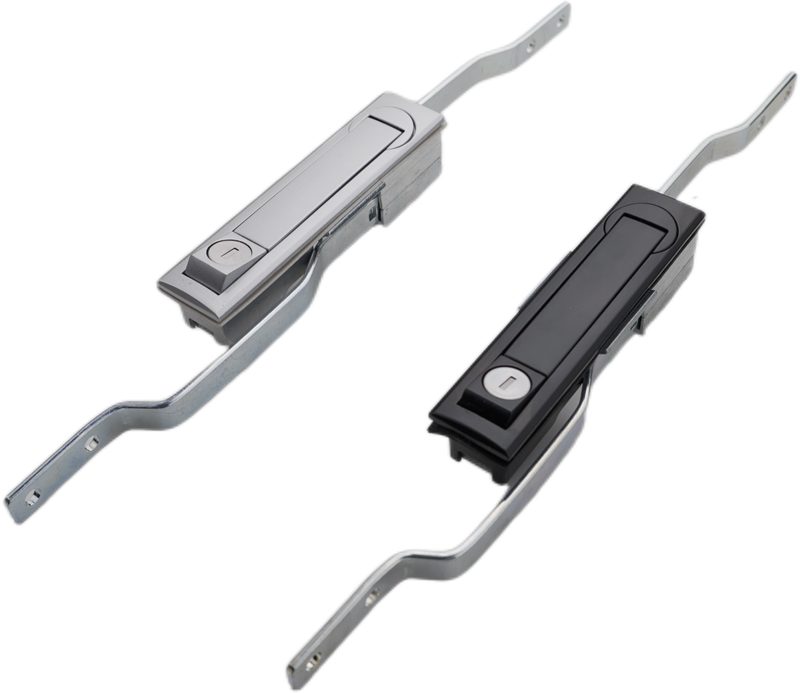
2. Head-to-Head: 10 Differences That Matter
Here are compression latches (quarter-turn and lever type) against a swing handle with rods. All figures are from our catalogue and lot testing unless noted.
| Factor | Compression latch | Swing handle + rods |
|---|---|---|
| Points per action | 1 | 1–3 (single cam, 2-point, 3-point) |
| Gasket pull-in | 1–2 mm quarter-turn; 2–4 mm lever | 0 mm plain; 1.5–3 mm compression version |
| Clamp force per point | 200–500 N quarter-turn; 300–800 N key-locking; 500–1,500 N lever | Rated per system; ask for per-point load |
| Cutouts in the door | One per latch (19.1 mm round or 20×20 mm square) | One handle cutout + rod guides + frame keepers |
| Operation | Key or tool at every point | One key, one handle swing |
| Typical operating torque | 2–5 N·m per latch | Lower at the hand, because the handle gives leverage |
| Profile | Flush or near-flush, nothing inside the door | Flush outside; rods and guides take depth inside |
| Padlock / LOTO | Rare | Padlockable handles common |
| Washdown (IP69K) | Good in 316 stainless, tool-less | More crevices; needs a stainless sealed design |
| FOB unit price (1,000 pcs) | $2.40–$6.50 zinc; $8–$25 lever | $9.50–$22.00 with 3-point rods |
Two rows decide most projects: clamp force per point and points per action. The first tells you whether a latch can seal the door at all. The second tells you whether people will close it properly every time. If you want the mechanism detail behind the first row, ourcompression latch guide covers cam stroke and grip range. Theswing handle and multi-point rod latch guidecovers rods, guides and inserts.
3. The Force Budget: What Your Gasket Asks For
Most comparisons stop at “compression latches seal better.” That isn't the question. The question is whether the latches you can fit deliver enough force for the gasket you've chosen. Here's the arithmetic.
Step 1: total gasket load. A closed-cell EPDM enclosure gasket at 20–25% compression needs roughly 3–7 N per cm of gasket length. Softer sponge sits at the low end. Denser profiles and anything at 30–40% deflection sit at the high end. A door of width W and height H has a perimeter of 2(W + H).
Step 2: how much of it the latch edge carries. Take moments about the hinge line. The hinge-side gasket sits on the hinge axis and adds nothing. The top and bottom strips act at an average distance of W/2. The latch-side strip acts at distance W. Solve, and the force the latch edge must supply is:
Flatch edge = q × (W + H)
q = gasket force per cm. This is exactly half the total gasket load; the hinges carry the other half.
Step 3: safety factor. Multiply by 1.5 for compression set and tolerance. Use2 for vehicles, gensets and anything that vibrates.
Step 4: divide by the number of points. That number is the force each latch, or each rod point, has to hold. Then compare it with the rating. Notice what this means for a standard quarter-turn compression latch at 200–500 N: a single one runs out of force sooner than most buyers expect.
Want us to run the numbers on your door?
Send door width, height, panel thickness, gasket profile and IP target. We'll return the force per point, the latch count and an FOB quote for both options. It's free.
Get a latching recommendation →4. Four Doors, Worked Out
Here are four common sealed (IP65/IP66) door sizes. Each uses gasket force q = 3–7 N/cm and a 1.5× factor. The compression latches are spaced at no more than 600 mm along the closing edge. The swing handle points follow our door-height thresholds moved down 300 mm for a sealed door: 2-point from 900 mm and 3-point from 1,500 mm.
| Door H × W (mm) | Latch-edge force ×1.5 | Compression latches | Swing handle points |
|---|---|---|---|
| 600 × 500 | 495–1,155 N | 1–2 latches → 495–1,155 N for one, 250–580 N each for two | 1 (single cam) |
| 1,200 × 600 | 810–1,890 N | 2 → 405–945 N each | 2 → 405–945 N each |
| 1,800 × 800 | 1,170–2,730 N | 3 → 390–910 N each | 3 → 390–910 N each |
| 2,000 × 800 | 1,260–2,940 N | 4 → 315–735 N each | 3 → 420–980 N each |
Three things fall out of this table that you won't find in a catalogue:
- Force per point is about the same either way. A swing handle doesn't seal better because it's stronger. Physics gives each point the same job. The swing handle wins on operation and cost, not force.
- The gasket picks the latch type. At 3 N/cm, every door above can use standard 200–500 N quarter-turn compression latches. At 7 N/cm, every option in the table needs 578–1,155 N per point, above the 500 N ceiling of a quarter-turn compression latch. That's key-locking or lever territory. Ask your gasket supplier for the compression-force curve (ASTM D1056 for cellular materials) before you choose latches, not after.
- The 600 mm small door is the trap. One quarter-turn compression latch at 500 N max only works with a soft gasket. With a stiff one, use two latches or one lever-type latch. One undersized latch is the most common reason a small wall box passes IP66 at the factory and leaks after a year. Ourgasket compression and IP66 vs NEMA 4X article explains why the factory test doesn't catch it.
5. Cost per Door, Not per Part
A swing handle looks expensive next to a $3 compression latch. Price the door instead. The figures below are indicative FOB Ningbo prices at 1,000 pcs, zinc alloy, for the 1,800 × 800 mm IP66 door above.
| Option | Force per point | Hardware per door | Cutouts | Verdict |
|---|---|---|---|---|
| 3 × quarter-turn compression | 200–500 N | $7.20–$19.50 | 3 | Soft gasket only |
| 3 × key-locking compression | 300–800 N | $15–$45 | 3 | Mid-stiffness gasket |
| 3 × lever compression | 500–1,500 N | $24–$75 | 3 | Works, but costs the most |
| Swing handle + 3-point rods | Holds only | $9.50–$22.00 | 1 | IP54 at best |
| Compression swing handle + 3-point rods | Confirm per system | ~$11.40–$29.70 | 1 | Best value on tall sealed doors |
The compression swing handle line uses our catalogue system price plus the 20–35% we typically add for the compression cam. Rods are cut to your door height at no tooling cost. Two caveats keep this honest. First, rod-system per-point ratings vary by model, so get the rated load for your rod length in writing. Second, the cutout count understates the work. The rod system also needs guides every 500–600 mm and keepers on the frame.
On the 600 × 500 mm door the result flips. One or two compression latches cost $2.40–$13.00 against $9.50 or more for any swing handle. Below about 900 mm, compression latches win on cost almost every time. For the cheaper quarter-turn option and where it stops sealing, seecompression latch vs quarter-turn latch.
6. How Each One Fails in the Field
Both options seal on day one. They fail in different ways, and the failure is often a better reason to choose than the price.
| Failure | Compression latches | Swing handle + rods |
|---|---|---|
| Partly latched door | Common: 2 of 3 closed looks shut | Rare: one action moves every point |
| Shallow engagement | Rare: cam stops on the frame | Common if rod end engages under 8–10 mm |
| Uneven compression | Fixed grip on a toleranced panel: one tight, one loose | Rod length set once; adjust thread ±5 mm |
| Rod buckling | N/A | Unguided rods flex under gasket load |
| Grip mismatch | Latch grip vs panel thickness | Handle rated 1–2 mm fitted to 3 mm sheet |
The partly latched door matters more than it looks. On a street cabinet opened by different contractors every month, assume someone will close two latches out of three. A swing handle removes that choice. If you stay with independent latches, use adjustable-grip versions. They cost about $1.20 more than fixed grip and absorb panel tolerance, so the latches don't end up one tight and one loose. Then fit them keyed alike so no one skips the latch they don't have a key for.
7. Which to Choose, by Application
| Application | Choose | Why |
|---|---|---|
| Wall-mount NEMA 4/4X box, < 900 mm | 1–2 compression latches | Cheapest seal, flush, no rods inside |
| Food / washdown machine housing | 316 stainless compression latches, tool-less | Fewer crevices than a rod system |
| Outdoor telecom cabinet | Compression swing handle, 3-point | Tall door, mixed contractors, IP55–IP66 |
| EV charging enclosure | Compression swing handle, 2-point, 304 SS | Public access, revenue equipment, one key |
| Switchgear / MCC section | Swing handle, 3-point, padlockable | LOTO; sealing is often secondary |
| Data center rack (unsealed) | Plain swing handle, insert-type | No gasket to compress; per-tenant keying |
| Retrofit of an existing fleet | Adjustable or lever compression latches | Same 19.1 mm / 20×20 mm holes, no new cutouts |
For specific sectors, see our guides to EV charging cabinet latches and locks, IP66 compression latches for outdoor enclosures and compression latches for data center racks. If the existing holes decide for you, thelatch cutout and retrofit guide lists the common cutouts. For the full latch family tree, see types of latches.
8. MOQ, Lead Time & What to Send Us
| Item | MOQ | Lead time |
|---|---|---|
| Catalogue compression latch | 500 pcs | 15–25 days; samples in 7 days |
| Catalogue swing handle + rods cut to length | 500–1,000 pcs | 25–35 days |
| Custom key code / master key system | 2,000–3,000 pcs | 35–45 days |
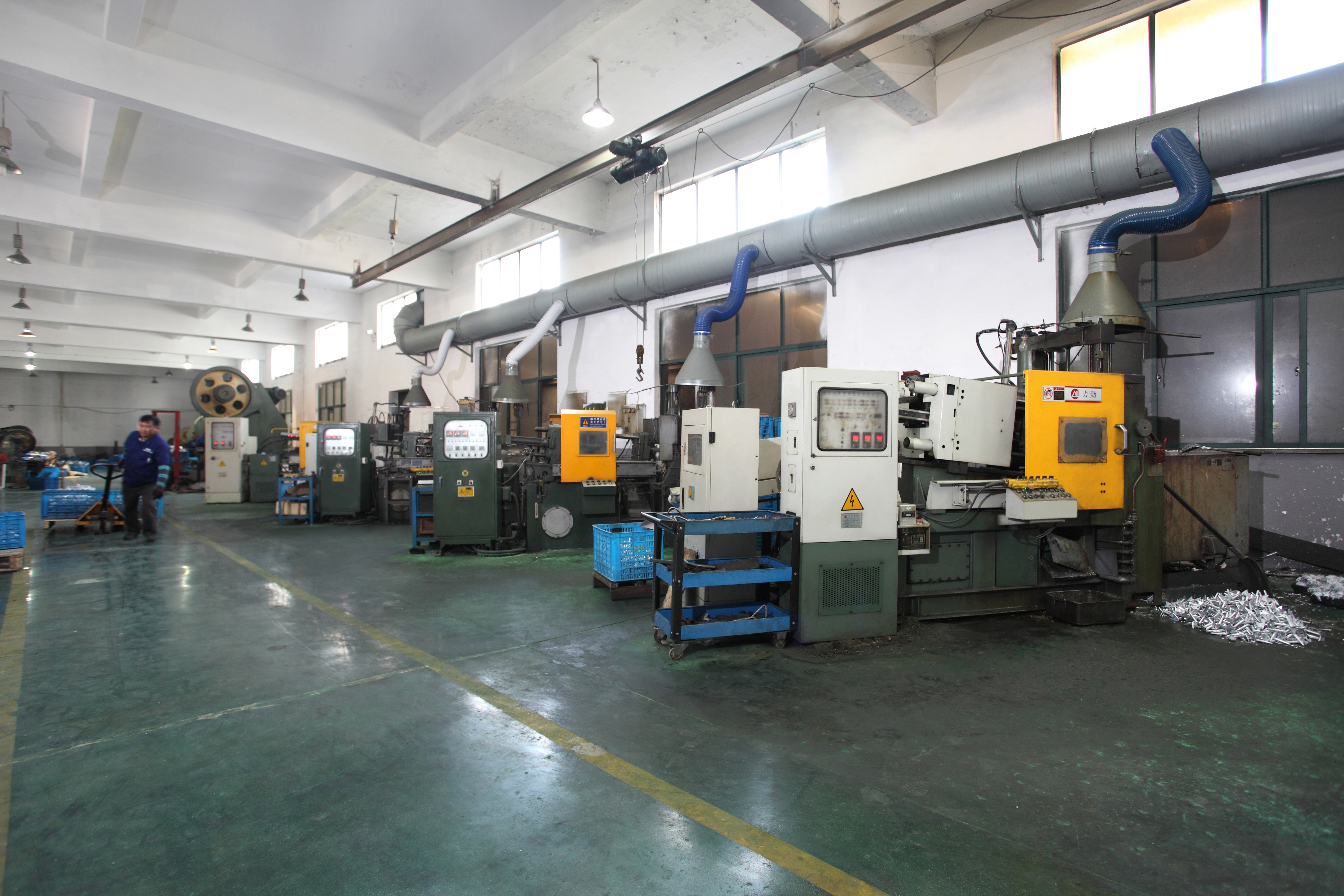
| New die-cast handle body | 5,000 pcs | USD 3,000–8,000 tooling; 30–45 days tooling + 30 days production |
To quote both options side by side, we need six things: door height, door width, panel thickness, gasket profile (or its N/cm), IP/NEMA target and keying scheme. With those we return the force per point, the latch count and a price for each route. Browse the ranges first if you like: ourswing handle locks, rod control locks, plane locks and sealing strips. If you're comparing suppliers, our list of lock and latch manufacturers in China sets out who makes what.
9. Frequently Asked Questions
What is the difference between a swing handle and a compression latch?
Is a swing handle or a compression latch better for an IP66 enclosure?
How many compression latches replace one swing handle with rods?
Which is cheaper per door, a swing handle or compression latches?
What is the most common field failure with each option?
Can I retrofit a swing handle into a door cut for compression latches?
What MOQ and lead time apply to swing handles and compression latches?
Standards and data referenced
- IEC 60529 — degrees of protection provided by enclosures (IP code)
- NEMA 250 / UL 50E — enclosure type ratings (Type 4, 4X)
- ASTM D1056 — compression-deflection of flexible cellular materials (gasket force curves)
- Latch-edge load formula: moment balance about the hinge line, uniform gasket load per unit length
- Clamp force, cam stroke, torque, cycle life, door-height thresholds: Hengchieh catalogue and lot-test data
- Prices: indicative FOB Ningbo, October 2026, zinc alloy catalogue models at 1,000 pcs
Related Guides
Swing Handle & Multi-Point Rod Latches
Rod sizing, guides, cutouts, inserts
Compression Latches: Complete Guide
Tool-less and key-locking, IP66, panel chart
Compression vs Quarter-Turn Latch
Cam stroke, unit cost, vibration
Gasket Compression: IP66 vs NEMA 4X
Why seals pass at the factory and fail later
Electrical Panel Lock Types
Swing, quarter-turn, cam and rod compared
Swing Handle Locks
Factory direct since 1988, MOQ 500
Not sure which one your door needs?
Send your door size, gasket and IP target. We'll quote both routes FOB Ningbo within 24 hours. Samples in 7 days.
Request a Quote →