
Selection Guide
Types of Latches: 12 Industrial Latch Types Compared by What They Actually Do
Most latch lists mix up mechanisms, handles and key options, so a paddle latch, a cam latch and a compression latch end up side by side as if they were alternatives. They aren't. This guide sorts every common industrial latch by the one job it does: hold, pull in, or seal.
Quick answer
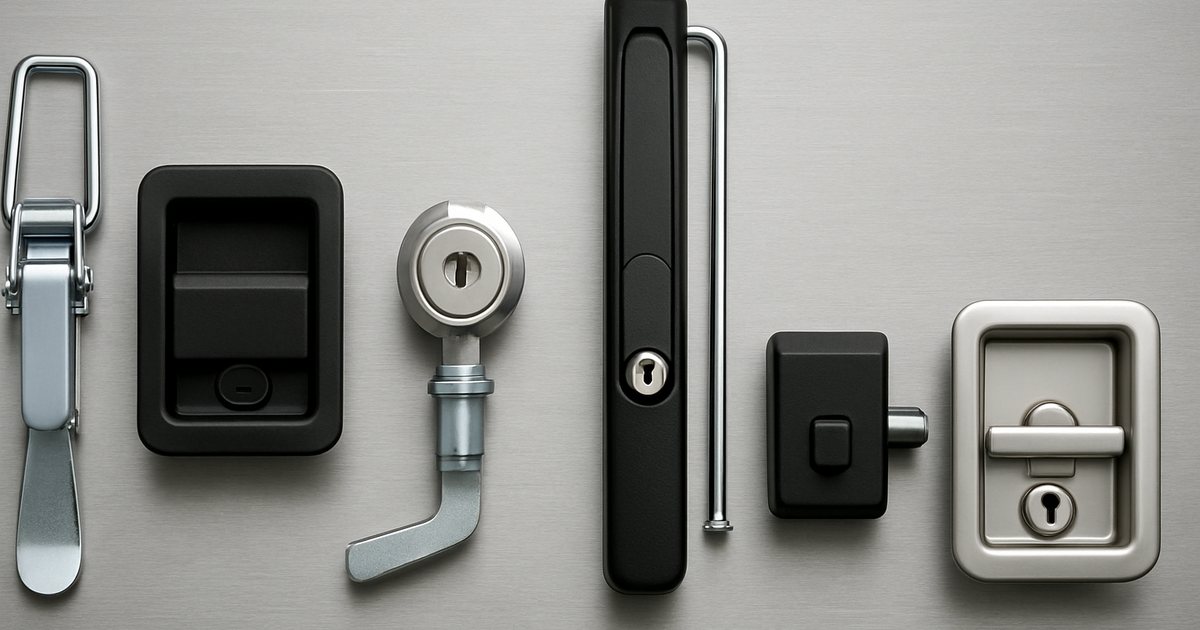
The main types of latches are cam locks, quarter-turn latches, spring point latches, rotary slam latches, over-center draw latches, adjustable draw latches, concealed draw latches, compression latches, lever (plane) locks, swing handle / multi-point rod latches, paddle latches and T-handle locks. They do three different jobs. Hold-only types keep a door shut with no closing force.Draw types pull surfaces together at roughly 100–2,000 N.Compression types add 2–8 mm of inward travel to seal a gasket to IP65/IP66. Pick the job first, then the handle and key.
Key takeaways
- A plain cam or quarter-turn latch gives 0 mm of pull-in. Its realistic sealing ceiling is about IP42–IP54, whatever gasket you fit.
- Compression latches add 2–8 mm of axial travel and take a gasket to 25–40% of its free height. That's the range where it actually seals.
- Door height decides single-point vs multi-point: <600 mm single cam, 600–1,200 mm swing handle, >1,200 mm 2- or 3-point rods.
- “Paddle latch” and “T-handle” are handle styles, not mechanisms. Specify what sits behind the panel separately.
1. Every Latch Does One of Three Jobs
We've been die casting and assembling latches in Ningbo since 1988. Our catalogue runs to 358 models across cam locks, plane locks, swing handles, rod controls, toggle latches and panel locks. Buyers' RFQs show the same mistake every week: two different latch types listed as interchangeable quotes, when only one of them can do the job the cabinet needs.
The fix is to stop sorting latches by what they look like and sort them by what they do to the door:
- Hold. A tongue, cam or claw sits behind the frame so the door can't swing open. It applies no force pulling the door shut, so the gasket sees only the force you used to close it.
- Draw. A lever and hook pull two surfaces together under tension, then lock over center so the tension holds. Rated in newtons of holding force.
- Compress. A ramped or eccentric cam turns a handle rotation into inward travel, squeezing a gasket by a set distance. Rated in millimetres of travel and grip range.
Every latch on the market is one of those three mechanisms. On top of it sits an actuator(slot, knob, lever, paddle, T-handle, swing handle) and a security option (none, key, combination, padlock hasp, electronic). The same compression latch body can ship with any of six inserts. The mechanism is what you're actually choosing.
2. Hold-Only Latches (Types 1–4)
Type 1: Cam lock
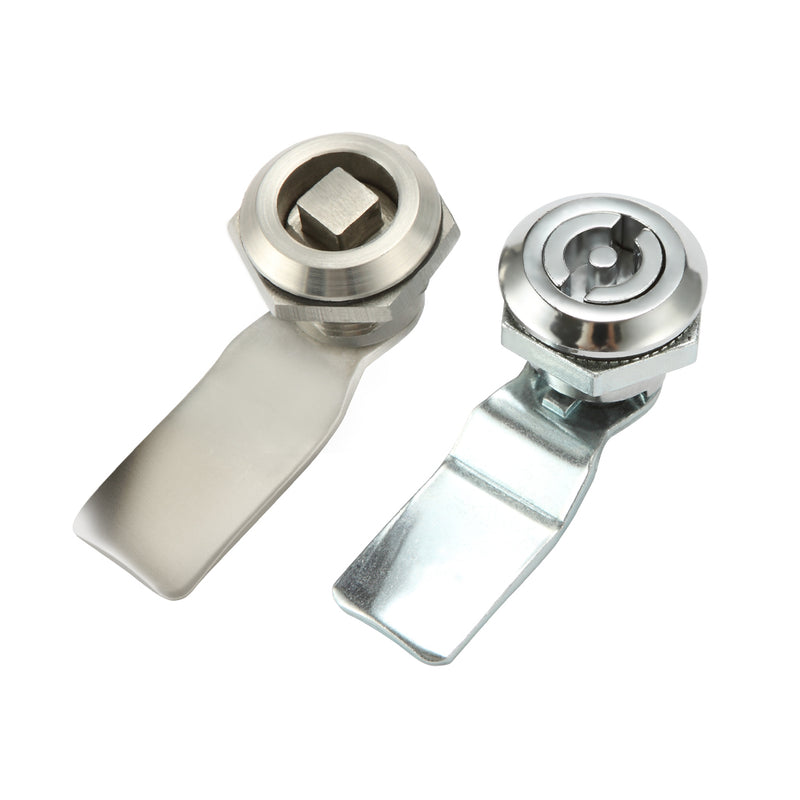
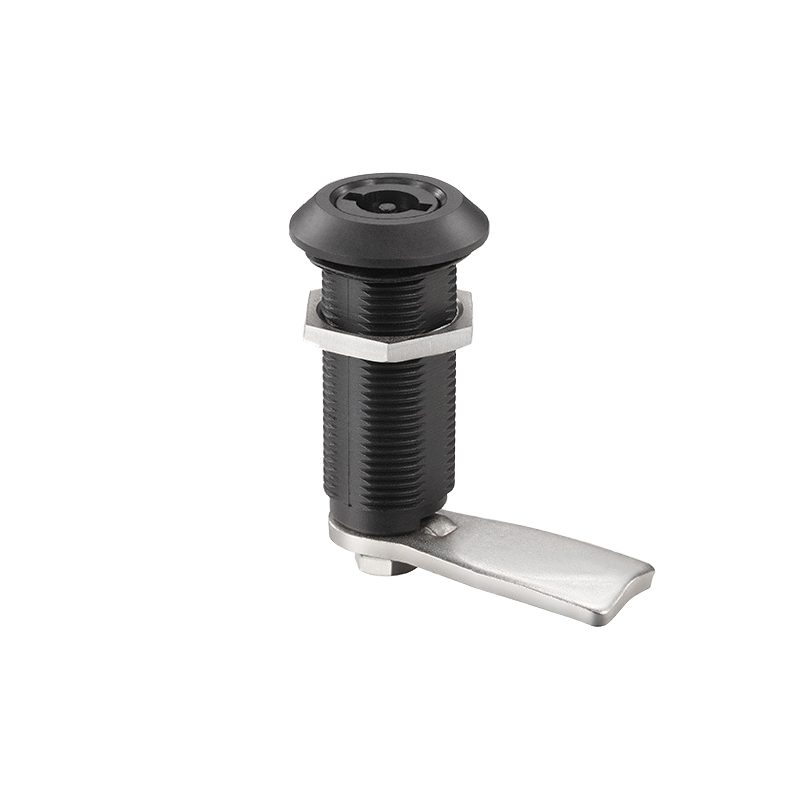
A cylinder in a round or double-D hole turns a flat steel tongue behind the frame. Body diameters are usually 16, 19 or 22 mm, and the 19.1 mm round cutout is the most common single-hole mounting. It's the cheapest latch there is, at about $0.50–$5.00 FOB. It's right for office furniture, lockers, mailboxes and indoor cabinets. It's wrong for anything with a gasket. See ourcam lock guide for keying options and the75 cam lock models we make.
Type 2: Quarter-turn latch
The same idea with a faster 90° throw and a slotted, hex, triangle or wing-knob insert in place of a key. It's the standard latch for indoor electrical and server enclosures, and opens in about 0.6–1.2 N·m of torque. Its weakness is vibration: there's no preload, so a shaking door can back the cam out. Ourquarter-turn lock guide covers the insert types.
Type 3: Spring point latch
A spring-loaded tongue snaps into a keeper when the door is pushed shut, so there's no handle to turn. Typical retention is 40–80 N for vehicle and cabinet doors. On its own it reaches IP44–IP55 at best. The usual pattern on large panels is a compression latch on the main door and a point latch on the small service hatch. Details in the point latch guide.
Type 4: Rotary (slam) latch
A rotating claw captures a striker pin, usually in two stages: a safety catch, then a full latch. Because the claw wraps the striker, it holds much higher loads than a spring tongue and doesn't rattle open. You'll find it behind the paddle on truck toolboxes and on vehicle and genset doors. It's still a hold-only latch, though. It closes the door; it doesn't squeeze a seal.
3. Draw & Toggle Latches (Types 5–7)
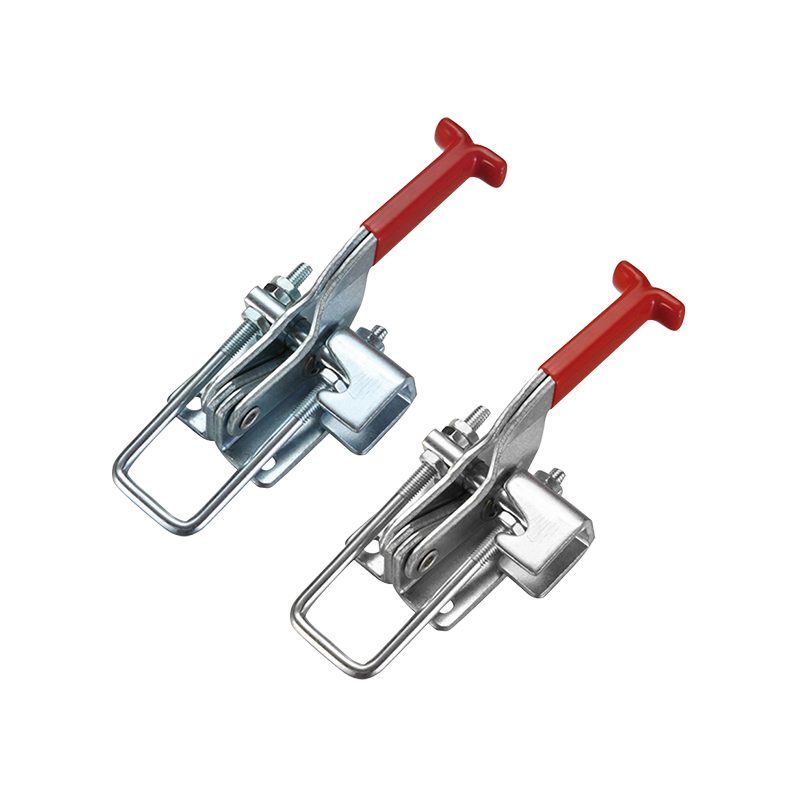
A draw latch is the simplest way to put real force across a joint. You hook the keeper, then push the lever past center, and the tension locks itself in. That's why they're on flight cases, toolboxes, lids, ventilation ducting and anything that ships. We cover them in depth in ourdraw latch guide and the companiontoggle latch guide.
| Type | Holding force | Profile | Adjustable | Typical use |
|---|---|---|---|---|
| 5. Over-center draw latch | 200–2,000 N | Protruding | No | Toolboxes, flight cases, lids |
| 6. Adjustable draw latch | 150–1,500 N | Protruding | Yes, ±5–10 mm | Gasketed lids, variable gaps |
| 7. Concealed draw latch | 100–800 N | Flush | Some models | Medical, AV, military cases |
| Heavy-duty over-center | up to 5,000 N | Protruding | Often | Moulds, fixtures, rail equipment |
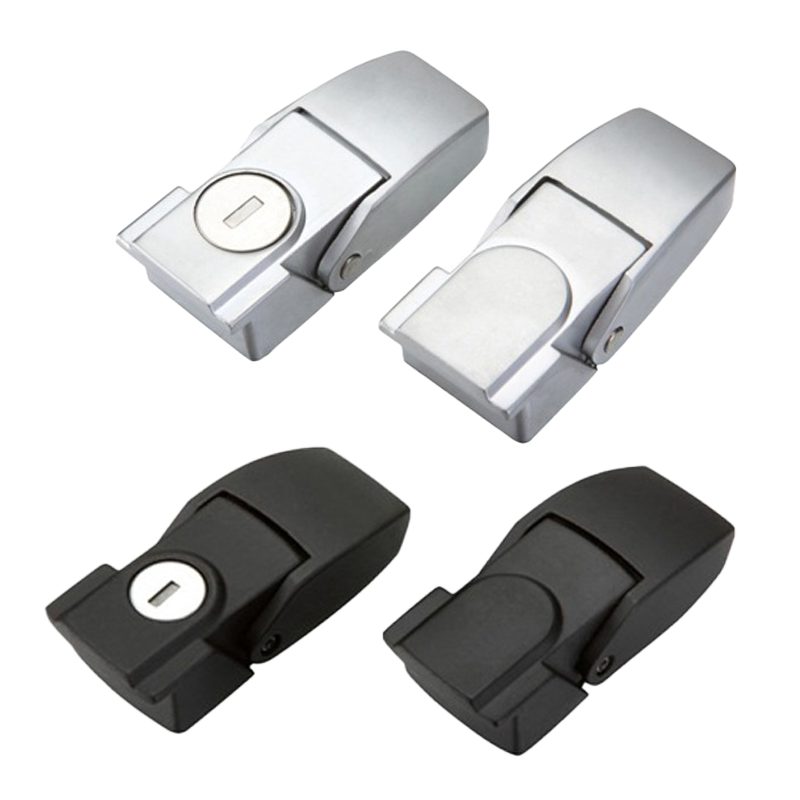
The adjustable version matters more than its sales volume suggests. A lid gasket needs a set draw distance: the gap between the surfaces plus 20–30% of the gasket's free height. A 3 mm gap and 2 mm of compression means a 5 mm minimum draw. When panel tolerances wander, a fixed latch either can't close or doesn't compress. The screw-adjusted hook fixes that on the line.
Not sure whether your design needs a draw latch or a compression latch?
Send us the door or lid size, panel thickness and gasket profile. We'll recommend the mechanism and the number of latch points, and tell you plainly if a cheaper cam lock will do. MOQ 500 pcs, free samples on catalogue models.
Ask an engineer →4. Compression & Multi-Point Latches (Types 8–10)
This is the family most buyers mean when they say “industrial latch”, and the one most often confused with a quarter-turn. Both turn 90°. The difference is axial stroke: a compression latch's ramped cam converts the turn into 2–8 mm of inward travel, and that's what seals. Expect 2–5 N·m of operating torque and a body 10–25 mm deeper behind the panel. The full numbers are in compression latch vs quarter-turn.
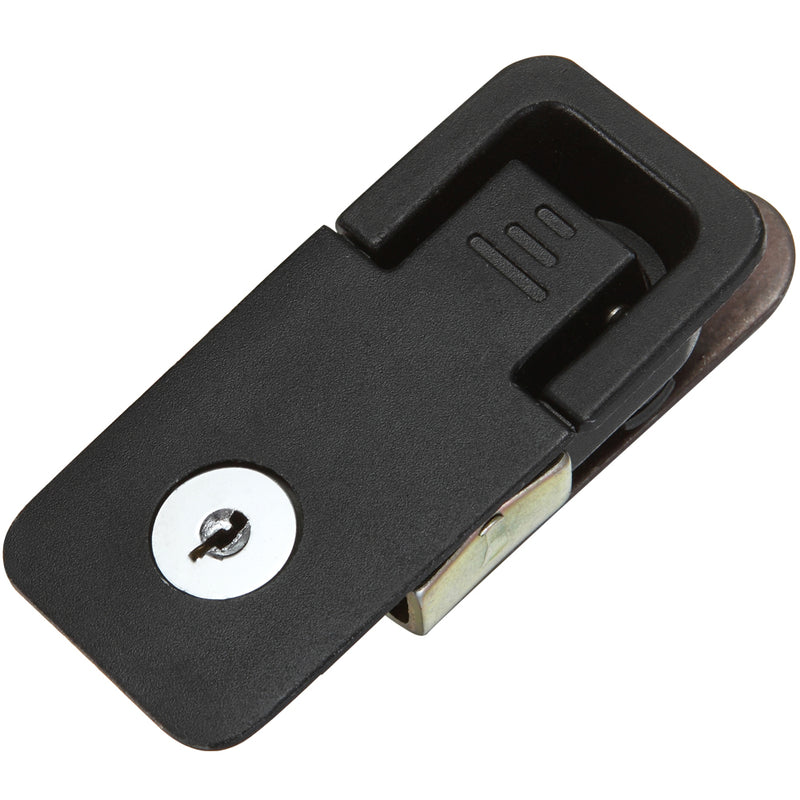
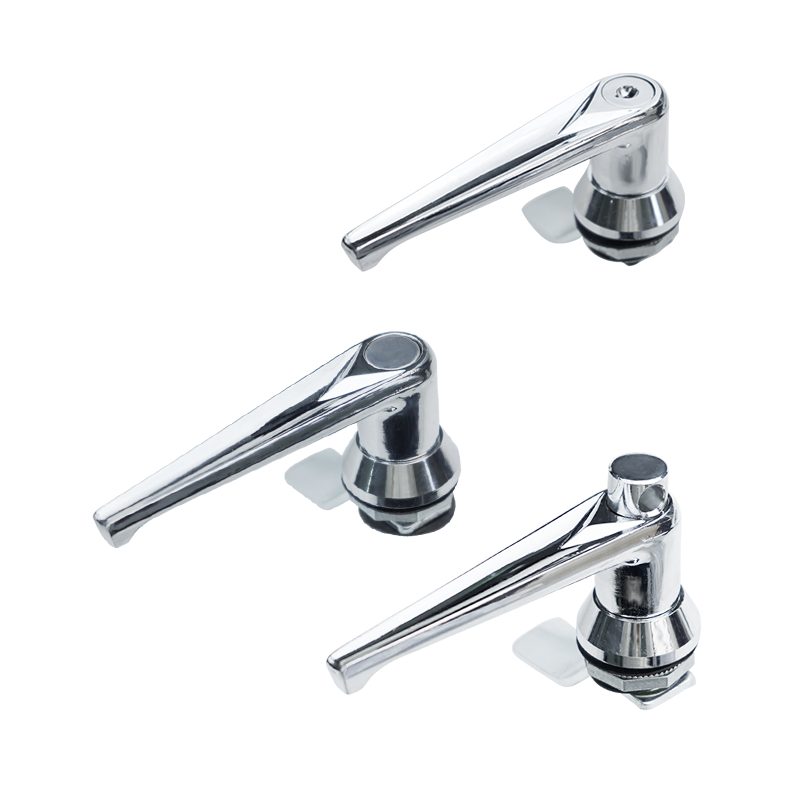
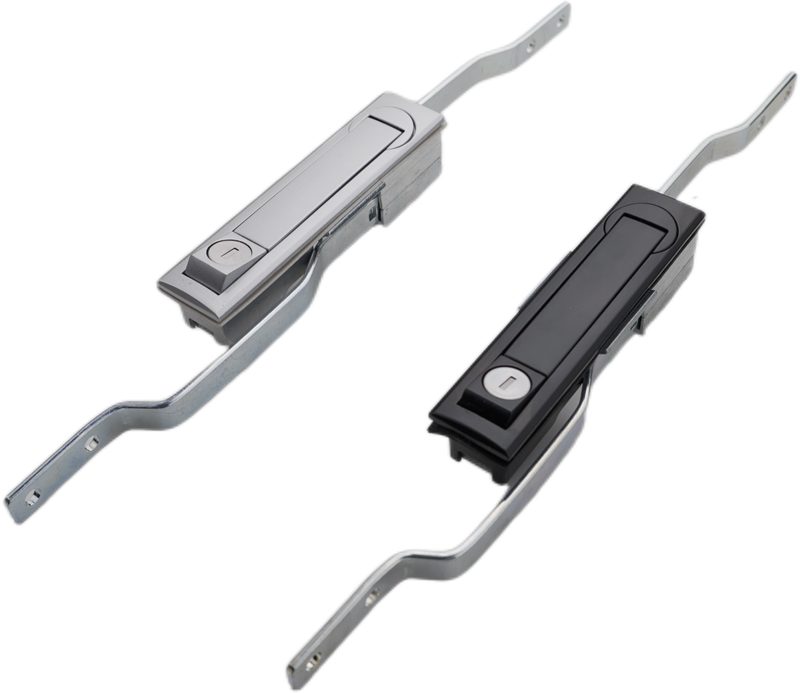
Type 8: Compression latch (quarter-turn compression)
A drop-in for the same 19.1 mm round or 20×20 mm square cutout as a quarter-turn, with a fixed or adjustable grip. It's the default for wall-mount NEMA 4/4X and IP65/IP66 boxes. If you're specifying one, thecompression latch guide and ourgasket compression article explain why the gasket, not the latch, is usually what fails in year three.
Type 9: Lever (plane) lock
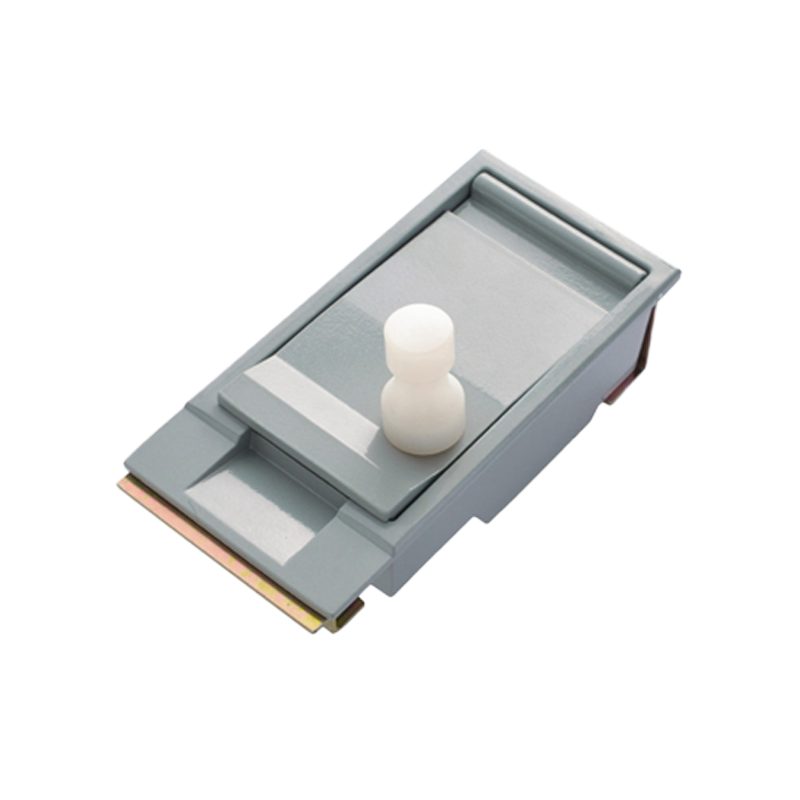
A flush body with a lever that pops out on a button or key, then turns a compression cam. It's flatter than a handle and easier to grip than a knob, which is why it's common on distribution boards, telecom shelters and EV chargers. We make 33 plane lock models, from theMS726 button lock to stainless washdown versions.
Type 10: Swing handle and multi-point rod latch
A larger handle drives one cam, or a gearbox that pushes rods to the top and bottom of the door. Many swing handles also draw the door a further 1.5–3 mm in the last 20–30° of travel. Door height decides how many points you need:
| Door height | Recommended latching | Why |
|---|---|---|
| < 600 mm | Single cam or compression latch | Door is stiff enough to seal from one point |
| 600–1,200 mm | Single-point swing handle | More torque and leverage against gasket load |
| 1,200–1,800 mm | Swing handle + 2-point rods | Corners bow away from the frame under gasket load and wind |
| > 1,800 mm | Swing handle + 3-point rods | Mid-span and both corners need clamping |
See the swing handle & rod latch guidefor rod sizing and cutouts, and our rod control locks andswing handle locks. For server racks specifically, readcompression latches for data center cabinets. If you need an access log, the same handle format comes as an electronic lock (ourMS899 IoT lock) without changing the cutout family.
5. Handle-Style “Types”: Paddle and T-Handle (Types 11–12)
Almost every “types of latches” list includes these two. That's fair, because buyers search for them by name, but they're handles. What's behind the panel decides holding force and sealing.
Type 11: Paddle latch
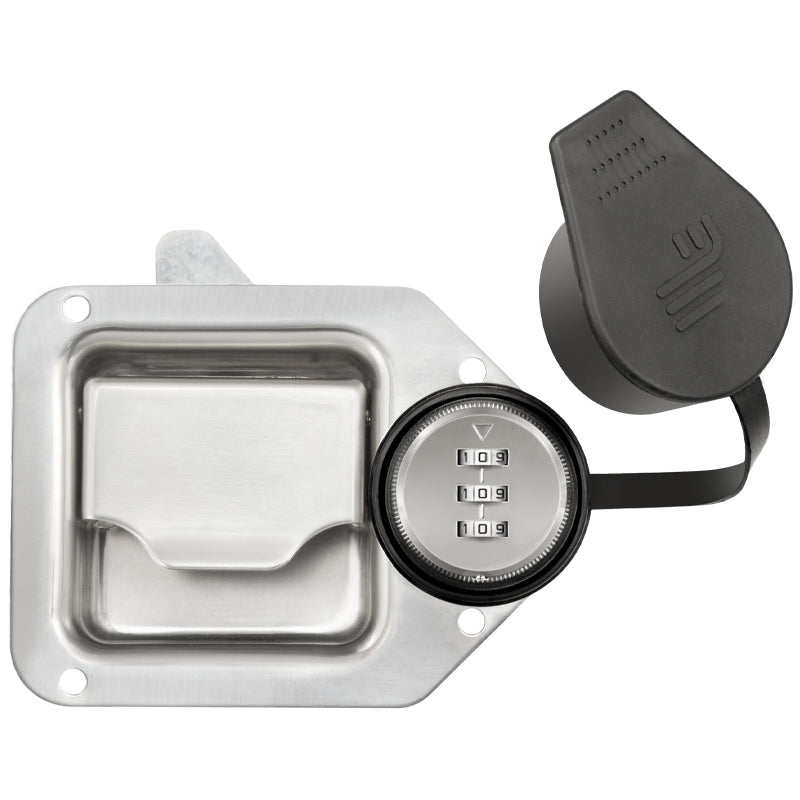
A recessed paddle you lift or pull. Behind it there's usually a rotary claw or spring bolt (truck boxes) or a cam/rod drive (enclosures). It's chosen because it sits flush and doesn't snag. Indicative FOB is $2–$6 in zinc/chrome and $8–$18 in 304 stainless. Start with the paddle latch guide, and see our panel locks and paddle latches.
Type 12: T-handle lock
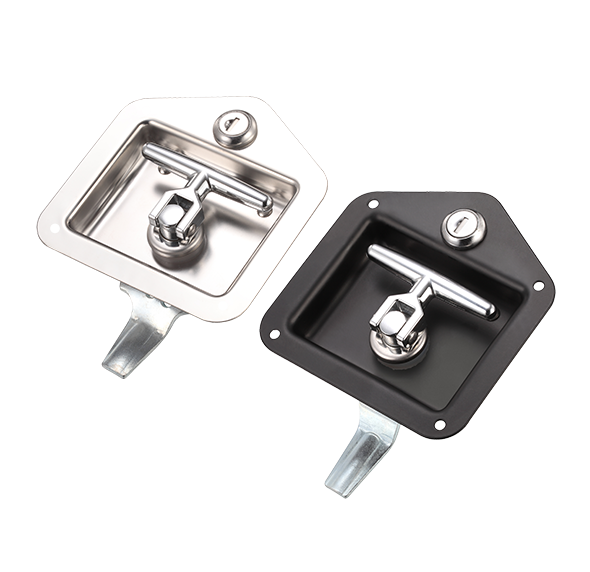
A fold-down T-handle that turns a cam or drives rods. It gives more torque than a paddle and it's easy to use with gloves, so it's popular on truck toolboxes, trailers and genset doors. Indicative FOB is $3–$8 in zinc alloy and $15–$30 in 316 stainless. Sizing is in the T-handle lock guide. For toolbox-specific fitment (UWS, Weather Guard), see toolbox locks.
6. All 12 Latch Types Side by Side
The table compares all twelve on the questions that decide a specification. Green marks the strongest choice for that column.
| # | Type | Job | Pull-in / force | Realistic sealing | Vibration | Flush? |
|---|---|---|---|---|---|---|
| 1 | Cam lock | Hold | 0 mm | IP42–IP54 | Fair | Yes |
| 2 | Quarter-turn | Hold | 0 mm | IP42–IP54 | Weak | Yes |
| 3 | Spring point latch | Hold | 40–80 N retention | IP44–IP55 | Fair | Yes |
| 4 | Rotary slam latch | Hold | 0 mm, high retention | Depends on door seal | Good | Behind panel |
| 5 | Over-center draw | Draw | 200–2,000 N | IP65+ on lids | Good | No |
| 6 | Adjustable draw | Draw | 150–1,500 N | IP65+, tunable | Good | No |
| 7 | Concealed draw | Draw | 100–800 N | IP65 on small lids | Good | Yes |
| 8 | Compression latch | Compress | 2–8 mm | IP65–IP66 (IP67 double seal) | Excellent | Yes |
| 9 | Lever / plane lock | Compress | Compression cam, per model | IP54–IP66 | Good | Yes |
| 10 | Swing handle / rod | Compress | 1.5–3 mm, 1–3 points | IP55–IP66, tall doors | Excellent | Mostly |
| 11 | Paddle latch | Handle | Per mechanism behind | Up to IP65–IP67 sealed | Per mechanism | Yes |
| 12 | T-handle lock | Handle | Per mechanism behind | IP54–IP65 with compression | Good | Folded |
IP ranges are what we see these mechanisms reach in finished enclosures with a correctly specified gasket. The rating belongs to the enclosure, tested per IEC 60529, not to the latch on its own.
7. How to Choose: Five Questions in Order
Answer these in order. Each one rules out whole families, so you're rarely left with more than two candidates.
- Is there a gasket that has to seal? If yes, cross off types 1–4. Use compression (types 8–10) on hinged doors and draw latches (5–6) on lids. If there's no gasket, hold-only latches are cheaper and simpler.
- How tall is the door? Over about 1,200 mm you need a multi-point rod system, whatever the handle looks like. Over 1,800 mm you need three points. See the NEMA enclosure types guide for what each rating demands.
- Will it vibrate or travel? Vehicles, gensets, rail, compressors, shipping cases: avoid plain quarter-turns. Prefer preloaded latches (draw, compression) or a rotary claw.
- Does anything need to be flush? Walkways, vehicle sides, cases that get stacked: choose concealed draw, lever/plane, or paddle.
- Who is allowed to open it? Only now choose the actuator and security: tool insert for qualified staff, key for controlled access, a padlock hasp for LOTO, electronic for audit trails. Material follows the environment. Our zinc vs stainless vs brass comparison has salt-spray hours for each finish.
8. Worked Example: How Many Latches?
Here's a real sizing exercise for a gasketed equipment lid, using the method we use for OEM quotes:
| Step | Input | Result |
|---|---|---|
| Gasket perimeter | Lid 400 × 200 mm | 1,200 mm = 120 cm |
| Gasket force | Rubber gasket, 3–7 N/cm; use 5 | 600 N |
| Safety factor | ×2 for vibration and ageing | 1,200 N |
| Spacing check | ≤ 300 mm between centers for IP65+ | 4 latches (one per side) |
| Per-latch rating | 1,200 N ÷ 4 | ≥ 300 N each → over-center draw latch |
Two mistakes we see often. First, buying fewer, stronger latches: two 1,000 N latches on that lid still leave the long sides gapping between them. Second, checking the force but not the travel: a latch with plenty of force but too little draw distance closes against the gap before it compresses the gasket. For cutout and grip measurements on existing doors, use our latch cutout and retrofit guide.
9. Factory Prices, MOQ & Lead Time
Indicative FOB Ningbo prices for standard catalogue models, chrome-plated zinc alloy unless noted, at 500–1,000 pcs. Stainless and custom keying cost more. A drawing gets you a firm number.
| Latch type | Indicative FOB / pc | Notes |
|---|---|---|
| Cam lock | $0.50–$5.00 | Key type and length drive the range |
| Quarter-turn | $1.10–$2.20 | 4–6 needed to seal a 1,200 mm door |
| Compression, fixed grip | $2.40–$4.80 | 2–3 per 1,200 mm door |
| Compression, adjustable grip | $3.60–$6.50 | Absorbs panel tolerance |
| Paddle latch | $2–$6 (304 SS $8–$18) | Finish sets the salt-spray rating |
| T-handle lock | $3–$8 (316 SS $15–$30) | Rod kits extra |
| Draw / toggle, swing handle, rod systems | Quote | Load rating, rod length and material vary too widely to list |
Per-door cost matters more than unit price. Sealing a 1,200 mm door takes four to six quarter-turns ($4.40–$13.20 plus four to six cutouts) or two to three compression latches ($4.80–$14.40 with half the cutouts). The “expensive” latch is usually the cheaper door.
Ordering terms: MOQ 500 pcs on standard models, samples in 7 days, mass production typically 15–25 days. Cam stroke, torque and salt spray are tested on every production lot. Cycle life on our lot tests is 50,000–100,000 operations for cam and compression latches. If you're comparing suppliers, our list of lock and latch manufacturers in China sets out who makes what.
10. Latches You'll See in Other Lists
If you searched “types of latches”, you've probably seen door and gate hardware mixed in. Here's where those fit, so you can rule them in or out quickly:
| Latch | Job | Where it belongs |
|---|---|---|
| Tubular / mortice door latch | Hold | Building doors (architectural hardware) |
| Gravity / thumb gate latch | Hold | Gates and fences |
| Barrel bolt / slide bolt | Hold | Doors, light enclosures; manual, no key |
| Magnetic catch / ball catch | Hold (light) | Furniture and interior cabinet doors |
| Hook-and-eye / hasp | Hold (+ padlock) | Sheds, crates, LOTO points |
None of these apply sealing force, and none are rated for vibration. For equipment, enclosures and vehicles, you'll almost always end up choosing among types 1–12 above. For cabinet doors specifically, see ourcabinet lock buying guide.
11. Frequently Asked Questions
What are the main types of latches?
What is the difference between a latch and a lock?
Which type of latch is best for a sealed IP65 or NEMA 4 enclosure?
How many latches does a door or lid need?
Which latch types resist vibration best?
What is a paddle latch, and is it a separate latch type?
How much do industrial latches cost from a factory?
Standards and data referenced
- IEC 60529 — degrees of protection provided by enclosures (IP code)
- NEMA 250 / UL 50E — enclosure type ratings (Type 4, 4X, 12)
- Holding forces, cam stroke, torque, cycle life and salt-spray figures: Hengchieh lot testing and catalogue data
- Prices: indicative FOB Ningbo, October 2026, standard catalogue models at 500–1,000 pcs
Related Guides
Compression Latches: Complete Guide
Tool-less and key-locking, IP66, panel chart
Draw Latches: 7 Types, 50–5,000 N
Over-center, adjustable and concealed sizing
Paddle Latches for Enclosures
IP67, NEMA 4X, cutout chart
Swing Handle & Multi-Point Rod Latches
Door-height rules, rod sizing, inserts
15 Types of Hinges
The other half of every enclosure door
All 358 Latches, Locks & Hinges
Factory direct since 1988, MOQ 500
Send us your door, lid or enclosure drawing
We'll recommend the latch type and number of points, and quote FOB Ningbo within 24 hours. Samples in 7 days.
Request a Quote →