
Engineering Guide
Enclosure Gasket Compression: Why IP66 Latches Leak in Year Three
Your latch is specified in millimetres. Your gasket is specified in percent. Almost nobody does the conversion — and the two standards you are relying on disagree about how hard to spray the seam and whether any water may enter at all.
Quick answer
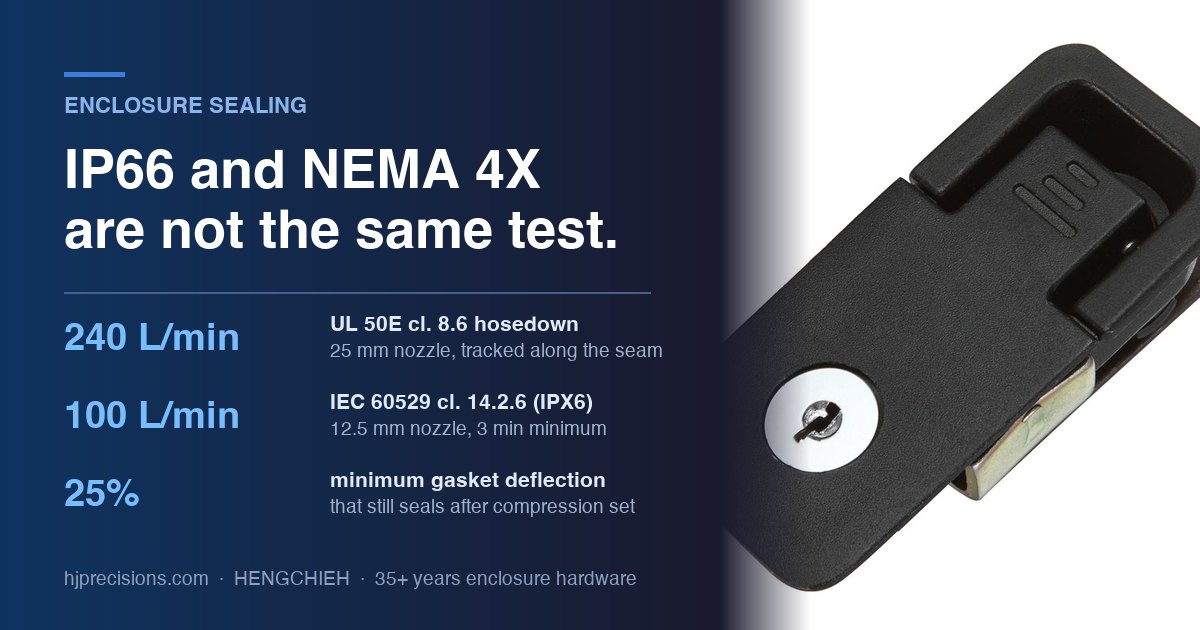
IP66 and NEMA 4X are not the same test. UL 50E clause 8.6 sprays240 L/min through a 25 mm nozzle, tracked along every joint at 6 mm/s, and passes only if no water has entered. IEC 60529 clause 14.2.6 sprays100 L/min through a 12.5 mm nozzle for a minimum of 3 minutes, and clause 14.3permits water to enter so long as it does no harm. Both are type tests on aclean, new sample. Neither tests ageing. What actually keeps water out in year three isgasket deflection, and the safe design floor is 25%, not the 15% that gets quoted. Jump to the clause comparison, the compression-set table, or thegrip tolerance math.
1. The Two Numbers That Never Meet
Open any compression latch catalogue, ours included. Every model is specified in millimetres: grip range, cam offset, cam stroke, panel thickness. Now open the gasket datasheet for the same cabinet. Every number there is a percentage: compression 20–30%, compression set 15%, recovery 85%.
Nobody converts between them. The latch engineer sells clamping distance, the gasket supplier sells deflection ratio, and the enclosure builder in the middle buys both, bolts them together, and finds out which combination they actually got when the first cabinet comes back from a customer site with water in it.
That gap is where nearly every sealing complaint we handle originates. It is not usually a bad latch and it is not usually a bad gasket. It is that the closed door gap was never specified as a dimension, so the gasket deflection was whatever the sheet metal happened to produce that week.
This guide closes the gap in both directions. First, what the two sealing standards actually require — quoted from the clauses, because the summaries circulating online get this wrong. Then the arithmetic that converts a latch grip in millimetres into a gasket deflection in percent, and the compression-set maths that tells you how much deflection you need on day one to still be sealing in year five.
2. What IP66 Actually Promises — and What Its Own Scope Excludes
IP66 is defined by IEC 60529. The second characteristic numeral 6 means, in the standard's own words,“Water projected in powerful jets against the enclosure from any direction shall have no harmful effects”, verified by the test in clause 14.2.6.
Three things in that standard matter enormously to a buyer and are almost never mentioned on a datasheet.
First, the sample is new. Clause 11.2 is explicit: “The tests specified in this standard are type tests… the test samples for each test shall be in a clean and new condition, with all parts in place and mounted in the manner stated by the manufacturer.” An IP66 report is a photograph of one cabinet on one day, before it has ever been opened.
Second, the scope hands the ageing problem to somebody else. Clause 1 lists what the standard does not address — mechanical impacts, corrosion, corrosive solvents, fungus, vermin, solar radiation, icing, moisture produced by condensation, explosive atmospheres — and states these“are matters for the relevant product standard”. The same clause assumes, rather than tests, that materials and workmanship “ensure that the claimed degrees of protection are maintained under the normal conditions of use”. That is an expectation with no verification attached to it. There is no gasket ageing test in the IP code, because ageing is not what the IP code is for.
Third, and most surprising: IPX6 permits water to enter. Clause 14.3 says that after the test the enclosure is inspected, and “in general, if any water has entered, it shall not be sufficient to interfere with the correct operation of the equipment or impair safety”, must not deposit on insulation where it could cause tracking, must not reach live parts, and must not accumulate at the cable end. It explicitly leaves the permitted quantity to the relevant technical committee. IPX6 is aconsequences test, not a zero ingress test.
Hold that last point. It is the single biggest difference between the IP code and the American system, and it is the reason a factory can honestly hold an IP66 report and still fail a NEMA 4X evaluation.
Specifying a sealed enclosure and not sure which rating your buyer actually needs?
Send us the cabinet drawing and the target market. We will tell you which latch grip, cam stroke and gasket profile combination gets you there — and say so plainly if your gasket, not your latch, is the limiting part. MOQ 500 pcs, free samples on catalogue models.
Ask our engineers →3. What NEMA 4X Does Differently: 2.4× the Water, Zero Tolerance
In North America the enclosure rating comes from NEMA 250 and its harmonised certification standards UL 50E and CSA C22.2 No. 94.2. For Type 4 and Type 4X the governing requirement is the hosedown test, UL 50E clause 8.6. As reproduced in Seifert Systems' engineering note RDEN1901, it reads:
“The enclosure and its external mechanisms shall be subjected to a stream of water from a hose that has a 25 mm inside diameter (1 inch inside diameter) nozzle that delivers at least 240 L per minute (65 gallons per minute). The water shall be directed at all joints from a distance of 3.0–3.5 m (10–12 feet). The nozzle shall be moved along each joint one time at a uniform nominal rate of 6 mm/s (1/4 inch per second).”
“The enclosure shall be considered to have met the requirements if at the conclusion of the testno water has entered the enclosure.”
Read the two pass conditions next to each other. IEC 60529 clause 14.3: water may enter, provided it does no harm. UL 50E clause 8.6.2: no water has entered. These are not two wordings of the same requirement. They are two different requirements, and only one of them is absolute.
The consequence is an asymmetry that runs strictly one way, and Seifert's note states it directly: a unit meeting the UL 50E hosedown satisfies IPX6, but a unit meeting IPX6 still needs to be evaluated against the hosedown test.
In commercial terms: if your supplier hands you an IP66 report and you are shipping to a North American customer who wrote “NEMA 4X” on the specification, you do not have the evidence you think you have. The conversion works in the other direction only. We have covered how the rating families map onto each other in the NEMA enclosure types guide; this is the one place where the usual equivalence table quietly misleads.
4. The Two Clauses, Side by Side
Every figure in this table is from the clause text, not from a summary.
| Parameter | UL 50E cl. 8.6 (NEMA Type 4 / 4X) | IEC 60529 cl. 14.2.6 (IPX6) |
|---|---|---|
| Nozzle inside diameter | 25 mm (1″) | 12.5 mm |
| Delivery rate | ≥ 240 L/min (65 GPM) | 100 L/min ± 5% |
| Distance | 3.0–3.5 m | 2.5–3.0 m |
| Aiming | At all joints, traversed once at 6 mm/s | All practicable directions, whole surface |
| Duration | Set by joint length ÷ 6 mm/s | 1 min/m²; minimum 3 min |
| Pass condition | No water has entered | Water may enter if it has no harmful effects (cl. 14.3) |
| Sample condition | Type test | Type test, clean and new (cl. 11.2) |
| Gasket material qualified? | Yes — UL 50E compression test + UL 157 | No requirement of any kind |
| Corrosion covered? | Yes, for 4X | No — excluded by cl. 1 |
Clause parameters per IEC 60529 and UL 50E cl. 8.6 as reproduced in Seifert Systems note RDEN1901 (rev 1.0, 2019).
The last two rows are the ones that should change how you buy. UL qualifies the gasket; IEC does not. UL Solutions publishes a UL 50E compression test that applies specifically to cellular gasket materials in periodic recompression applications — that is, seals which are broken and re-established every time the door opens — and UL 157 evaluates gasket and seal materials for tensile strength, elongation, compression set, tensile set, hardness, low-temperature behaviour and oven ageing.
IEC 60529 has no counterpart. It classifies the box and is silent on the seal. That is precisely why a supplier can hold a genuine IP66 report and have no data whatsoever on what their gasket does after 500 door cycles — and why asking for one is the cheapest due-diligence question in this category.
5. 1,867 Litres on One Seam: The Arithmetic Nobody Runs
The flow rates alone (240 vs 100 L/min) understate the difference, because the two tests aim differently. Work it through on a common cabinet: 600 × 800 × 250 mm.
UL 50E. The door perimeter is 2×(600+800) = 2,800 mm. Traversed once at 6 mm/s, that is 467 seconds — 7.8 minutes of continuous 240 L/min aimed directly at the seam. Total water delivered along that one joint:roughly 1,870 litres.
IEC 60529. The external surface area of the same cabinet is about 1.66 m². At 1 min/m² that is 1.7 minutes, so the 3-minute minimum governs. Total water for the entire test, spread across every face: 300 litres.
| Derived quantity | UL 50E cl. 8.6 | IEC 60529 cl. 14.2.6 | Ratio |
|---|---|---|---|
| Jet exit velocity | 8.15 m/s | 13.58 m/s | IEC 1.67× faster |
| Stagnation pressure at the jet core | 33.2 kPa | 92.2 kPa | IEC 2.8× higher |
| Total jet thrust (ρQv) | 32.6 N | 22.6 N | UL 1.44× higher |
| Test water, 600×800×250 cabinet | ~1,870 L on the door seam | 300 L over the whole box | 6.2× |
Derived by Hengchieh engineering from the clause parameters above, incompressible jet at 20 °C. Velocity = Q/A; stagnation pressure = ½ρv²; thrust = ρQv.
This is more interesting than a simple “UL is harsher” conclusion, and it explains why the two tests catch different defects.
The IEC jet is faster and hits harder per unit area — a narrower nozzle at a similar pressure produces nearly three times the stagnation pressure. It is good at finding a thin spot in a membrane, a badly seated window, a cable gland that was not torqued.
The UL jet carries 2.4× the mass flow and is walked along the seam at a crawl. It is a seam-tracking endurance test. A gasket that is marginally under-compressed will survive a three-minute all-over spray and fail eight minutes of point-blank flooding at the exact line where it is weakest.
Which is the honest summary: IPX6 tests the enclosure, UL 50E tests the joint. If your product's failure mode is the door seal — and for a latched cabinet it nearly always is — the American test is the one that will find it. That is also why the long-tail questions we see most often are application-specific: compression latches for washdown, food processing and data centre cabinets are all cases where the seam, not the panel, is the risk.
6. The Floor Is Not 15%. It Is 25%.
Now the part neither standard covers: what happens after the report is filed.
Every elastomer takes compression set — the fraction of applied deflection it never recovers. It is measured to ASTM D395 Method B (or ISO 815): compress the specimen to a fixed deflection, typically 25%, hold it in an oven for 22 hours at 70 °C or 70 hours at 100 °C depending on the material, release, and measure 30 minutes later. A result of 25% means the gasket permanently kept a quarter of the squeeze you gave it.
There is also a faster effect that catches people out: stress relaxation. Sealing force can fall to around 75% of its initial value within the first hour after the door is closed, long before any ageing. The gasket has not thinned yet — it has simply stopped pushing back as hard.
Here is what that does to a real door. Take a 3.0 mm solid EPDM cord, a fixed closed-door gap (the latch is not re-adjusted), and apply 25% compression set. The gasket's free height falls, so at the same gap the residual deflection falls too:
| Design deflection (day 1) | Closed door gap | Free height after 25% set | Residual deflection | Still sealing? |
|---|---|---|---|---|
| 15% | 2.55 mm | 2.888 mm | 11.7% | No — leaks |
| 18% | 2.46 mm | 2.865 mm | 14.1% | No — leaks |
| 20% | 2.40 mm | 2.850 mm | 15.8% | Marginal |
| 25% | 2.25 mm | 2.812 mm | 20.0% | Yes |
| 30% — recommended | 2.10 mm | 2.775 mm | 24.3% | Yes |
| 35% | 1.95 mm | 2.737 mm | 28.8% | Yes |
Hengchieh calculation. 3.0 mm solid elastomer, fixed door gap, compression set per ASTM D395 Method B definition (fraction of applied deflection not recovered). Sealing threshold taken as 15%.
Read the first two rows again. A gasket designed at 15–18% deflection stops sealing after one normal ageing cycle — and 15% is exactly the figure that circulates as “the minimum compression to seal”. It is the minimum. It is not a design target, because you have to spend some of your deflection budget on set before you get to year five.
Now run it again for a cabinet that runs hot — a genset enclosure, an inverter cabinet, a cabinet in Arizona — where 40% compression set is realistic:
| Design deflection (day 1) | Residual after 25% set | Residual after 40% set | Verdict for a hot cabinet |
|---|---|---|---|
| 20% | 15.8% | 13.0% | Fails |
| 25% — the floor | 20.0% | 16.7% | Holds |
| 30% | 24.3% | 20.5% | Holds comfortably |
| 35% | 28.8% | 24.4% | Holds |
That is the rule this article exists to state plainly:
Design solid-elastomer door gaskets at 25–30% deflection, never 15–20%.25% is the floor that survives a realistic compression set; 30% is the target that survives a hot cabinet with margin. Stay under roughly 50%, where the elastomer is being crushed rather than elastically deformed and takes permanent set immediately.
For closed-cell sponge used in water sealing the equivalent window is 30–40%. Open-cell sponge runs 40–60% but should not be used for water sealing at all — it is an air and dust seal.
7. ±0.5 mm of Stack-Up Is the Difference Between Leak and Crush
Here is the manufacturer's half of the problem, and the number that surprises most enclosure builders.
Gasket deflection is not something you specify directly. It is whatever falls out of the closed door gap, which is set by the latch cam, the frame return depth and every sheet-metal tolerance in between. On a 3.0 mm gasket nominally set to 30% deflection — a 2.10 mm gap — here is what ordinary stack-up variation does:
| Stack-up deviation | Actual closed gap | Actual deflection | What you get |
|---|---|---|---|
| +0.75 mm | 2.85 mm | 5.0% | Leaks on day one |
| +0.50 mm | 2.60 mm | 13.3% | Below sealing threshold |
| +0.25 mm | 2.35 mm | 21.7% | Seals now, fails after set |
| Nominal | 2.10 mm | 30.0% | Correct |
| −0.25 mm | 1.85 mm | 38.3% | Acceptable, high closing force |
| −0.50 mm | 1.60 mm | 46.7% | Near crush; rapid permanent set |
| −0.75 mm | 1.35 mm | 55.0% | Over-compressed; gasket destroyed |
Hengchieh calculation, 3.0 mm gasket, 2.10 mm nominal gap. A ±0.5 mm band spans 13.3% to 46.7% deflection — a 3.5× range.
±0.5 mm is not a demanding tolerance for a welded sheet-metal door and frame. It is roughly what you get without trying. And across that ordinary band the same latch, the same gasket and the same drawing produce cabinets ranging from “leaks immediately” to “gasket crushed flat in a season”.
Four things follow directly, and they are what we tell customers before they buy anything:
- Specify the closed door gap on the drawing, with a tolerance. Not the latch model, not the gasket part number — the gap. It is the only dimension that controls sealing, and it is the one almost nobody dimensions.
- Use a thicker gasket to buy tolerance. The same ±0.5 mm on a 6 mm profile is ±8.3% of deflection instead of ±16.7%. Doubling gasket height halves your sensitivity to sheet metal. This is the cheapest fix available and it is usually rejected because the thicker cord costs a few cents more per metre.
- Use an adjustable-grip compression latch so the line can trim each door to the drawn gap rather than accepting whatever the weld fixture produced. Fixed-grip latches are fine when your stack-up is genuinely controlled; the trouble is that most builders believe theirs is.
- Put enough latches on the door. A door sealed only at its latching edge bows in the middle under gasket reaction force. The gap at mid-span is not the gap at the latch, and the arithmetic above applies at every point along the seam — which is exactly what UL 50E's 6 mm/s traverse is designed to find.
Grip range is the bridge between all of this and the catalogue, and it deserves its own treatment — we go through how to measure total grip, cam offset and frame return depth in theenclosure latch cutout and retrofit guide. If you are still choosing a latch family, thecompression latch vs quarter-turn comparisoncovers why a quarter-turn cannot generate the axial stroke this maths requires.
8. Profile and Material: What to Actually Specify
With the deflection target settled, the remaining choices are profile and polymer.
| Profile type | Design deflection | Closing force | Use for |
|---|---|---|---|
| Solid cord / extrusion | 25–30% (max ~50%) | High | Rigid doors, high IP, washdown |
| Closed-cell sponge | 30–40% | Low–medium | Water sealing with light latching |
| Hollow / D-profile | Per supplier CFD curve | Low | Large doors, uneven gaps |
| Open-cell sponge | 40–60% | Very low | Air/dust only — never water |
| Foam-in-place (FIPG) | Per supplier data | Low | Complex cast or moulded covers |
| Material | Compression set resistance | Strengths | Verdict for a door seal |
|---|---|---|---|
| EPDM | Good — premium grades reported as low as 7% (D395 B) | Water, weather, ozone, UV | Default choice, outdoor & washdown |
| Silicone (VMQ) | Excellent, especially hot | Holds up at 150–200 °C | Best for hot cabinets; weaker, costlier |
| Neoprene (CR) | Moderate to high set | General purpose, flame resistant | Acceptable indoors, not for critical seals |
| Nitrile (NBR) | Moderate set | Oil and fuel resistance | Only where oil contact demands it |
Compression set per ASTM D395 Method B. Note that at elevated temperature several common elastomers have been reported at set values as high as 50%, which is why the hot-cabinet column in section 6 matters.
One purchasing note worth more than the whole table: a compression set figure without its test conditions attached is not a specification. “Compression set 15%” is meaningless. “15% per ASTM D395 Method B, 22 h at 70 °C, 25% deflection” is a number you can hold a supplier to. The gap between those two statements is where a great many disappointing gaskets are sold.
9. A Verification Procedure You Can Run on the Line
None of this needs a laboratory. Five checks, all doable with calipers and consumables:
| # | Check | Method | Pass |
|---|---|---|---|
| 1 | Actual closed gap | Crush a lead wire or modelling-clay bead at 6–8 points around the seam, close, latch, reopen, measure with calipers | Every point within the drawn gap tolerance |
| 2 | Deflection uniformity | Compare the corner readings to the mid-span readings from check 1 | Spread < 15% of gasket free height |
| 3 | Witness mark continuity | Chalk or engineer's blue along the frame flange, close and reopen | Unbroken contact line, no gaps at corners |
| 4 | Set after cycling | Repeat check 1 after 100 open/close cycles and after a heat soak | Residual deflection still ≥ 15% |
| 5 | Seam, not surface | If you water-test in house, walk the jet along the joint slowly — do not just wave it at the door | No ingress at the seam |
Check 1 is the one to adopt if you adopt only one. A crushed clay bead takes two minutes, costs nothing, and converts your sealing system from an assumption into a measurement. It is also the single most effective incoming-inspection step we have seen customers add, because it catches a drifting weld fixture weeks before the first field complaint arrives.
Check 4 is the one that would have caught the failures this article is about — and it is precisely the check that neither an IP66 report nor, for the enclosure as a whole, a NEMA 4X listing performs for you.
10. Where This Guide Is Imprecise
Worth stating plainly, because sealing advice is usually sold with more confidence than it deserves.
- The 15% sealing threshold is a working rule, not a law. Published guidance puts the minimum for solid rubber somewhere between 10% and 15%, and the true figure depends on surface finish, profile, durometer and the pressure differential. We used 15% because it is the conservative end. If your flange is rough or your profile is hollow, it will be higher.
- The compression-set model assumes a fixed door gap. In reality many latches can be re-adjusted, and a maintenance regime that re-torques or re-trims the latch every few years changes the outcome entirely. The model describes the common case — a cabinet nobody adjusts — not every case.
- ASTM D395 set values are not service-life predictions. Like salt spray hours, they are comparative. A 22-hour oven result tells you which of two materials is better, not how many years your gasket has.
- We have not reproduced the UL 50E gasket compression test parameters, because UL does not publish them free of charge. We have stated only what UL Solutions publicly describes: that the test exists, that it applies to cellular materials in periodic-recompression service, and that UL 157 covers compression set among other properties. If you need the acceptance criteria, buy the standard or ask UL.
- The 600×800×250 mm water volumes are illustrative. The ratio is what matters and it scales with door perimeter versus enclosure surface area — a tall narrow cabinet shifts it further in UL's direction, a large flat one shifts it back.
11. Frequently Asked Questions
Is IP66 the same as NEMA 4X?
How much should an enclosure gasket be compressed?
Why does my IP66 enclosure leak after two or three years?
What is compression set and how is it measured?
How does latch grip range affect gasket compression?
Does UL 50E test the gasket material itself, and does IEC 60529?
Which gasket material should I specify for an outdoor enclosure?
Can I fix a leaking cabinet by just fitting a thicker gasket?
Standards and sources referenced
- IEC 60529 (Ed. 2.2, 1989+A1:1999+A2:2013) — clauses 1, 11.1, 11.2, 14.2.6, 14.3
- UL 50E clause 8.6 hosedown test, as reproduced in Seifert Systems R&D Engineering Note RDEN1901 rev 1.0 (2019)
- NEMA 250; UL 50E; CSA C22.2 No. 94.2 — enclosure type ratings
- UL 157 — Standard for Gaskets and Seals; UL Solutions published description of the UL 50E compression test for cellular gasket materials
- ASTM D395 Method B / ISO 815 — compression set of vulcanised rubber; ASTM D1056 — compression force deflection of cellular materials
- Jet velocity, stagnation pressure, thrust and test-water volumes derived by Hengchieh engineering from the clause parameters above
Related Guides
Compression Latches: Complete Guide
Types, gasket force data, sizing & 33 models
NEMA Enclosure Types 1–13
Where the IP equivalence table is safe — and where it isn’t
Latch Cutout Dimensions & Retrofit
How to measure total grip, cam offset and frame return
IP66 Compression Latches for Outdoor Cabinets
Gasket materials, stainless grades, UV & salt spray
Compression Latch vs Quarter-Turn
Why a quarter-turn can’t generate the axial stroke
Compression Latches — 33 Models, Factory Direct
Adjustable grip, zinc alloy & SS304/316, MOQ 500
Sealing Problem, or a Latch Problem?
35+ years of die casting and enclosure hardware. Send us your door gap, gasket profile and target rating — our engineers reply within 24 hours with a grip and cam stroke recommendation, and tell you honestly if the gasket rather than the latch is your limiting part. MOQ 500 pcs, samples in 7 days.