
Reference Guide
MS899, MS705, MS816 Lock Model Number Guide
Decode MS899, MS705, MS816, MS858 and 50+ MS-series industrial lock model numbers. Number bands, suffix rules, JL/DK/LS/TX prefixes, and how to cross-reference an orphaned part. Factory direct, OEM available. Free quote.
Quick Answer
MS is a shared industry prefix for industrial cabinet locks — not a brand. The number band tells you the type: MS2xx–MS3xx = swing handle locks, MS7xx = cylinder cam locks and plane locks, MS8xx = cam locks, panel locks, rod control and transformer locks, MS888–MS899 = IoT/electronic locks. Different prefixes cover other hardware: JL = hinges, DK = toggle latches, LS = pull handles, TX = door stops. Jump to the band table or the cross-reference checklist.
1. What “MS” Actually Means — and What It Doesn’t
If you have ever pulled a failed lock out of an electrical cabinet, found MS705 or MS858 stamped on the body, and then discovered that fifteen different suppliers all sell “the same” part at prices ranging from USD 0.80 to USD 9.00 — this guide is for you.
MS is not a brand and not a standard. It is a catalogue convention that grew out of the Chinese industrial hardware cluster (mainly Ningbo, Yuyao and Wenzhou), derived from the pinyin mén suǒ — literally “door lock.” Over roughly three decades, the numbering drifted into a de-facto shared language: when a European panel builder writes MS705 on a BOM, every factory in the cluster knows approximately what to pull off the shelf.
That is genuinely useful. It is also the source of most sourcing failures we see. Because no standards body owns the MS numbering, there is no guaranteed dimensional interchangeability between factories. Two MS816 locks from two suppliers will normally share a mounting hole and a general shape. They may not share cam thickness, shaft length, cylinder pin count, key code series, salt-spray performance, or the torque at which the zinc body shears.
We manufacture 358 catalogue models across 13 hardware categories, most of them under MS, JL, DK, LS and TX numbers. What follows is the mapping as it exists in a real production catalogue — not a theoretical scheme.
2. MS Number Bands: What the Digits Tell You
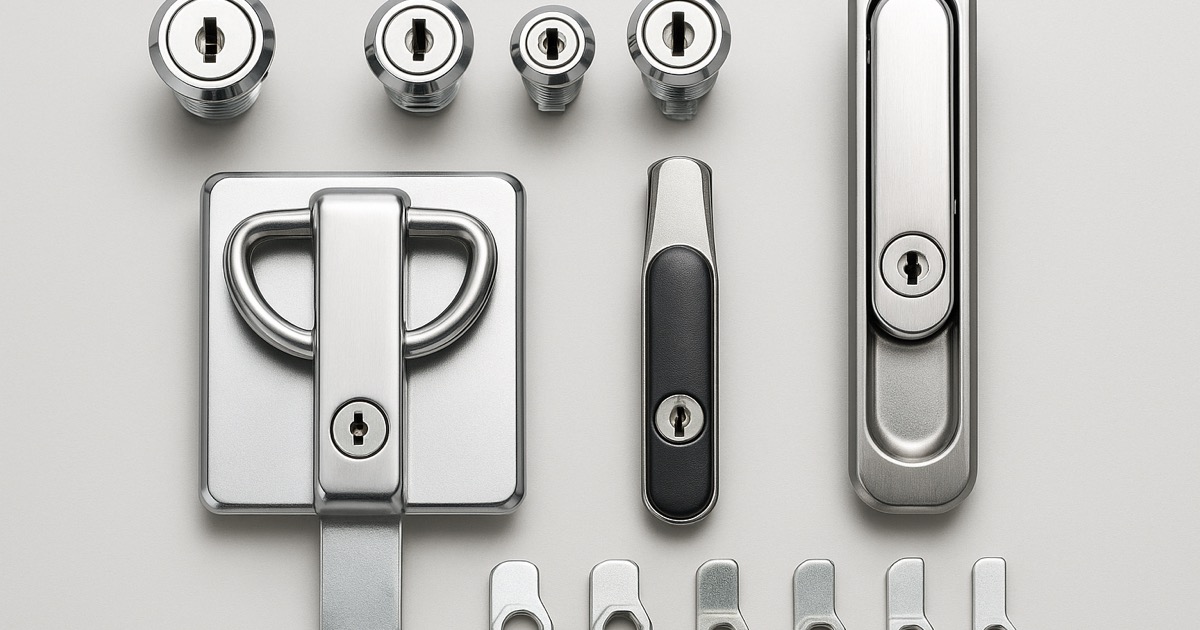
The first digit after “MS” is the strongest signal. Here is how the bands break down across our own catalogue, with the number of active models in each band:
| Band | Dominant Product Type | Typical Use | Models in our catalogue |
|---|---|---|---|
| MS00xx / MS10xx | Cam locks, plane locks, swing handles | Legacy and export-specific numbering | 7 |
| MS2xx | Cam locks | Light cabinet doors, drawers | 1 |
| MS3xx | Swing handle locks | Server cabinets, network enclosures, control panels | 12 |
| MS40xx | Plane locks | Flush-mount distribution cabinets | 2 |
| MS7xx | Cylinder cam locks (27) + plane locks (20) | Electrical, telecom, HVAC enclosures | 50 |
| MS8xx | Cam locks (41), panel locks (16), rod control (16), plane locks (7), swing handles (6), transformer locks (6) | The broadest band — nearly every lock type appears here | 93 |
| MS888 / MS891 / MS899 | IoT / electronic locks | Charging stations, vending, smart cabinets | 3 families |
| MS9xx | Swing handle locks | Heavy-duty enclosure access | 2 |
Two practical takeaways. First, MS8xx is not a type — it is a landfill. Because the 800 band filled up first and stayed commercially popular, factories kept adding models to it regardless of category. Never assume an MS8xx number is a cam lock just because the last MS8xx you bought was one: MS816 is a cam lock, MS830 is a multi-point rod control lock, and MS858 is a folding T-handle panel latch.
Second, the 300 band is the most reliable. If you see MS3xx, you are almost certainly looking at a swing handle lock.
3. MS705 & the MS7xx Cylinder Cam Locks
MS705 is the single most widely copied industrial lock number in the Chinese hardware cluster. It designates a heavy cylinder cam lock — the type you find on electrical distribution cabinets, telecom street cabinets and communication racks across Europe, the Middle East and Latin America.
| Attribute | MS705 family (typical) |
|---|---|
| Category | Cam lock / cylinder lock |
| Body materials | 304 stainless steel, or zinc alloy |
| Common finishes | Mirror polished, bright chrome plated, natural (cam & nut) |
| Mounting hole | Commonly 19–22.5 mm depending on variant |
| Actuation | Key-operated cylinder, or triangular / square / double-bit insert |
| Typical variants | MS705-3A, -3B, -3C, -3E, -3U, MS705A–J, MS705-K02 |
The MS705 family is unusually wide — we alone carry over a dozen variants. That is because the same cylinder body gets paired with different actuation heads for different utility markets: triangular inserts for European power distribution, double-bit 3 mm for German-standard cabinets, square 7 mm and 8 mm for telecom, and conventional key cylinders for general industry.
Neighbouring MS7xx numbers are frequently not cam locks. MS713, for example, is a flush-mounted plane lock (also called a compression latch) with a matt chrome body and white zinc plated core — a completely different installation. In our MS7xx band, 27 models are cam locks and 20 are plane locks, so the odds are close to a coin flip. Read the drawing.
Sourcing an MS-series part and not sure which variant you have?
Send us a photo of the front, back and cam plus your panel cutout dimensions. We will identify the family and quote from an existing tool where possible.
Send Us Your Sample Photos4. MS816 & the Quarter-Turn Cam Lock Family
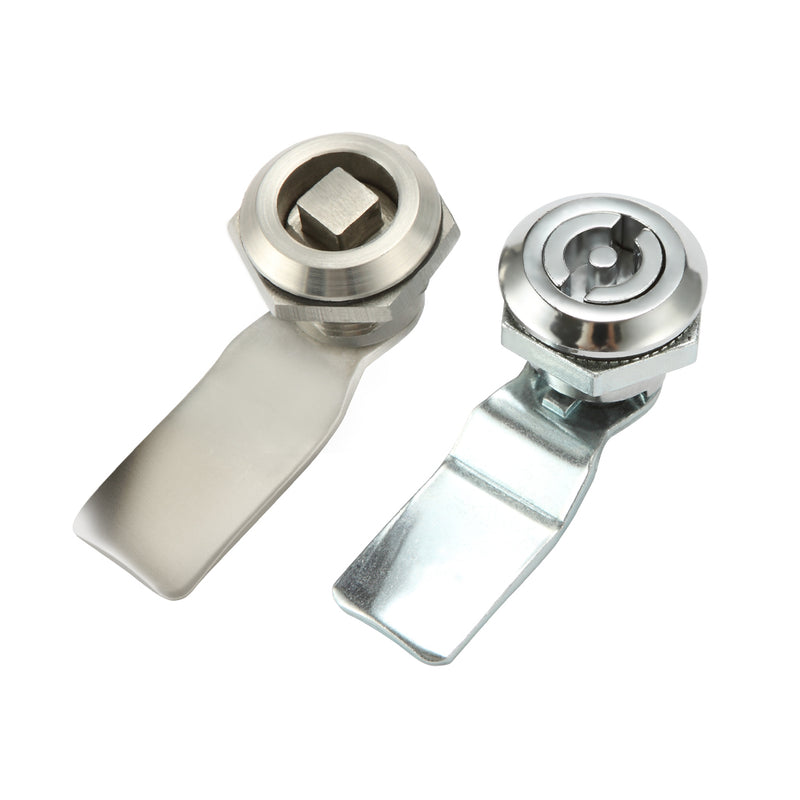
MS816 is the volume workhorse: a zinc alloy quarter-turn cam lock with a bright chrome plated body and cylinder, a steel cam, and a white zinc plated nut. It is what goes on control panels, distribution boxes, lockers and general-purpose enclosures where the door is small enough that a single latching point is sufficient.
| MS705 | MS816 | |
|---|---|---|
| Body material | 304 SS or zinc alloy | Zinc alloy |
| Cam material | Steel / stainless | Steel, white zinc plated |
| Relative unit cost | Baseline ×2–4 | Baseline |
| Corrosion suitability | Outdoor / coastal (SS version) | Indoor / sheltered |
| Typical door size | Medium–large panels | Small–medium panels |
| Best for | Utility, telecom, street cabinets | Control panels, distribution boxes |
A recurring specification error: choosing MS816 for an outdoor enclosure because the sample looked bright and clean in the showroom. Bright chrome over zinc alloy typically clears 48–96 hours of neutral salt spray per ASTM B117; 304 stainless clears 500+ hours and 316 clears 1,000+. If the cabinet lives outdoors, move to the stainless MS705 family or specify a stainless variant — the cost delta is far smaller than a field replacement campaign. Our industrial lock material comparison works through that trade-off in detail, and the cam lock guide covers cam geometry and grip range.
5. MS858 & the Panel Lock / Paddle Latch Family
MS858 is the number people search when a truck tool box latch has failed. It designates a 304 stainless steel folding T-handle panel lock — a paddle-style latch that sits flush in the door skin, folds out to give you leverage, and drives a cam or connecting rod behind the panel.
| Attribute | MS858 family |
|---|---|
| Category | Panel lock / paddle latch / folding T-handle |
| Materials | 304 stainless steel, carbon steel |
| Finishes | Mirror polished, bright chrome plated, black sprayed |
| Actuation | Fold-out T-handle, key-locking cylinder |
| Rear drive | Cam, or single/double connecting rod |
| Applications | Truck tool boxes, special vehicles, engineering vehicles, gensets, equipment cabinets, RV/caravan storage |
| Common variants | MS858-3, -4, -6, -7, -8, MS858A, MS858A-1, MS858B, MS858C, MS858D, MS858R |
The variant spread matters more here than anywhere else in the MS catalogue, because MS858 parts are installed in sheet metal that the customer already owns. The cutout is fixed; the lock has to match it. In our experience the three dimensions that decide whether a replacement drops in are:
- Cutout length × width of the rectangular recess in the door skin.
- Panel thickness range the body is designed to clamp — usually 1.0–3.0 mm for vehicle sheet, up to 6 mm for heavy equipment.
- Shaft length behind the body, which sets whether the cam can reach the striker.
If you are replacing a failed unit rather than designing new, our toolbox lock replacement guide walks through the measurement sequence, and the T-handle lock guide covers the compression versus non-compression decision. For the general paddle family, see the paddle latch guide.
6. MS3xx & MS8xx Swing Handle and Rod Control Locks
Two adjacent families cover the “big door” problem — enclosures tall enough that a single latching point lets the door bow and break the gasket seal.
MS3xx swing handle locks
MS306 is representative: a zinc alloy swing handle with a steel latch tongue and brass key, bright chrome plated body and white zinc plated tongue. The handle sits flush, pivots out into your palm, and rotates a spindle. Twelve of our swing handle models sit in the MS3xx band, with six more scattered in MS8xx and two in MS9xx.
MS8xx rod control locks
MS830 and its neighbours drive vertical rods to two or three latching points. Materials are typically zinc alloy body and handle, steel tongue and rods, brass key; finishes commonly grey powder coat on the body, black powder coat on the handle, white zinc on the internals. Sixteen models in our catalogue sit in this family, plus six aluminium-alloy transformer cabinet locks engineered specifically for outdoor substation doors.
| Door height | Recommended latching | Family |
|---|---|---|
| Under 600 mm | Single point | MS816 / MS705 cam lock |
| 600–1,200 mm | Single point swing handle | MS3xx swing handle |
| 1,200–1,800 mm | 2-point rod | MS8xx rod control |
| Over 1,800 mm | 3-point rod | MS8xx rod control + guides |
7. MS899 & the IoT Smart Lock Family
The MS888 / MS891 / MS899 numbers are the newest additions and behave differently from the mechanical catalogue. MS899 is a remote IoT lock with ID card access, designed for access management on charging stations, vending machines, data centre cabinets and high-value equipment enclosures.
Two things buyers consistently underestimate here. First, the mechanical envelope still has to fit your existing cutout — an electronic lock is not a drop-in for a mechanical one unless it was designed as a retrofit. Second, the protocol and back-end matter more than the lock: ID card, Bluetooth, NB-IoT and 4G variants have very different power budgets and very different integration effort. Ask for the API documentation before you ask for the price.
For EV charging and battery cabinet applications specifically, our EV charger and battery enclosure security guide covers the mechanical and electronic options side by side. Browse the current range on the IoT smart locks page.
8. Suffix Letters and Dash Numbers Decoded
This is where MS numbering does the most damage to procurement. There is no cross-factory standard — but there is a strong convention, and knowing it will save you a shipment.
| Pattern | Convention | Example | What actually changes |
|---|---|---|---|
| Base number | Body family | MS705 | The reference configuration |
| –digit | Dimensional variant | MS858-4, MS812-2 | Shaft length, cam shape, cutout size |
| Trailing letter | Configuration variant | MS705A, MS858B | Lock core, handle style, material, finish |
| –digit + letter | Combined | MS705-3A, MS816-1A | Both dimensional and configuration change |
| Letter suffix “R” | Often handing or rod-drive | MS858R | Right-hand, or rod-actuated version |
| –K / –S codes | Key or special series | MS705-K02, MS816-3S | Key code series or special build |
The rule we give every customer: a model number is sufficient to start a conversation and never sufficient to close a purchase order. Every enquiry that ends well includes a 2D drawing or a dimensioned photograph. Every enquiry that ends in a rejected container did not.
9. JL, DK, LS, TX: The Non-Lock Prefixes
The same catalogue convention extends beyond locks. If your BOM mixes prefixes, this table tells you what you are actually looking at:
| Prefix | Product family | Range in our catalogue | Models |
|---|---|---|---|
| MS | Industrial locks (all types) | MS0003 – MS913 | 170 |
| JL | Hinges — surface-mounted and concealed | JL042 – JL5xx | 135 |
| DK | Toggle latches / draw latches | DK603 – DK619 | 19 |
| LS | Pull handles | LS series | 18 |
| TX | Door stops and holders | TX series | 7 |
Within JL, the 200 band is by far the largest — 75 surface-mounted hinges and 36 concealed hinges. So JL210 is a concealed hinge (zinc alloy, black powder coated, nickel-plated steel pin), while other JL2xx numbers are surface hinges. Again: the band narrows the search, the drawing closes it. Our cabinet hinge types comparison and concealed hinge guide cover the selection logic.
DK numbers map to toggle and draw latches — see the draw latch and toggle latch load-rating guide for tension ranges.
10. How to Cross-Reference an Orphaned MS Part
The most common enquiry we receive is some version of: “Our supplier stopped responding. We have 4,000 cabinets in the field using MS8xx locks. What do we do?”
You do not need the original factory. You need five measurements. Take them from a physical sample with a caliper — not from a catalogue PDF, which is frequently out of date:
| # | Measurement | Why it decides the match |
|---|---|---|
| 1 | Panel cutout (dia. or L×W, plus any anti-rotation flat) | Fixed by sheet metal you already own — non-negotiable |
| 2 | Panel thickness the body clamps | Sets nut travel and grip range; wrong grip = loose lock |
| 3 | Shaft/spindle length behind the body | Determines whether the cam reaches the striker |
| 4 | Cam offset, thickness and rotation (90° vs 180°) | Sets engagement and gasket compression |
| 5 | Key code stamped on the cylinder face | Determines whether existing field keys still work |
Add three photographs — front face, rear with cam fitted, and a side view against a ruler. With that package, a factory with an existing tool library can normally confirm a match within 48 hours and quote from existing tooling. Without it, you are buying a guess.
One extra step worth taking: check whether the key code is a common series. Many MS cam locks ship on a handful of widely distributed codes, which is convenient for maintenance and terrible for security. If the same key opens every cabinet in your fleet, treat that as a finding, not a feature — and specify a dedicated key series on the replacement order.
11. MOQ, Tooling & Pricing Reality
Straight numbers, because vague answers waste everybody’s time:
| Scenario | Typical MOQ | Tooling cost | Lead time |
|---|---|---|---|
| Catalogue model, standard finish | 500–1,000 pcs | None | 25–35 days |
| Catalogue model, custom finish or logo | 1,000–2,000 pcs | None to low | 30–40 days |
| Custom key code / master key system | 2,000–3,000 pcs | None | 35–45 days |
| Modified cam / shaft length | 2,000 pcs | USD 300–1,200 (insert) | 40–50 days |
| New die-cast body | 5,000 pcs | USD 3,000–8,000 | 30–45 days tooling + 30 days production |
Two cost levers most buyers miss. Finish drives more cost variance than material on zinc alloy parts — moving from white zinc to bright chrome to powder coat changes the unit price meaningfully, and mirror polishing stainless is a labour operation, not a plating one. And a modified insert is far cheaper than a new tool: if you can live with an existing body and only need a different cam or shaft, you are in the USD 300–1,200 bracket rather than USD 3,000–8,000.
If you are running a broader supplier evaluation, our guide to sourcing industrial hardware from China covers audit criteria, tooling ownership and the payment terms worth negotiating. For build-to-print work, see OEM hardware manufacturing and our DFM guide for hardware parts.
12. Frequently Asked Questions
What does MS mean in a cabinet lock model number like MS705 or MS858?
MS is the industry prefix for industrial cabinet and enclosure locks, from the Chinese pinyin for “door lock” (mén suǒ). It is not a brand — it is a shared catalogue convention used by most Ningbo and Wenzhou lock factories. MS705, MS816, MS858 and MS899 are therefore generic model designations that multiple factories build to broadly similar form, fit and function. The prefix tells you the part is a lock; the number band tells you which type.
Is MS858 the same lock from every supplier?
No. MS858 identifies a family of stainless steel folding T-handle / paddle panel latches used on special vehicles, truck tool boxes and equipment enclosures. The mounting footprint is usually interchangeable, but shaft length, cam or rod geometry, key code, gasket and finish vary between factories and between suffix variants such as MS858-3, MS858-4, MS858A and MS858R. Match on the drawing, not on the number alone.
What is the difference between MS705 and MS816?
Both are cylinder cam locks for cabinet doors. MS705 is the larger, heavier industrial cylinder family — typically 304 stainless steel or zinc alloy, mounting hole around 19–22.5 mm — used on electrical distribution and telecom cabinets. MS816 is a lighter zinc alloy quarter-turn cam lock with a bright chrome body and white zinc plated cam, used on control panels and distribution boxes. MS705 costs more and takes higher torque; MS816 is the volume, cost-driven option.
What do the suffix letters and dash numbers mean on MS models?
Dash numbers (MS705-3A, MS858-4, MS812-2) normally indicate a dimensional variant within the same body — different shaft length, cam shape or cutout. Trailing letters (MS705A, MS858B, MS815D) normally indicate a configuration change: different lock core, handle style, material or finish. There is no cross-factory standard for these suffixes, which is exactly why a 2D drawing must accompany every enquiry.
What do JL, DK, LS and TX prefixes mean?
Same catalogue convention, different families: JL = hinges (JL1xx and JL2xx cover both surface-mounted and concealed types), DK = toggle and draw latches, LS = pull handles, TX = door stops and holders. So JL210 is a concealed hinge, DK607 is a toggle latch, and LS-series parts are handles, not locks.
How do I find a replacement when my original MS-series supplier is gone?
Measure five things before contacting anyone: panel cutout dimensions, panel thickness range, shaft or spindle length from the back of the body, cam/rod geometry and throw, and the key code stamped on the cylinder face. Photograph the front, back and cam. Any competent lock factory can match an MS-series part from those five data points within 48 hours, usually from an existing tool rather than new tooling.
What is the MOQ for MS-series locks from a Chinese factory?
For an existing catalogue model in a standard finish, typical MOQ is 500–1,000 pieces. Custom key codes, master-key systems or non-standard finishes usually push MOQ to 2,000–3,000 pieces. A genuinely new body shape requires new die casting tooling — typically USD 3,000–8,000, 30–45 days tooling lead time, and a 5,000-piece first order.
Browse MS-Series Products
Cam Locks
75 models
Panel Locks
MS858 family
Plane Locks
33 models
Swing Handle Locks
MS3xx family
Rod Control Locks
Multi-point
IoT Smart Locks
MS899 family
Related Guides
Need an MS-Series Lock Matched or Quoted?
358 catalogue models, 35+ years of die casting and tooling, IATF 16949 and ISO 9001 certified. Send a photo and cutout dimensions — we identify the family and quote from existing tooling where possible. MOQ from 500 pcs.