
Engineering Guide
Industrial Cabinet Hinges: Types Compared
Compare 9 industrial cabinet hinge types — concealed, piano, butt, weld-on, lift-off, strap, spring, torque & detachable — with load ratings, NEMA compatibility, material specs, and price ranges. From a manufacturer with 35+ years and 136 hinge models.
Quick Answer
For sealed enclosures (IP65/NEMA 4X): use concealed hinges — they mount inside so they don’t compromise the gasket seal. For heavy doors (>50 kg): piano (continuous) hinges distribute load across the full door height, supporting 100+ kg. For removable doors: lift-off hinges let you pull the door off without tools. For permanent weld-in setups: weld-on hinges handle 200+ kg per pair. Skip to the master comparison table for specs side by side.
1. Why Hinge Selection Matters for Industrial Cabinets
Picking the wrong hinge for an industrial cabinet isn’t a minor inconvenience — it’s a failure point. We’ve seen telecom enclosures with sagging doors after 6 months because the hinge couldn’t handle the door weight. We’ve seen IP65-rated cabinets fail water ingress tests because an external hinge left gaps in the gasket line.
Here’s what’s at stake when you choose a cabinet hinge:
- Load capacity — An undersized hinge sags, binds, or rips out of the panel under a 40 kg steel door
- Seal integrity — External hinges can break the gasket path, voiding your IP65 or NEMA 4X rating
- Maintenance access — Some enclosures need the door completely removed for wiring; a fixed hinge makes this impossible
- Corrosion — A zinc-plated hinge in a coastal NEMA 4X enclosure will rust in under a year
- Cycle life — A server rack door opened 20 times/day needs a hinge rated for 100,000+ cycles
Hengchieh manufactures 93 surface-mounted hinges and 43 concealed hinges — 136 models total. This guide covers the 9 hinge types you’ll encounter for industrial cabinets, with the actual specs, load ratings, and NEMA compatibility data you need to make the right choice.
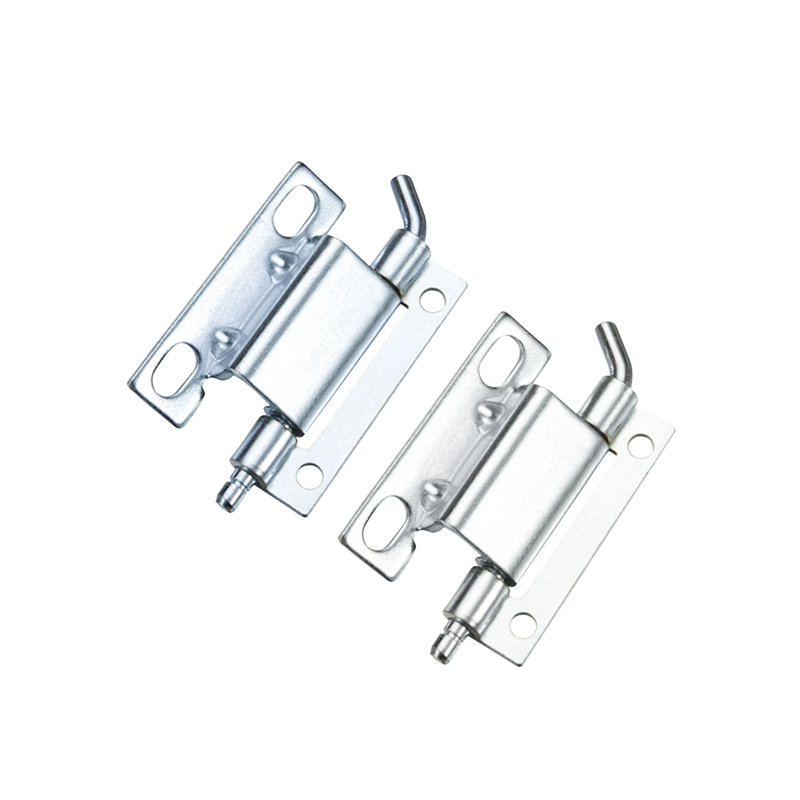
2. Concealed (Hidden) Hinges
Concealed hinges — also called hidden hinges, European hinges, or internal hinges — mount entirely inside the cabinet. When the door is closed, no hinge hardware is visible from the outside.
This isn’t just an aesthetic choice. For industrial enclosures, concealed mounting means the hinge doesn’t interrupt the gasket path around the door perimeter. That’s why concealed hinges are the default choice for IP65 and NEMA 4X enclosures.
Key Specifications
- Load capacity: 15–80 kg per hinge (depending on model and bearing type)
- Opening angle: 90°, 110°, 135°, or 180° (application-dependent)
- Adjustment: 3-axis — vertical (±2 mm), horizontal (±2 mm), depth (±3 mm)
- Materials: Zinc alloy die-cast (standard), 304 SS (outdoor), 316 SS (marine/chemical)
- Cycle life: 50,000–200,000 cycles (per ASTM E2068 testing protocol)
- Mounting: Screw-on or clip-on; typical cutout 26 mm or 35 mm diameter
When to Use Concealed Hinges
- Server racks and data center cabinets (clean lines, no snag points)
- IP65/IP67 electrical enclosures (gasket path unbroken)
- Medical equipment housings (smooth exterior for cleaning)
- Telecom cabinets and outdoor junction boxes
- Any application where tamper resistance matters (no exposed hinge pins to remove)
Hengchieh offers 43 concealed hinge models, including heavy-duty versions rated for 80 kg doors with 180° opening.
3. Piano / Continuous Hinges
A piano hinge (continuous hinge) runs the full length of the door — or the full length of the surface being joined. Unlike point-loaded butt hinges that concentrate all stress at 2–3 mounting points, a piano hinge distributes the load evenly across hundreds of millimeters.
The result: a single stainless steel piano hinge can support 100+ kg while adding minimal thickness (typically 1.2–2.0 mm leaf thickness). That makes them the go-to hinge for heavy industrial doors, long equipment covers, and lids on toolboxes and flight cases.
Key Specifications
- Load capacity: 50–150+ kg per hinge (depends on material and leaf thickness)
- Standard lengths: 300 mm, 500 mm, 1,000 mm, 1,800 mm, or cut-to-length
- Leaf thickness: 0.8 mm (light-duty) to 2.5 mm (heavy-duty)
- Pin diameter: 3.0–6.0 mm
- Materials: Cold-rolled steel, 304 SS, 316 SS, aluminum 6061
- Opening angle: Typically 270° (full rotation)
When to Use Piano Hinges
- Heavy enclosure doors (40+ kg) where butt hinges would sag
- Long equipment covers and access panels (>600 mm)
- Toolbox lids and flight case construction
- Situations where even weight distribution prevents door warping
For a deeper dive, see our complete piano hinge guide with installation specs.
Need help selecting the right hinge?
Send us your door dimensions, weight, and environment — we’ll recommend the optimal hinge type and model number within 24 hours.
Get a Recommendation4. Butt Hinges & Surface-Mounted Hinges
Butt hinges are the most fundamental hinge type: two rectangular leaves joined by a pin knuckle. One leaf mounts to the door, the other to the frame. They’re visible on the outside of the cabinet when closed.
For industrial use, surface-mounted butt hinges are the workhorse choice when aesthetics and IP sealing are not primary concerns — think internal equipment frames, non-sealed utility cabinets, and access panels inside larger enclosures.
Key Specifications
- Load capacity: 10–50 kg per hinge pair (depending on size and bearing type)
- Standard sizes: 40×40 mm, 50×50 mm, 60×60 mm, 80×80 mm, 100×100 mm
- Leaf thickness: 1.0–3.0 mm
- Materials: Zinc alloy, cold-rolled steel, 304 SS, 316 SS
- Bearing options: Plain (friction), ball bearing (for heavy/frequent use)
- Opening angle: 90°, 120°, 180°, or 270°
Surface-Mounted vs Mortise Butt Hinges
In residential cabinetry, butt hinges are typically mortised (recessed into the wood). In industrial metalwork, they’re almost always surface-mounted — bolted or welded directly onto the panel surface. Surface mounting is faster, requires no milling, and works on thin sheet metal (0.8–2.0 mm) where mortising isn’t practical.
Hengchieh manufactures 93 surface-mounted hinge models covering zinc alloy, stainless steel, and nylon options in multiple opening angles.
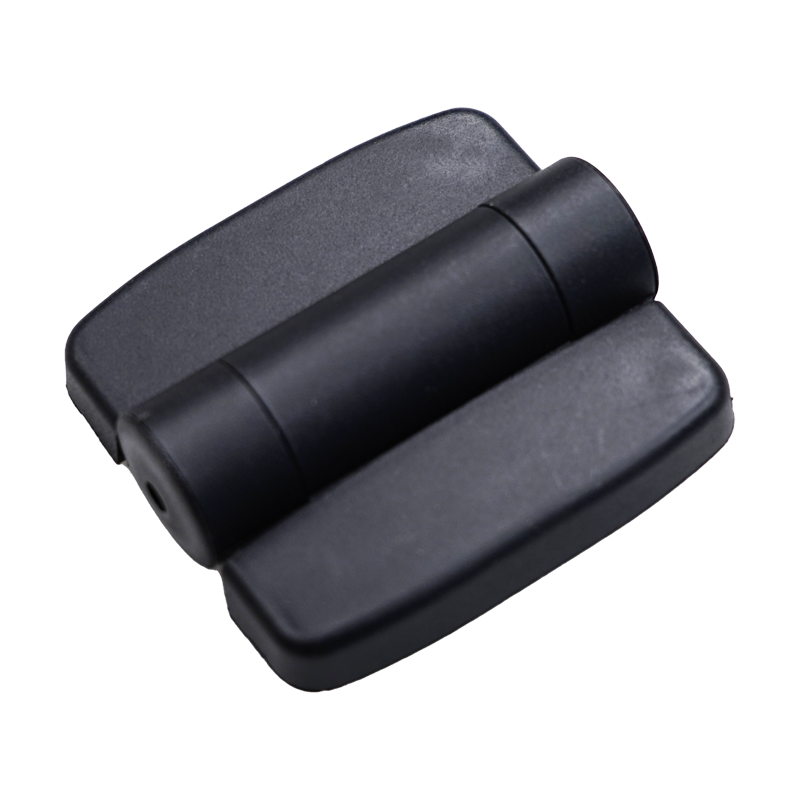
5. Specialty Hinges: Weld-On, Lift-Off, Strap, Torque & Detachable
Weld-On Hinges
Weld-on hinges are permanently attached to steel enclosures by welding — no screws, no holes in the panel. This creates the strongest possible hinge joint and is used for heavy-gauge steel doors (3.0+ mm thickness) on switchgear cabinets, transformer enclosures, and vault doors.
- Load capacity: 100–300+ kg per pair
- Materials: Carbon steel (most common), 304 SS for outdoor
- Pros: Strongest joint, no fastener holes, tamper-proof
- Cons: Permanent — cannot be repositioned after welding; requires skilled welding
Lift-Off (Flag) Hinges
Lift-off hinges allow the door to be completely removed by lifting it straight up off the hinge pin — no tools required. This is critical for electrical panels where the door must come off entirely for wiring, cable routing, or DIN rail installation.
- Load capacity: 15–60 kg per pair
- Handedness: Available in left-hand (LH) and right-hand (RH) versions
- Typical use: Electrical distribution panels, control cabinets, junction boxes
- Caution: Doors can be lifted off by anyone — not suitable where security is required
Strap / T-Hinges
Strap hinges feature a long triangular leaf that distributes mounting load across a wider area of the door surface. They’re common on heavy gates, large access panels, and industrial equipment doors where the long leaf provides additional leverage and support.
- Load capacity: 20–80 kg per pair
- Leaf length: 100–400 mm
- Best for: Heavy gates, barn-style equipment covers, large utility panels
Torque (Friction) Hinges
Torque hinges — also called friction hinges or position-control hinges — hold the door at any angle without a separate stay or prop. Internal friction elements resist movement, so the door stays wherever you leave it. This is ideal for equipment lids, display panels, and test equipment covers that need to stay open at varying angles.
- Torque range: 0.1–5.0 Nm (adjustable on some models)
- Materials: Zinc alloy body with stainless steel friction elements
- Typical use: Laptop-style equipment lids, control panel covers, POS enclosures
Detachable (Quick-Release) Hinges
Detachable hinges let you separate the door from the frame using a pin-release mechanism, spring clip, or quick-release lever. Unlike lift-off hinges (which only work vertically), detachable hinges can be released in any orientation — useful for equipment mounted at non-standard angles.
- Load capacity: 10–40 kg per pair
- Release mechanism: Spring pin, cam lever, or push-button
- Typical use: Telecom cabinets, avionics enclosures, field-serviceable equipment
6. Master Comparison Table: All 9 Hinge Types
Here’s every industrial cabinet hinge type compared side by side — load ratings, IP compatibility, price range, and best applications.
| Hinge Type | Load Rating | IP/NEMA Compatible? | Door Removable? | Price Range (FOB) | Best For |
|---|---|---|---|---|---|
| Concealed | 15–80 kg | Yes (IP65+) | No | $3–$15 | Sealed enclosures, server racks |
| Piano / Continuous | 50–150+ kg | Partial (needs gasket routing) | No | $5–$25/m | Heavy doors, long panels |
| Butt (Surface) | 10–50 kg | No (external mount) | No | $0.80–$8 | General cabinets, utility panels |
| Weld-On | 100–300+ kg | Yes (no fastener holes) | No | $1.50–$6 | Heavy steel doors, switchgear |
| Lift-Off (Flag) | 15–60 kg | Limited | Yes (lift up) | $1.50–$5 | Electrical panels, service doors |
| Strap / T-Hinge | 20–80 kg | No | No | $1–$5 | Heavy gates, large access panels |
| Spring / Self-Closing | 5–30 kg | No | No | $2–$8 | Self-closing fire doors, clean rooms |
| Torque (Friction) | 3–15 kg | No | No | $3–$12 | Laptop lids, test equipment covers |
| Detachable (Quick-Release) | 10–40 kg | Limited | Yes (any angle) | $3–$10 | Telecom cabinets, field service |
Prices are FOB China at MOQ 500+ pieces, zinc alloy standard finish. Stainless steel versions typically 2–3× above base price. Data from Hengchieh production records, 2026.
7. Material & Finish Selection Guide
The hinge type only solves half the equation. Material selection determines whether your hinge lasts 1 year or 20 years in the target environment. Here’s a comparison based on our factory testing and field data:
| Material | Salt Spray (ASTM B117) | Temp Range | Relative Cost | Best Environment |
|---|---|---|---|---|
| Zinc Alloy (Zamak 5) | 96–200 hrs (with plating) | −25 to +120°C | 1× (baseline) | Indoor, mild outdoor |
| 304 Stainless Steel | 500–700 hrs | −40 to +300°C | 2–3× | Outdoor, food processing |
| 316 Stainless Steel | 1,000+ hrs | −40 to +300°C | 3–4× | Marine, chemical, coastal |
| Cold-Rolled Steel + Zinc Plate | 48–96 hrs | −20 to +150°C | 0.7× | Indoor only, economy |
| Nylon / Engineered Plastic | N/A (non-metallic) | −20 to +80°C | 0.5–1× | Non-conductive, lightweight |
Salt spray hours per ASTM B117 standard. Temperature ranges for continuous operation. Cost multipliers relative to zinc alloy baseline.
Surface Finishes
Common finishes for industrial hinges and their protective performance:
- Bright chrome — decorative, 24–48 hr salt spray, indoor use only
- Satin chrome — fingerprint-resistant, 48–96 hr salt spray
- Black powder coating — 200–500 hr salt spray, excellent UV resistance, most popular for outdoor
- Zinc plating (clear) — 96–200 hr salt spray, lowest cost protective finish
- Brushed stainless — no coating needed, best long-term corrosion performance
8. NEMA / IP Rating Compatibility
This is where most hinge selection guides fall short — they don’t tell you which hinge types actually work with sealed enclosures. Here’s the reality from our engineering team:
| NEMA / IP Rating | Recommended Hinge Type | Why |
|---|---|---|
| NEMA 1 / IP20 | Any type | Indoor only, no sealing requirement |
| NEMA 3R / IP44 | Concealed or weld-on | Rain-proof; external hinges create drip paths |
| NEMA 4 / IP65 | Concealed (preferred) or internal piano | Dust-tight + water jets; gasket path must be unbroken |
| NEMA 4X / IP66 | 316 SS concealed only | Corrosion-resistant + sealed; 316 SS required for 4X |
| IP67 | 316 SS concealed with compression latch | Temporary immersion; requires 20–30% gasket compression |
Key insight from our factory: The hinge alone doesn’t determine the IP rating — it’s the hinge + latch + gasket system working together. We always recommend pairing concealed hinges with compression latches for IP65+ applications. The compression latch provides the 3–7 N/cm gasket force that keeps the seal tight.
9. How to Choose the Right Hinge — Decision Flowchart
Walk through these four questions in order:
Question 1: Does the enclosure need an IP or NEMA rating?
- Yes (IP54+) → Start with concealed hinges. They don’t break the gasket path.
- No → Move to Question 2.
Question 2: How heavy is the door?
- Under 25 kg → Standard butt or concealed hinges (2 per door)
- 25–50 kg → Heavy-duty concealed or butt hinges (3 per door)
- 50–100 kg → Piano hinge or 4+ heavy-duty concealed
- Over 100 kg → Weld-on hinges
Question 3: Does the door need to be removable?
- Yes, frequently (daily) → Detachable / quick-release hinges
- Yes, occasionally (for maintenance) → Lift-off (flag) hinges
- No → Fixed hinge is fine
Question 4: What’s the environment?
- Indoor, climate-controlled → Zinc alloy is sufficient
- Outdoor, rain/sun exposure → 304 SS or powder-coated zinc alloy
- Marine, coastal, chemical → 316 SS only
- High-temperature (>120°C) → Stainless steel (zinc alloy softens above 120°C)
10. Frequently Asked Questions
What type of hinge is best for heavy industrial cabinet doors?
For doors weighing 30–80 kg, continuous (piano) hinges are the strongest option because they distribute load across the entire door height. A single stainless steel piano hinge can support 100+ kg. For doors over 80 kg, use heavy-duty concealed hinges with ball bearings (rated 60+ kg per hinge) plus a third hinge point. Weld-on hinges are strongest for permanent installations — a 100 mm weld-on hinge in 304 SS can handle 200+ kg per pair.
What is the difference between concealed hinges and surface-mounted hinges?
Surface-mounted hinges are visible on the outside of the cabinet and install with exposed screws. Concealed (hidden) hinges mount inside the cabinet and are completely invisible when the door is closed. Concealed hinges offer 3-axis adjustment and a cleaner aesthetic, making them preferred for server racks, medical equipment, and any enclosure where a flush exterior or IP rating matters. We manufacture 43 concealed models and 93 surface-mounted models.
Which hinge material should I use for outdoor or NEMA 4X enclosures?
304 stainless steel is the standard for outdoor and NEMA 3R/4 enclosures. For marine, coastal, or chemical wash-down environments (NEMA 4X), use 316 stainless steel which contains 2–3% molybdenum for superior salt-spray resistance (1,000+ hours per ASTM B117). Zinc alloy with powder coating is a cost-effective alternative for moderate outdoor use.
How many hinges do I need per industrial cabinet door?
2 hinges for doors under 1 m tall and under 25 kg. 3 hinges for doors 1–2 m tall or 25–40 kg. 4+ hinges for doors over 2 m or over 40 kg. For industrial enclosures, add one extra hinge per 15 kg of door weight beyond 30 kg. Using continuous (piano) hinges eliminates this calculation since the hinge spans the full door height.
Can industrial hinges maintain an IP65 seal on enclosures?
Yes, but the hinge type matters. Concealed hinges are best for sealed enclosures because they mount inside the cabinet, leaving no external holes that compromise the IP rating. External hinges require gasket routing around the hinge knuckle. For IP65+ enclosures, pair concealed hinges with compression latches that provide the 3–7 N/cm gasket compression force needed for reliable sealing.
What is a lift-off hinge and when should I use one?
A lift-off (flag) hinge allows the door to be completely removed by lifting it upward — no tools needed. Use them on electrical panels, control cabinets, and any enclosure requiring frequent full-door removal for maintenance or wiring access. Standard load ratings range from 15–50 kg per hinge pair.
What is the price range for industrial cabinet hinges?
Zinc alloy butt hinges: $0.80–$2.50 each. Stainless steel surface hinges: $2.00–$8.00. Concealed hinges: $3.00–$15.00 depending on load rating. Piano hinges: $5.00–$25.00 per meter. Weld-on hinges: $1.50–$6.00. These are FOB China prices at MOQ 500+ pieces. Custom dimensions or certifications may add 15–30%.
Related Guides
Need Industrial Hinges? Get a Factory-Direct Quote
Hengchieh manufactures 136 hinge models in zinc alloy, 304 SS, and 316 SS. Custom dimensions, finishes, and keyed-alike configurations available. MOQ from 500 pieces.