
Engineering Guide
Draw & Toggle Latches: Types & Load Ratings
Toggle latch engineering guide: over-center mechanism explained, pull-down vs push-down, adjustable vs fixed, spring-loaded types, vibration test data (10-50 Hz, 1-5g). Load ratings up to 5,000 N. 21 models from a 35-year manufacturer.
Quick Answer
Draw latches pull two surfaces together under tension. Toggle latches use an over-center mechanism that self-locks against vibration. For vibrating equipment: use over-center toggle latches with 3–4× safety factor. For sealed enclosures: use adjustable draw latches to fine-tune gasket compression. For flight cases and toolboxes: standard hook-and-loop draw latches at 100–300 N rating. For heavy machinery covers: spring-loaded toggle latches rated 500+ N. Skip to the comparison table.
1. What Are Draw Latches & Toggle Latches?
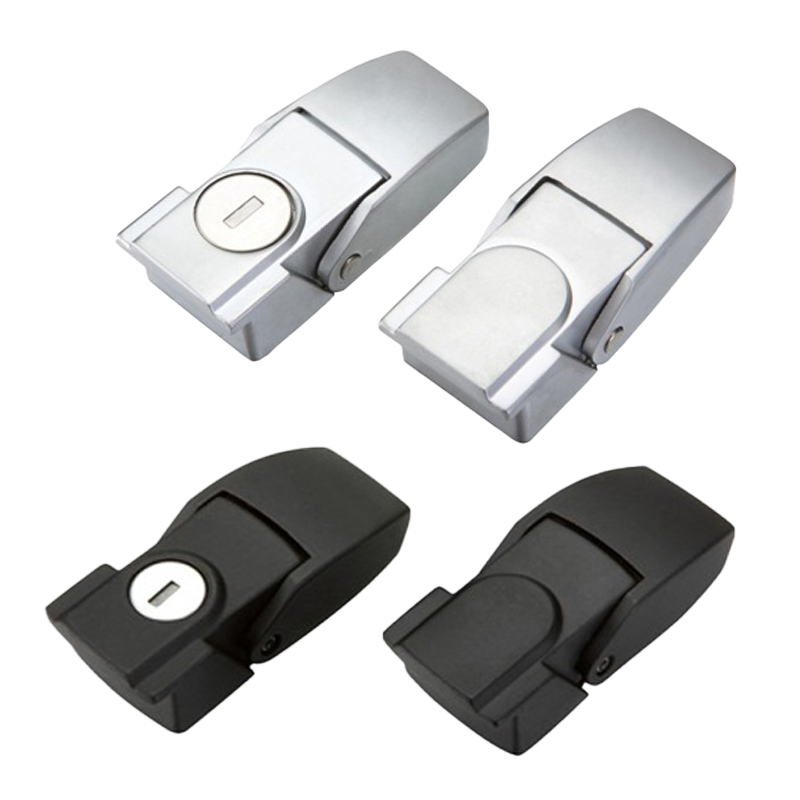
A draw latch (also called a draw catch or draw-pull latch) is a two-piece fastening mechanism that creates tension between two surfaces. One piece — the latch body — mounts to the door, lid, or panel. The other piece — the keeper (also called a catch or strike) — mounts to the frame. When the lever is closed, the hook engages the keeper and pulls the two surfaces together, compressing any gasket or seal in between.
A toggle latch is a specific type of draw latch that uses an over-center mechanism. The lever passes through a geometric dead point during closing, creating a self-locking effect that resists vibration, shock, and accidental opening. This is why toggle latches are the standard choice for mobile equipment, vehicles, and vibrating machinery.
Key terminology:
- Draw — the pull-up distance; how far the latch pulls the two surfaces together (typically 5–15 mm)
- Clamping force — the tension created when the latch is closed (measured in Newtons or kg-force)
- Over-center — the point where the lever geometry locks the mechanism against opening
- Keeper / Strike — the mating piece that the hook engages
Hengchieh manufactures 21 toggle latch and draw latch models in zinc alloy and stainless steel, covering over-center, adjustable, spring-loaded, and lockable configurations.
2. How the Over-Center Mechanism Works
The over-center mechanism is what separates a toggle latch from a simple hook closure. Understanding it helps you specify the right latch for vibration-prone applications.
Phase 1 — Open position: The lever is raised, and the hook hangs free above the keeper. No tension on the system.
Phase 2 — Engagement: The operator pushes the lever down. The hook catches the keeper and begins to draw the two surfaces together. Tension builds in the linkage.
Phase 3 — Dead center: The lever passes through the geometric dead point where the pivot axis of the lever, the attachment point on the base, and the hook engagement point are all in line. At this instant, the clamping force peaks and the mechanism is in an unstable equilibrium.
Phase 4 — Over-center lock: The lever moves past the dead point and drops below the centerline. Now the geometry works against opening. Any external force trying to lift the lever would first have to push it back over center — which requires deliberate, directed force. Vibration cannot generate this directed force, so the latch stays locked.
Manufacturer insight: We test our toggle latches on a vibration table at 10–50 Hz, 1–5g acceleration for 1 hour. Over-center latches consistently hold. Non-over-center hook latches pop open within minutes at 2g. If your application vibrates, over-center is non-negotiable.
3. 7 Types of Draw & Toggle Latches
Type 1: Over-Center Toggle Latch (Standard)
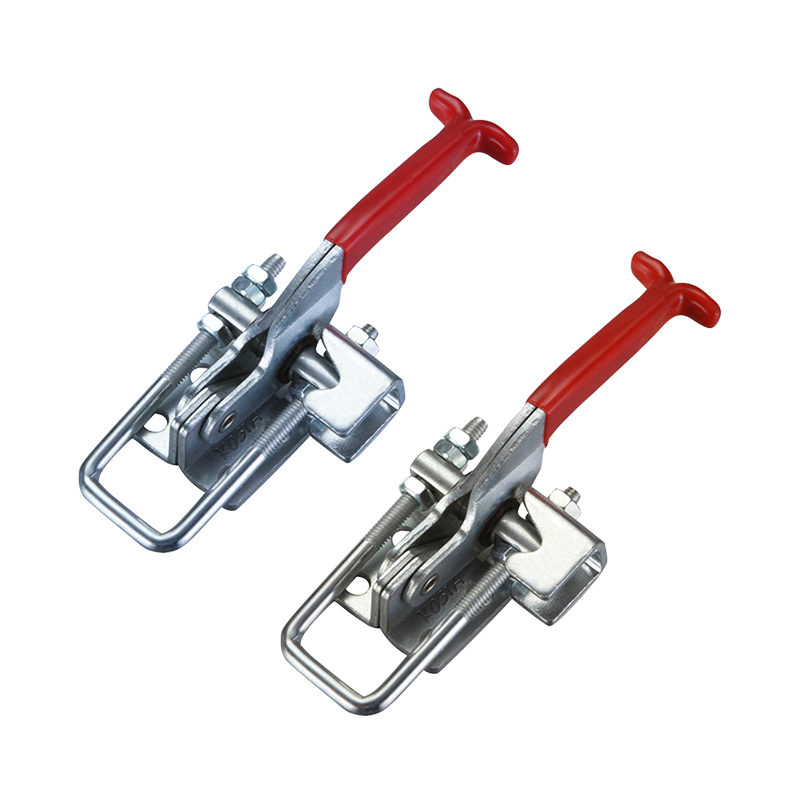
The most common type. A lever pivots on a base, driving a hook into a keeper. The over-center geometry self-locks the mechanism. Available in pull-down (hook pulls toward base) and push-down (lever pushes catch downward) configurations.
- Clamping force: 100–2,000 N depending on size
- Draw (pull-up): 5–15 mm
- Typical use: Flight cases, toolboxes, equipment covers, industrial enclosures
Type 2: Adjustable Draw Latch
Features a threaded hook or turnbuckle that allows the draw distance and clamping force to be adjusted after installation. Turn the hook clockwise to increase tension, counterclockwise to decrease. This is essential for gasket applications where compression needs fine-tuning.
- Adjustment range: Typically 5–10 mm of thread travel
- Clamping force: 100–1,500 N (adjustable)
- Typical use: Sealed enclosures, enclosures with gaskets, welded cabinets with manufacturing tolerances
Need help sizing a draw latch?
Send us your enclosure dimensions, gasket type, and environment — we’ll calculate the required clamping force and recommend specific models within 24 hours.
Get a RecommendationType 3: Spring-Loaded Toggle Latch
Incorporates an internal or external spring that maintains constant tension on the hook, even as the door/panel vibrates or the gasket relaxes over time. The spring compensates for thermal expansion, gasket creep, and manufacturing tolerances.
- Spring force: 20–80 N constant tension
- Clamping force: 200–1,000 N
- Typical use: HVAC panels, engine covers, vibrating machinery, outdoor enclosures
Type 4: Concealed Draw Latch
Mounts behind the panel surface — no visible hardware on the exterior. Operated by pushing or pulling a hidden lever or using a tool (screwdriver, hex key) through a small access hole. Provides both clean aesthetics and tamper resistance.
- Clamping force: 50–500 N
- Typical use: Medical equipment, retail displays, secure enclosures, architectural panels
Type 5: Hook & Loop Draw Latch
The simplest draw latch design: a hook on the lid engages a loop (or bail) on the body. No over-center mechanism — the hook simply drops into the loop. Requires a separate padlock or clip to prevent accidental opening.
- Clamping force: Low (gravity-dependent)
- Typical use: Chest-style toolboxes, storage trunks, basic enclosure covers
Type 6: Rotary Draw Latch
Uses a rotating cam or lever mechanism instead of the traditional toggle linkage. A quarter-turn of the handle engages or disengages the latch. More compact than toggle latches and works well in tight spaces.
- Clamping force: 100–800 N
- Typical use: Automotive panels, avionics enclosures, compact equipment housings
Type 7: Slide-Action (Slam) Draw Latch
Engages automatically when the door or lid slams shut — no manual lever operation required. A spring-loaded catch grabs the keeper as the door closes. To open, you lift or push a release lever. Fastest operation time of any draw latch type.
- Clamping force: 50–300 N
- Typical use: Packaging machinery, conveyor covers, high-frequency access panels
4. Draw Latch Comparison Table
All 7 types compared side by side for clamping force, vibration resistance, and applications:
| Latch Type | Clamping Force | Vibration Safe? | Adjustable? | Lockable? | Price (FOB) |
|---|---|---|---|---|---|
| Over-Center Toggle | 100–2,000 N | Yes | No | Padlock hole | $1.50–$8 |
| Adjustable Draw | 100–1,500 N | Optional | Yes (5–10 mm) | Padlock hole | $2–$10 |
| Spring-Loaded | 200–1,000 N | Yes | Self-compensating | Some models | $3–$12 |
| Concealed | 50–500 N | Varies | Some models | Tool-actuated | $3–$15 |
| Hook & Loop | Low (gravity) | No | No | Padlock hasp | $0.50–$3 |
| Rotary | 100–800 N | Yes (with detent) | No | Some models | $2–$10 |
| Slide-Action (Slam) | 50–300 N | Limited | No | Release lever | $2–$8 |
Prices FOB China, MOQ 500+. Clamping forces are typical ranges — exact ratings vary by model and size. Data from Hengchieh production catalog, 2026.
5. Load Ratings & Sizing Calculations
This is where most selection mistakes happen. Engineers either over-spec (wasting money) or under-spec (causing failures). Here’s the calculation method we recommend to our OEM customers:
Step 1: Calculate Total Required Clamping Force
For gasket applications: Total force = gasket perimeter (mm) × gasket compression force per mm (N/mm). Standard EPDM gaskets require 0.3–0.7 N per mm of gasket length for 20–25% compression.
For non-gasket applications (toolbox lids, flight cases): Total force = weight of lid/door × g-force factor. For stationary equipment: 1.5× door weight. For mobile/vehicle-mounted: 3–5× door weight.
Step 2: Divide by Number of Latches
Per-latch force = total force ÷ number of latches. Space latches evenly around the perimeter of the door/lid.
Step 3: Apply Safety Factor
| Application | Safety Factor | Why |
|---|---|---|
| Stationary indoor equipment | 1.5× | Minimal dynamic loads |
| Stationary outdoor equipment | 2× | Wind, thermal expansion |
| Vehicle-mounted equipment | 3× | Road vibration, shock loads |
| Vibrating machinery | 3–4× | Continuous dynamic loading |
| Pressure vessels / vacuum | 4× | Internal pressure adds to load |
Worked Example
Application: Outdoor HVAC equipment cover, 600 mm × 400 mm, EPDM gasket, 4 draw latches, stationary outdoor.
- Gasket perimeter: 2 × (600 + 400) = 2,000 mm
- Compression force: 2,000 mm × 0.5 N/mm = 1,000 N total
- Per latch: 1,000 ÷ 4 = 250 N
- Safety factor (outdoor): 2× → 500 N per latch minimum
- Selection: Choose toggle latches rated ≥500 N each
6. Materials & Corrosion Resistance
| Material | Salt Spray (ASTM B117) | Strength | Relative Cost | Best Environment |
|---|---|---|---|---|
| Cold-Rolled Steel + Zinc Plate | 48–96 hrs | High | 1× (baseline) | Indoor only |
| Zinc Alloy Die-Cast | 96–200 hrs | Medium–High | 1.2× | Indoor, mild outdoor |
| 304 Stainless Steel | 500–700 hrs | High | 2.5–3× | Outdoor, food, pharma |
| 316 Stainless Steel | 1,000+ hrs | High | 3.5–4× | Marine, chemical |
| Glass-Filled Nylon | N/A (non-metallic) | Medium | 0.8× | Non-conductive, lightweight |
Salt spray hours per ASTM B117. Cost multipliers relative to zinc-plated steel baseline. Data from Hengchieh quality lab, 2026.
For food processing and pharmaceutical applications, all-stainless-steel construction (body + hook + keeper + fasteners) is typically required to meet FDA 21 CFR and USDA guidelines. Zinc alloy or plated steel is not accepted in direct food contact zones.
7. Vibration Resistance & Safety Features
Vibration is the number one failure mode for draw latches in industrial applications. A standard hook latch on a vibrating machine will pop open within minutes. Here’s how to prevent it:
Anti-Vibration Features (in order of effectiveness)
- Over-center mechanism — Self-locks past dead point; vibration cannot generate the directed force needed to reverse. Most effective, recommended for all vibrating applications.
- Spring-loaded tension — Constant spring force maintains clamping even as components settle or gaskets relax.
- Locking lever — A secondary safety catch or padlock prevents the lever from lifting even if the over-center mechanism weakens.
- Rubber-dampened keeper — Absorbs shock loads and reduces noise; extends latch fatigue life by 2–3×.
Testing standard: Our factory tests vibration resistance per IEC 60068-2-6 (sinusoidal vibration) at 10–150 Hz, 0.5–5g acceleration, 1 hour per axis (X, Y, Z). Over-center toggle latches pass consistently at 5g. Standard hook latches fail above 2g.
Safety Latch Features
- Padlock hole: Most toggle latches include a hole in the lever for a padlock to prevent unauthorized opening
- Safety catch: A secondary lever that must be released before the main lever can be lifted
- Key-locking: Integrated cylinder lock in the latch body (no padlock needed)
- Anti-rattle spring: Keeps the lever tight against the body, eliminating noise in vibrating environments
8. Industrial Applications Matrix
| Application | Recommended Type | Min. Force Rating | Material | Special Requirements |
|---|---|---|---|---|
| Flight case / road case | Over-center toggle | 200 N | Zinc alloy or steel | Padlock hole |
| Toolbox / equipment case | Standard draw latch | 100–300 N | Zinc alloy | Rubber grip |
| HVAC equipment cover | Adjustable + spring | 500 N | 304 SS | Gasket compression |
| Vehicle-mounted enclosure | Over-center toggle | 500–1,000 N | 304 SS | Safety catch, anti-rattle |
| Vibrating machine guard | Spring-loaded toggle | 800–2,000 N | Steel or 304 SS | Over-center, 4× safety |
| Food processing panel | Adjustable draw | 300–500 N | 316 SS | FDA-compliant, all-SS |
| Medical equipment cover | Concealed draw | 100–300 N | 304 SS or nylon | Clean aesthetics, tamper |
| Packaging / conveyor cover | Slam-action | 100–200 N | Zinc alloy | Quick-release, high cycle |
9. Adjustable vs Non-Adjustable: When to Use Each
This is one of the most frequent questions we get from OEM customers. Here’s the decision framework:
Use Adjustable Draw Latches When:
- Gasket compression needs tuning — Different gasket materials compress differently; adjustability lets you dial in the exact force
- Manufacturing tolerances vary — Welded enclosures have ±1–2 mm tolerance; adjustable latches compensate
- Gasket aging is a concern — EPDM rubber loses 10–15% of its height over 5+ years; adjustable latches can be tightened to maintain seal
- Multiple latch points — On large enclosures with 6+ latches, some will need more tension than others due to panel flex
Use Non-Adjustable (Fixed) Draw Latches When:
- CNC-machined parts ensure consistent gap — Precision manufacturing eliminates the tolerance issue
- Cost is the primary driver — Non-adjustable latches are 20–30% cheaper
- Operator tampering is a risk — If you don’t want field technicians changing the tension setting, use fixed latches
- High-volume consumer products — Simpler assembly, no calibration step in production
Manufacturer recommendation: For most industrial enclosures, we default to adjustable draw latches. The extra $1–$2 per latch saves hours of field troubleshooting when gaskets don’t seat perfectly on first assembly.
10. Frequently Asked Questions
What is the difference between a draw latch and a toggle latch?
A draw latch is any latch that pulls two surfaces together under tension. A toggle latch specifically uses an over-center mechanism where the lever passes through a dead point to self-lock. All toggle latches are draw latches, but not all draw latches use the over-center toggle mechanism. In industrial catalogs, the terms are often used interchangeably. Read our toggle latch guide for a deeper comparison.
How do I calculate the draw latch clamping force I need?
Three steps: (1) Calculate gasket force = gasket perimeter × 0.3–0.7 N/mm for EPDM. (2) Divide by number of latches. (3) Apply safety factor (1.5× indoor, 2× outdoor, 3–4× vibrating). Example: a 600×400 mm enclosure with 4 latches needs ≥500 N per latch for outdoor use.
What is an over-center toggle latch?
An over-center toggle latch passes through a geometric dead point when closing, creating a self-locking effect. Vibration cannot open it because the force would need to push the lever back over center — requiring deliberate, directed input. Essential for vehicles, vibrating machinery, and any application where accidental opening is dangerous.
What materials are draw latches available in?
Common options: zinc-plated steel (indoor, economy), zinc alloy die-cast (standard industrial), 304 SS (outdoor, food), 316 SS (marine, chemical), and glass-filled nylon (non-conductive). See our material comparison guide for detailed specs.
Can draw latches be locked?
Yes. Most toggle latches include a padlock hole. Some models have integrated key locks. Concealed draw latches can require a specific tool to operate, providing tamper resistance without a separate lock.
How do I choose between adjustable and non-adjustable draw latches?
Use adjustable when gasket compression needs tuning, manufacturing tolerances vary, or gaskets will age. Use non-adjustable when parts are precision-machined, cost is the priority, or you want to prevent operator tampering.
What load rating do I need for a draw latch on vibrating machinery?
Apply a 3–4× safety factor instead of the standard 2×. Always use over-center toggle latches — non-over-center latches pop open above 2g vibration. A typical vibrating machine cover with 4 latches should use latches rated ≥200 N each minimum (after safety factor, ≥600–800 N specified).
Related Guides
- Toggle Latches & Draw Latches: Complete Industrial Selection Guide
- Draw Latches: Types, Sizing & Selection Guide
- Compression Latches: Types, IP Ratings & How to Choose
- Zinc Alloy vs Stainless Steel Lock Guide
- NEMA Enclosure Types Guide
- IP65 Waterproof Enclosure Lock Guide
- Draw Latch & Toggle Latch Manufacturer — 21 Models, OEM Available
Need Draw Latches or Toggle Latches? Get a Factory-Direct Quote
Hengchieh manufactures 21 toggle latch and draw latch models in zinc alloy, 304 SS, and 316 SS. Over-center, adjustable, spring-loaded, and lockable configurations available. MOQ from 500 pieces.