
Selection Guide
Paddle Latches: NEMA 4X Ratings & Install
Paddle latches buying guide: 6 types with NEMA 4, 4X, 12 & 13 compliance data. Flush paddle vs folding T-handle vs compression paddle. Material chart, cutout sizes, step-by-step installation. 19 models from IATF 16949 manufacturer →
Quick Answer
A paddle latch is a flush-mount handle-and-latch mechanism for industrial enclosures, truck toolboxes, and equipment cabinets. Choose zinc alloy with chrome plating for indoor NEMA 1/12 applications, 304 stainless steel for outdoor NEMA 3R/4, and 316 stainless steel for NEMA 4X (marine/chemical). Standard cutout: 92×42 mm. Typical FOB price: $2.50–$12.00 per unit depending on material and keying. MOQ: 100–500 pieces.
What Is a Paddle Latch?
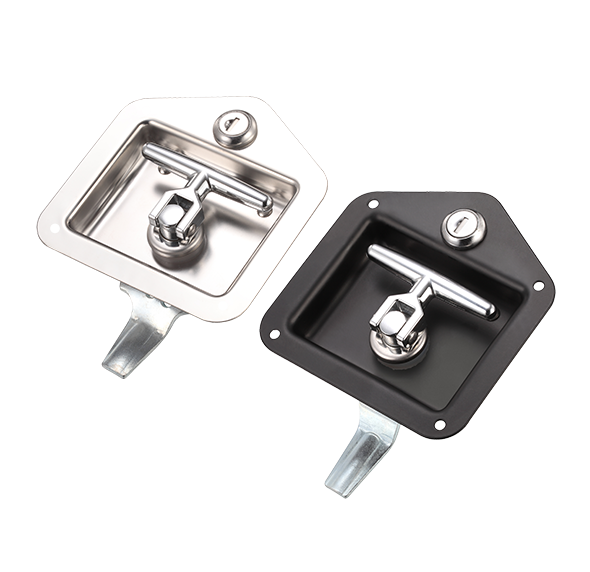
A paddle latch (also called a flush latch, recessed latch, or slam latch) is a latching mechanism where the handle sits recessed into the door surface, creating a smooth, snag-free profile. When not in use, the paddle folds flat — flush with the door panel. When you need to open the door, you pull the paddle out and rotate it to release the cam or tongue from the striker on the frame.
This flush-mount design solves three problems that protruding handles create:
- Anti-snag: No protruding handle to catch on clothing, cables, or equipment moving past the cabinet. Critical in manufacturing environments per OSHA 29 CFR 1910.303
- Anti-vandal: Harder to pry open than protruding handles. Many paddle latches accept padlocks for additional security
- Debris resistance: No handle cavity to collect dust, water, or ice. Important for outdoor and food processing environments
Paddle latches are used across dozens of industries — from electrical enclosures and server racks to truck toolboxes, RV compartments, HVAC access panels, and vending machines. The global industrial latch market is valued at approximately $1.8 billion (2025), with paddle latches representing the fastest-growing segment driven by demand for flush-mount aesthetics in modern enclosure design.
Types of Paddle Latches
Paddle latches come in several variations, each suited to different applications. Here is a comprehensive breakdown:
| Type | Handle Style | Locking | Best For | Hengchieh Models |
|---|---|---|---|---|
| Standard Flush Paddle | Flat rectangular | Key or keyless | Electrical panels, server racks | MS858, MS858A |
| Folding T-Handle Paddle | T-shaped, folds flat | Key cylinder | Heavy enclosure doors, HVAC | L848 |
| Push-to-Close (Slam) | Flat, spring-loaded | Auto-latch | Truck toolboxes, RV hatches | MS866-3 |
| Compression Paddle | Flush with cam | Key + compression | NEMA 4X sealed enclosures | MS858B |
| Combination Lock Paddle | Flush with dial | 3-digit combo | Fleet toolboxes (keyless entry) | L848 Combo |
| Quarter-Turn Paddle | Flush with thumb turn | Tool-free | Access panels, vending | MS858D |
The choice between types depends primarily on your security requirement (keyed vs keyless), sealing requirement (NEMA rating), and operating convenience (one-hand operation, gloved use, frequency of access).
NEMA & IP Ratings for Paddle Latches
The paddle latch is a critical component in achieving your enclosure's NEMA or IP rating. An expensive NEMA 4X enclosure with a poorly sealed latch is just an expensive box with a leak. Here is how paddle latch design maps to enclosure ratings:
| NEMA Rating | IP Equivalent | Protection Level | Paddle Latch Requirements | Typical Price Impact |
|---|---|---|---|---|
| NEMA 1 | IP20 | Indoor, basic dust | No gasket needed, any material | Base price |
| NEMA 12 | IP54 | Industrial dust/drip | Neoprene gasket, zinc alloy OK | +10-15% |
| NEMA 3R | IP24 | Outdoor rain | EPDM gasket, drain provisions | +15-20% |
| NEMA 4 | IP66 | Watertight, hosedown | EPDM/silicone gasket, compression design, 304 SS | +30-50% |
| NEMA 4X | IP66 + corrosion | Watertight + salt spray | Silicone gasket, 316 SS, 500hr salt spray per ASTM B117 | +60-100% |
Gasket compression is the key. For NEMA 4/4X sealing, the paddle latch must compress the door gasket by 20-30% of its free height. This means the latch needs to pull the door 1.5-3.0 mm toward the frame during the locking action. Standard paddle latches with flat cams provide minimal compression (suitable for NEMA 1/12). For NEMA 4+, specify paddle latches with compression cams or consider a dedicated compression latch.
At Hengchieh, we test all NEMA-rated paddle latches in our in-house environmental chamber: 48-hour salt spray test per ASTM B117 for NEMA 4X, and hose-down test per IEC 60529 for IP66 verification.
Material & Finish Comparison
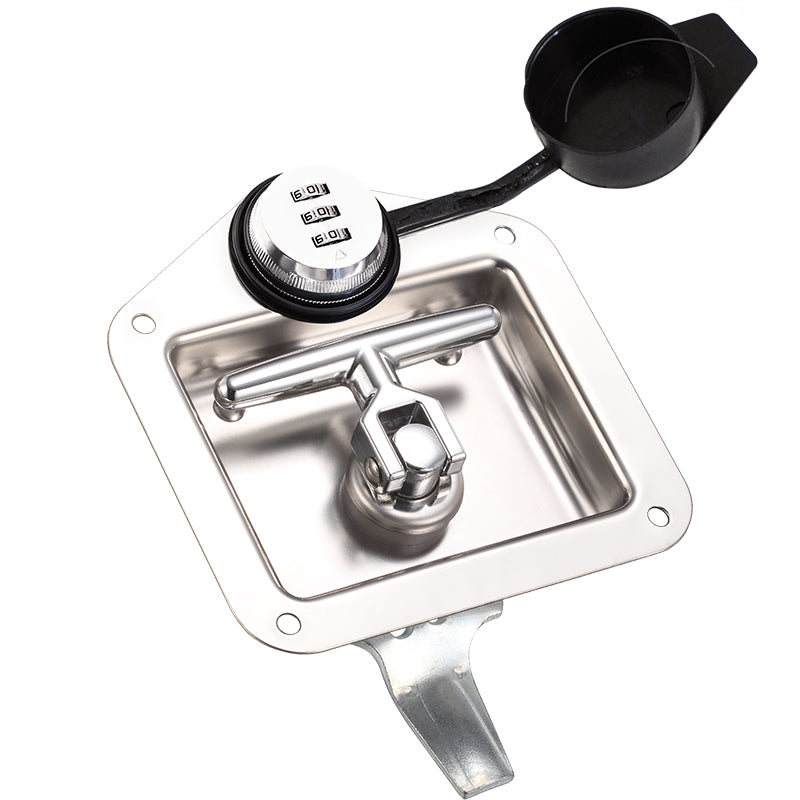
Material selection is the single biggest factor in paddle latch performance, lifespan, and cost. Here is a detailed comparison based on our 35+ years of manufacturing experience:
| Material | Tensile Strength | Salt Spray (hours) | Temperature Range | FOB Price Range | Best Application |
|---|---|---|---|---|---|
| Zinc Alloy (Zamak 3) | 283 MPa | 48-96h (chrome) | -25°C to +120°C | $2.50-$5.00 | Indoor cabinets, NEMA 1/12 |
| 304 Stainless Steel | 515 MPa | 200-500h | -60°C to +300°C | $5.00-$9.00 | Outdoor, food processing |
| 316 Stainless Steel | 485 MPa | 500-1000h | -60°C to +300°C | $8.00-$14.00 | Marine, chemical, NEMA 4X |
| ABS / PA66 (Nylon) | 40-80 MPa | N/A (non-metallic) | -20°C to +80°C | $1.50-$3.50 | Electrical isolation, lightweight |
| Mild Steel (powder coated) | 400 MPa | 24-48h | -30°C to +200°C | $2.00-$4.00 | Budget indoor, temporary |
Our recommendation: Start with zinc alloy (Zamak 3) die-cast for 80% of indoor applications — it offers the best balance of cost, aesthetics, and mechanical performance. Step up to 304 SS when the latch will be exposed to weather, wash-down, or food contact. Reserve 316 SS for marine, coastal, and chemical environments where salt spray resistance is non-negotiable.
Hengchieh manufactures paddle latches through high-pressure zinc alloy die casting in our own foundry, giving us full control over material quality and dimensional accuracy (tolerance ±0.05 mm).
Keying & Security Options
Security is a primary reason engineers specify paddle latches over simple latches. Here are the keying configurations available:
- Keyed-Alike (KA): All latches open with the same key number. Ideal for truck fleets (driver carries one key for all toolbox compartments) and multi-cabinet installations. Hengchieh maintains key number records across batches — order KA latches 6 months apart and they will still match.
- Keyed-Different (KD): Each latch has a unique key. Standard for individual security applications.
- Master-Keyed (MK): Each latch has its own key, plus a master key opens all. Used in data centers and telecom where technicians need individual accountability but supervisors need universal access.
- Padlock Provision: A hasp or hole that accepts a standard padlock (typically 6-8 mm shackle). Used for LOTO (lockout-tagout) compliance per OSHA 29 CFR 1910.147. Can be combined with key locking for dual security.
- Tool-Operated: Requires a specific tool (triangle, square, pentagon, double-bit) instead of a standard key. Used for utility enclosures where only authorized personnel carry the tool. Common tool types: 7mm triangle, 8mm square, 5mm double-bit.
- Combination Lock: 3-digit or 4-digit mechanical combination. No key to lose, resettable. Popular for fleet and rental applications.
Need help choosing the right security configuration? Contact our engineering team — we configure keying systems for multi-site deployments with 1,000+ latches.
Paddle Latch vs Compression Latch vs T-Handle: When to Use Each
This is the most common question we get from enclosure designers. Here is a clear decision framework:
| Feature | Paddle Latch | Compression Latch | T-Handle |
|---|---|---|---|
| Profile | Flush (0-3 mm proud) | Flush to semi-flush | Protrudes 15-40 mm |
| Gasket compression | Minimal (0-1.5 mm) | Strong (1.5-4 mm) | None |
| Max NEMA rating | NEMA 4 (with compression cam) | NEMA 4X / IP67 | NEMA 1 |
| One-hand operation | Yes | Yes | Yes |
| Gloved operation | Moderate | Good | Excellent |
| Aesthetics | Excellent (flush) | Good | Fair (protrudes) |
| Anti-snag | Excellent | Good | Poor |
| Typical price (FOB) | $2.50-$12.00 | $3.00-$15.00 | $4.00-$18.00 |
Decision rule:
- Need flush aesthetics + NEMA 1/12? → Paddle latch
- Need IP65+/NEMA 4+ sealing? → Compression latch
- Need maximum leverage for heavy doors? → T-handle
- Need flush + moderate sealing? → Compression paddle latch (hybrid design)
Installation: Cutout Sizes & Step-by-Step Guide
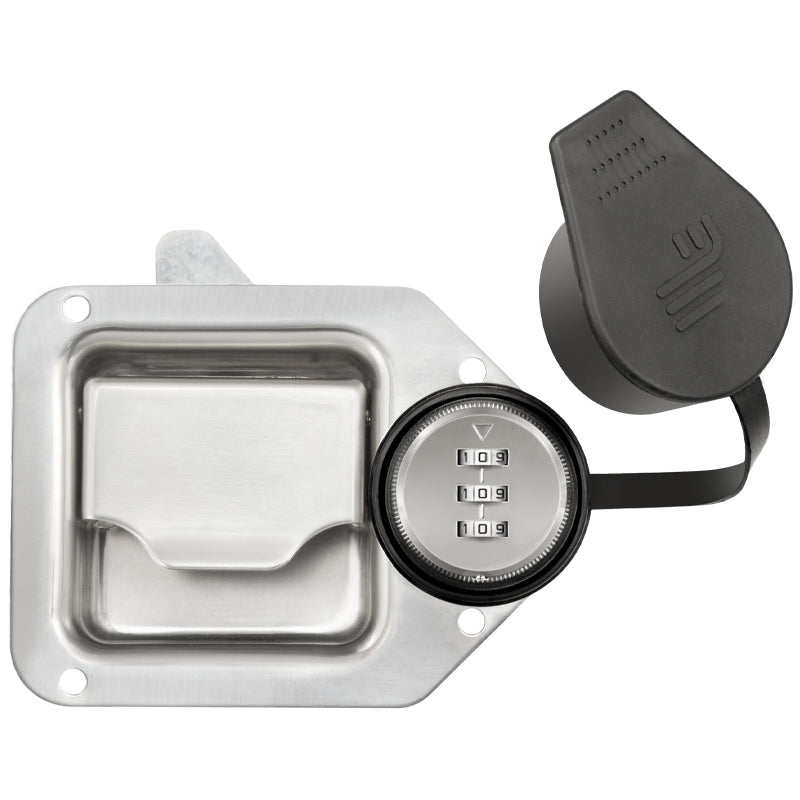
Proper installation is critical for both function and sealing. Here are the standard cutout dimensions for common paddle latch sizes:
| Size Class | Cutout (W x H) | Panel Thickness | Grip Range | Typical Models |
|---|---|---|---|---|
| Compact | 64 x 32 mm | 0.8-2.5 mm | 1-15 mm | MS866-4 |
| Standard | 92 x 42 mm | 1.0-3.0 mm | 1-22 mm | MS858, MS858A |
| Large | 120 x 92 mm | 1.0-3.0 mm | 1-25 mm | L848, L858 |
| Extra Large | 142 x 108 mm | 1.5-4.0 mm | 1-30 mm | Custom |
Installation Steps
- Mark the cutout: Center the DXF template on the door panel. Use a center punch to mark corner positions. Ensure the cutout is oriented correctly (handle opening direction matters for ergonomics).
- Cut the opening: For sheet metal (1-3 mm), use a CNC punch or jigsaw with metal-cutting blade. For thicker panels (3-6 mm), use a milling machine. Dimensional tolerance: ±0.5 mm for NEMA 1/12, ±0.3 mm for NEMA 4/4X (gasket sealing requires tighter tolerance).
- Deburr: Remove all burrs and sharp edges. For NEMA 4+ applications, apply a light radius (R0.5 mm) to prevent gasket damage.
- Insert the latch: Push the paddle latch body through the cutout from the front (exterior) side of the door.
- Secure from the back: Thread on the retaining nut or tighten the mounting screws. Torque to manufacturer specification (typically 2-4 Nm for zinc alloy, 4-8 Nm for stainless steel). Over-torquing can crack zinc alloy castings.
- Position the striker: Mount the striker plate on the frame at the correct height. The cam/tongue should engage the striker with 2-4 mm of overlap for reliable latching. Adjust the striker position for proper door compression if a gasket is used.
- Test: Operate the latch 50+ times, checking for smooth action, complete engagement, and proper door closure. For keyed models, test with both key and emergency release (if equipped).
Hengchieh provides: DXF and STEP files for all cutout dimensions, installation instructions in English/Chinese/Spanish, and video guides for complex installations. Request cutout files for any model.
Application Guide by Industry
Electrical Enclosures & Control Panels
The largest application segment for paddle latches. Electrical enclosure manufacturers need flush latches that meet NEMA 12 or NEMA 4 ratings while providing LOTO capability per OSHA. Key requirements: UL 508A listed enclosure compatibility, padlock provision, tool-operated option for utility access panels. Our MS858 series is designed specifically for this market.
Truck Toolboxes & Fleet Vehicles
Fleet managers need paddle latches that withstand constant vibration (per SAE J2527), temperature extremes (-30°C to +70°C), and frequent use (10,000+ cycles over the toolbox lifetime). Combination lock models eliminate key management headaches for large fleets. Stainless steel construction resists road salt corrosion. Our L848 with combination lock is the top choice for fleet toolbox applications.
Telecommunications & Data Centers
Telecom cabinets use master-keyed paddle latches for controlled access. Requirements include: 19-inch rack compatibility, anti-tamper design, optional monitoring switch (signals when door is opened). EMC/RFI shielding gaskets may integrate with the latch seal. Our MS858A in 304 stainless steel meets these requirements.
Food & Beverage Processing
FDA-compliant environments require 316 stainless steel (no zinc alloy or mild steel), smooth surfaces with no crevices for bacteria, and compatibility with caustic wash-down chemicals. The latch must maintain NEMA 4X sealing after repeated high-pressure wash-down cycles.
Marine & Offshore
Salt spray is the enemy. Only 316 stainless steel latches with silicone gaskets survive in marine environments. Requirement: 500+ hours salt spray per ASTM B117, UV-resistant gasket material, and stainless steel fasteners (not just the latch body).
Pricing & MOQ Guide (2026)
Here is a realistic pricing guide based on FOB China factory prices from Hengchieh:
| Material | Keying | Price Range (FOB) | MOQ | Lead Time |
|---|---|---|---|---|
| Zinc Alloy, chrome plated | Keyless | $2.50-$4.00 | 100 pcs | 2-3 weeks |
| Zinc Alloy, chrome plated | Keyed-alike | $3.50-$5.50 | 200 pcs | 3-4 weeks |
| 304 Stainless Steel | Keyed | $5.00-$9.00 | 200 pcs | 3-4 weeks |
| 316 Stainless Steel | Keyed | $8.00-$14.00 | 100 pcs | 4-5 weeks |
| ABS / PA66 | Keyless | $1.50-$3.00 | 500 pcs | 3-4 weeks |
| Any material | Master-keyed | +$1.50-$3.00/unit | 200 pcs | +1 week |
Volume discounts: 500+ pieces: 5-10% off. 2,000+ pieces: 10-18% off. 5,000+ pieces: negotiate project pricing directly.
Custom options included at standard MOQ: Logo engraving, custom key numbers, specific finish colors (RAL), custom gasket material.
Custom options requiring tooling: Non-standard cutout sizes, unique handle shapes, proprietary key profiles. Tooling cost: $500-$3,000 depending on complexity. Tooling is amortized into unit price at 5,000+ pieces.
Frequently Asked Questions
What is a paddle latch and how does it work?
A paddle latch is a flush-mount latching mechanism. The paddle handle sits recessed in the door. Pull it out and rotate to engage/disengage the cam from the striker on the frame. The flush design prevents snagging and improves aesthetics.
What NEMA rating can paddle latches achieve?
Standard paddle latches support NEMA 1 and NEMA 12. With compression cam design and EPDM gasket, they can reach NEMA 4. For NEMA 4X, use 316 stainless steel construction with silicone gasket and verify 500-hour salt spray resistance per ASTM B117.
What is the standard cutout size for a paddle latch?
The most common cutout is 92 x 42 mm (standard size). Large paddle latches use 120 x 92 mm, and compact models use 64 x 32 mm. Always verify with the manufacturer's DXF template before cutting.
How do paddle latches differ from compression latches?
Paddle latches hold the door closed with minimal gasket compression (0-1.5 mm). Compression latches actively pull the door toward the frame (1.5-4 mm), compressing the gasket for IP65+/NEMA 4+ sealing. Choose compression latches when environmental sealing is the primary requirement.
Can I get paddle latches with LOTO (lockout-tagout) capability?
Yes. Most keyed paddle latches include a padlock hasp that accepts standard 6-8 mm shackle padlocks. This meets OSHA 29 CFR 1910.147 requirements for lockout-tagout on electrical panels and machinery enclosures.
What is the mechanical life of a paddle latch?
Hengchieh paddle latches are tested to 10,000+ open/close cycles per ASTM E2190 protocol. Stainless steel models exceed 30,000 cycles. The key cylinder (when equipped) is rated for 50,000+ key insertions. Zinc alloy castings maintain dimensional stability throughout the service life due to our precision die casting process with ±0.05 mm tolerance.
Do you provide samples before bulk orders?
Yes. We offer sample orders of 2-5 pieces for quality evaluation. Standard samples ship within 3-5 days. Custom samples (specific keying, finish, or material) take 7-10 days. Sample cost is deducted from the first bulk order.
Get Your Paddle Latch Quote
Whether you need 100 zinc alloy paddle latches for a control panel project or 10,000 stainless steel units for a fleet toolbox program, Hengchieh has the manufacturing capacity and engineering support to deliver.
What to include in your inquiry:
- Application (enclosure type, industry)
- NEMA/IP rating requirement
- Material preference (zinc alloy, 304 SS, 316 SS)
- Keying configuration (KA, KD, MK, padlock)
- Quantity and target delivery date
Our team will respond with a quotation and recommended models within 24 hours.
Related guides: Paddle Latch Manufacturer (19 Models) | Compression Latch Guide | Paddle Latch Types Explained | Paddle Latch Hardware Applications | Types of Toolbox Locks | NEMA Enclosure Types | Toggle Latches Guide