
Selection Guide
Flush Handles & Paddle Latches for Telecom
Flush handle and paddle latch selection guide for telecom cabinets and server racks. IP66 rated, NEMA 4X, keyed-alike systems for multi-site deployments. 19+ models, factory direct. Custom solutions available →
Quick Answer
For telecom outdoor cabinets, use IP66 keyed-alike paddle latches in 304/316 stainless steel with EPDM gaskets and anti-vandal features. For server racks, use flush paddle latches (zero aisle intrusion) with padlock provision for LOTO compliance. For full-height cabinet doors, swing handles with multi-point rod provide the highest compression. Skip to the selection matrix.
1. Why Flush Handles for Telecom & Data Centers?
Telecom cabinets and server racks share a critical requirement that most general-purpose enclosures don't: nothing can protrude from the door surface. In a server room aisle that's 600mm wide, a protruding handle is a cable snag hazard, a barrier to equipment installation, and a compliance violation. On a street-side telecom cabinet, protruding handles attract vandals, collect rainwater, and create unsightly profiles in residential areas.
Flush handles (also called recessed handles, paddle handles, or flush-mount latches) solve all of these problems. When closed, the handle sits completely within a pocket in the door panel. The door surface is smooth and uninterrupted. When the technician needs access, the handle pops out or folds up to provide both a grip and a latch release mechanism.
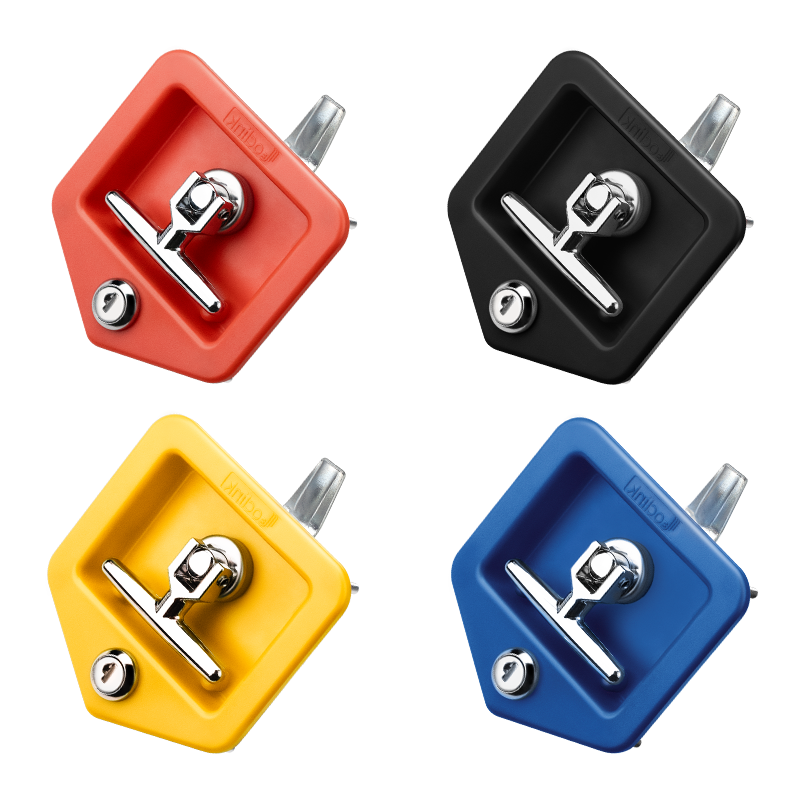
The three key benefits of flush handles for telecom and IT infrastructure:
- Zero aisle intrusion — Critical for hot-aisle/cold-aisle containment in data centers where every millimeter of clearance matters for airflow and equipment installation.
- IP rating enhancement — Flush profiles eliminate protruding surfaces where water can accumulate and seep into seals. This makes achieving IP65/IP66 significantly easier than with protruding handle designs.
- Vandal resistance — No protruding handle means no leverage point for prying. This is essential for unattended outdoor telecom cabinets.
2. Types of Flush Handles & Paddle Latches
| Type | Profile | Compression | Security | Best For |
|---|---|---|---|---|
| Flush Paddle (T-handle) | Completely flush | Single-point cam | Key cylinder + padlock | Telecom outdoor cabinets, electrical panels |
| Pop-Out Paddle | Flush when closed | Multi-point rod available | Key + padlock | Server racks, large IT cabinets |
| Recessed Cup Handle | Below surface | None (pull only) | Padlock hasp | Side panels, access doors |
| Push-to-Close Paddle | Flush | Spring-loaded auto | None | Frequently accessed service panels |
| Swing Handle (semi-flush) | Minimal protrusion | Multi-point rod | Key + padlock | Full-height server cabinets, large telecom enclosures |
For a comprehensive comparison of all paddle latch types beyond telecom/server applications, see ourcomplete paddle latch guide.
3. Telecom Cabinet Specific Requirements
Telecom cabinets serve a unique role in infrastructure: they house critical communications equipment (fiber optic terminators, power distribution, radio units, batteries) in unattended outdoor locations. The flush handle must satisfy multiple stakeholders:
Environmental Protection (IP66 Minimum)
Outdoor telecom cabinets must achieve IP66minimum for roadside installations and IP67 for underground or flood-prone locations. The flush handle contributes to IP rating by:
- Eliminating protruding surfaces where water pools
- Integrating gaskets within the recessed pocket
- Providing compression force to maintain the door seal
Keyed-Alike Systems for Field Operations
A major telecom operator may have 10,000+ outdoor cabinets across a region. Field technicians cannot carry 10,000 unique keys. Keyed-alike systems allow one key to open all cabinets in a region or network. Advanced deployments use master-key hierarchies:
- Level 1 (Technician key): Opens all cabinets in their assigned area
- Level 2 (Regional key): Opens all cabinets in the region
- Level 3 (Master key): Opens all cabinets network-wide
Anti-Vandal Features
Street-side telecom cabinets are targets for copper theft and general vandalism. The flush handle must include:
- Anti-drill cylinder (hardened steel pins in the lock barrel)
- Concealed mounting fasteners (no externally accessible screws)
- Tool-operated mechanism (not operable by hand or common tools)
- Anti-pry profile (no leverage points for prying tools)
4. Server Rack & Data Center Applications
Data center server racks have different priorities from outdoor telecom cabinets. The environment is controlled (temperature, humidity, security), but the density and compliance requirements are extreme.
Hot-Aisle/Cold-Aisle Containment
Modern data centers use containment strategies to prevent hot and cold air from mixing, which wastes cooling energy. Containment doors (end-of-row and in-row) need flush paddle latches that:
- Protrude 0mm from the door surface (any protrusion disrupts the containment seal)
- Open quickly without tools (emergency egress requirement)
- Self-close with positive latching (doors left open defeat containment)
- Accept padlocks for LOTO compliance during maintenance
Compliance Requirements
Data center physical security is governed by compliance frameworks that impact lock hardware selection:
- SOC 2 Type II: Requires documented physical access controls including lock hardware specifications
- HIPAA (healthcare data): Physical safeguards must prevent unauthorized access to equipment
- PCI DSS (payment data): Server cabinets containing payment processing equipment must have individual key locks
For a complete guide to data center lock hardware and compliance, see ourserver rack lock and data center security guide.
5. Flush Handle vs Swing Handle: When to Use Each
This is the most common selection question for telecom and server cabinet hardware. Both handle types are used extensively, but they serve different purposes.
| Criteria | Flush Paddle Handle | Swing Handle |
|---|---|---|
| Door protrusion | 0mm (completely flush) | 5–15mm when closed |
| Compression force | 200–500 N (single-point) | 500–2,000 N (multi-point rod) |
| Max IP rating | IP66 | IP67 |
| Door height range | Up to 800mm | 800mm–2,000mm+ |
| Ergonomics | Quick one-hand operation | Two-hand recommended |
| Locking points | 1 (single cam) | 3–5 (rod-driven) |
| Aisle clearance | Zero intrusion | Handle swings out 90°+ |
| Price range (OEM) | $3–$15 | $8–$35 |
| Best for | Small panels, side doors, containment | Full-height cabinet doors, heavy gaskets |
Rule of thumb: Use flush paddle latches for doors under 800mm tall or where aisle clearance is critical. Use swing handles for full-height doors (800mm+) where uniform gasket compression across the full height is required. For the detailed swing handle guide, seeswing handle & multi-point rod latch guide.
6. Key Systems for Multi-Site Deployments
Key management is a critical operational consideration for telecom and data center deployments. The wrong keying strategy creates security vulnerabilities or operational bottlenecks. Here are the common configurations:
| Key System | How It Works | Best For | Security Level |
|---|---|---|---|
| Keyed-Alike | One key opens all locks | Small telecom networks, fleet cabinets | Moderate |
| Master-Key | Individual keys + one master | Multi-tenant data centers | High |
| Grand Master | Multiple master groups + grand master | Large telecom operators (10,000+ sites) | High |
| Restricted Keyway | Proprietary key profile, blanks not available commercially | High-security infrastructure (utilities, government) | Very High |
Hengchieh maintains key databases across production batches, ensuring keyed-alike consistency even when latches are ordered months apart. For restricted keyway systems, we provide custom key profiles that cannot be duplicated at commercial key-cutting services.
7. IP Ratings & Environmental Protection
The required IP rating depends on where the cabinet is installed. This directly determines the handle material and gasket specification:
| Installation | Min. IP Rating | Handle Material | Gasket |
|---|---|---|---|
| Indoor server room | IP20–IP54 | Zinc alloy + chrome | Optional |
| Indoor telecom room | IP54 | Zinc alloy + chrome | EPDM |
| Covered outdoor (canopy) | IP55–IP65 | 304 stainless steel | EPDM |
| Exposed outdoor (roadside) | IP66 | 304 stainless steel | EPDM |
| Coastal outdoor | IP66–IP67 | 316 stainless steel | Silicone |
| Underground / flood zone | IP67 | 316 stainless steel | Silicone |
For the detailed IP66 specification guide including gasket compression calculations, see ourIP66 compression latch for outdoor enclosures article. For broader IP/NEMA coverage, see our waterproof enclosure lock guide.
8. Selection Matrix by Application
| Application | Handle Type | Material | IP Rating | Key System |
|---|---|---|---|---|
| Street-side telecom cabinet | Flush paddle, keyed | 304/316 SS | IP66 | Keyed-alike or master |
| Cell tower base station | Swing handle, rod latch | 316 SS | IP66–IP67 | Restricted keyway |
| Fiber distribution cabinet | Flush paddle, keyed | 304 SS | IP65 | Keyed-alike |
| Server rack (containment) | Flush paddle, push-to-close | Zinc alloy + chrome | IP20–IP54 | Padlock hasp |
| Full-height server cabinet | Swing handle, 3-point rod | Zinc alloy + chrome | IP54 | Individual key + master |
| Network equipment bay | Pop-out paddle | Zinc alloy + chrome | IP44 | Keyed-different |
9. Recommended Hengchieh Models
Hengchieh manufactures 19 paddle latch / panel lock models and 21swing handle lock models. Here are the top picks for telecom and server cabinet applications:
Paddle Latches for Telecom & Server Cabinets
| Model | Type | Material | Key Lock | Best Application |
|---|---|---|---|---|
| P858 | Paddle latch | Plastic, ABS | Optional | Telecom & server cabinets |
| L848 | Paddle latch | Zinc Alloy, Stainless Steel, 304 Stainless Steel | Optional | Telecom & server cabinets |
| MS848 | Paddle latch | Brass, 304 Stainless Steel, Zinc Alloy, Stainless Steel, Steel | Optional | Telecom & server cabinets |
| L858 | Paddle latch | Zinc Alloy, Stainless Steel, 304 Stainless Steel | Optional | Telecom & server cabinets |
| MS858 | Paddle latch | 304 Stainless Steel, Carbon Steel | Optional | Telecom & server cabinets |
Swing Handles for Large Cabinet Doors
| Model | Type | Material | Rod Latch | Best Application |
|---|---|---|---|---|
| MS301~2 | Swing handle | Zinc Alloy, Steel, Brass | Compatible | Full-height cabinet doors |
| MS303 | Swing handle | Zinc Alloy, Steel, Brass | Compatible | Full-height cabinet doors |
| MS304 | Swing handle | Zinc alloy | Compatible | Full-height cabinet doors |
| MS305 | Swing handle | Zinc Alloy, Steel, Brass | Compatible | Full-height cabinet doors |
10. Frequently Asked Questions
What is a flush handle for a telecom cabinet?
What type of latch is used on server racks?
What is the difference between a flush handle and a swing handle?
Can paddle latches be keyed alike across multiple telecom cabinets?
What IP rating do telecom cabinet handles need?
Related Guides
Paddle Latch Guide (Complete)
All types, sizing, installation & OEM options
Compression Latches Guide
IP ratings, gasket force, 33 models
Server Rack Lock Guide
Data center physical security & compliance
Swing Handle & Multi-Point Rod Latches
Rod sizing, compression calculations
IP66 Compression Latches for Outdoor Enclosures
NEMA 4X, gasket selection, material grades
Paddle Latch Manufacturer — 19 Models, OEM Available
Factory direct, NEMA ratings, custom key systems
Need Flush Handles for Telecom or Server Cabinets?
35+ years of precision manufacturing. Keyed-alike across batches. IP66/IP67 rated. MOQ 500 pcs.