Gravity vs High Pressure Die Casting Compared
"Should we gravity cast or high pressure die cast this part?" is one of the first questions we work through with every new OEM customer. The answer depends on your part geometry, mechanical requirements, annual volume, and whether heat treatment is needed. As a manufacturer running both processes on the same factory floor, we see the trade-offs play out daily across hundreds of different part designs.
How Each Process Works
Gravity die casting (GDC) is conceptually simple: molten metal is poured into a reusable steel mold (die) and fills the cavity under gravity alone — no external injection pressure. The metal flows downward through a gating system, fills the cavity over 5-15 seconds, and solidifies under atmospheric pressure. Some variants use low-pressure assistance (0.5-1 bar) or tilt-pouring to improve fill consistency, but the essential principle remains gravity-driven.
High pressure die casting (HPDC) injects molten metal into a steel die at extreme pressures — typically 10-175 MPa (1,500-25,000 psi) — using a hydraulic piston. The metal fills the entire cavity in 10-100 milliseconds, solidifies under sustained holding pressure, and the cycle completes in 15-90 seconds. HPDC machines are categorized as hot-chamber (for zinc, 88-400 ton) and cold-chamber (for aluminum, 250-4,000+ ton).
Head-to-Head Comparison
| Factor | Gravity Die Casting | High Pressure Die Casting |
|---|---|---|
| Injection Pressure | Gravity only (0 bar) | 10-175 MPa |
| Cycle Time | 2-5 minutes | 15-90 seconds |
| Min Wall Thickness | 3-5 mm | 0.6-1.5 mm |
| Dimensional Tolerance | ±0.2-0.5 mm | ±0.03-0.1 mm |
| Surface Finish (as-cast) | Ra 3.2-6.3 μm | Ra 0.8-3.2 μm |
| Internal Porosity | Very low | Moderate (gas + shrinkage) |
| Heat Treatable? | Yes (T6, T7) | Generally no (blistering) |
| Weldable? | Yes | Difficult (porosity issues) |
| Part Weight Range | 100g - 50kg | 5g - 15kg typical |
| Tooling Cost | $2K-15K | $5K-50K+ |
| Tooling Life | 30K-100K shots | 80K-500K+ shots |
| Ideal Annual Volume | 500 - 50,000 | 5,000 - 1,000,000+ |
| Common Alloys | A356, A357, AlSi7Mg | ADC12, A380, Zamak 3/5 |
When to Choose Gravity Die Casting
Gravity casting is the right choice when your part needs one or more of these characteristics:
Heat treatment is required. This is the single biggest differentiator. If your part needs T6 heat treatment to achieve maximum strength and hardness — common for structural automotive components like suspension brackets, steering knuckles, and engine mounts — gravity casting is almost mandatory. The low porosity in gravity castings allows solution treatment at 530°C without the surface blistering that plagues HPDC parts.
Thick walls are acceptable or desired. Gravity casting requires minimum wall thickness of 3-5mm, which is actually an advantage for heavy-duty structural parts where rigidity and mass are beneficial. Thick walls also allow for easier feeding and lower shrinkage porosity.
Low to medium volumes. Below 10,000 units annually, gravity casting's lower tooling cost ($2K-15K vs $5K-50K+ for HPDC) can make it more economical despite slower cycle times. For prototype runs (50-500 pieces), gravity casting is almost always the more cost-effective route.
Welding or pressure-tight sealing is needed. The low gas porosity in gravity castings allows reliable TIG/MIG welding and hermetic sealing — essential for fluid-handling components like pump housings and valve bodies that must pass leak testing.
When to Choose High Pressure Die Casting
HPDC dominates when speed, precision, and thin walls matter:
High volume production. Above 10,000 units annually, HPDC's 15-90 second cycle time versus gravity's 2-5 minutes means dramatically lower per-unit costs. At 100,000+ units, HPDC is typically 50-70% cheaper per piece than gravity casting for equivalent parts.
Thin walls and complex geometry. HPDC can fill walls as thin as 0.6mm (zinc) or 1.0mm (aluminum), enabling lightweight designs impossible with gravity casting. Complex internal features, snap-fit bosses, integrated threads, and thin ribs are all achievable with HPDC.
Tight dimensional tolerances. HPDC consistently holds ±0.03-0.1mm as-cast, reducing or eliminating secondary machining. For parts like lock mechanisms where pin positions must be accurate to hundredths of a millimeter, HPDC is the only viable casting process.
Decorative surface finish required. HPDC produces as-cast surfaces of Ra 0.8-1.6 μm (for zinc), smooth enough for direct chrome plating without polishing. Gravity castings typically require grinding and polishing before plating can be applied.
Cost Comparison: A Real Example
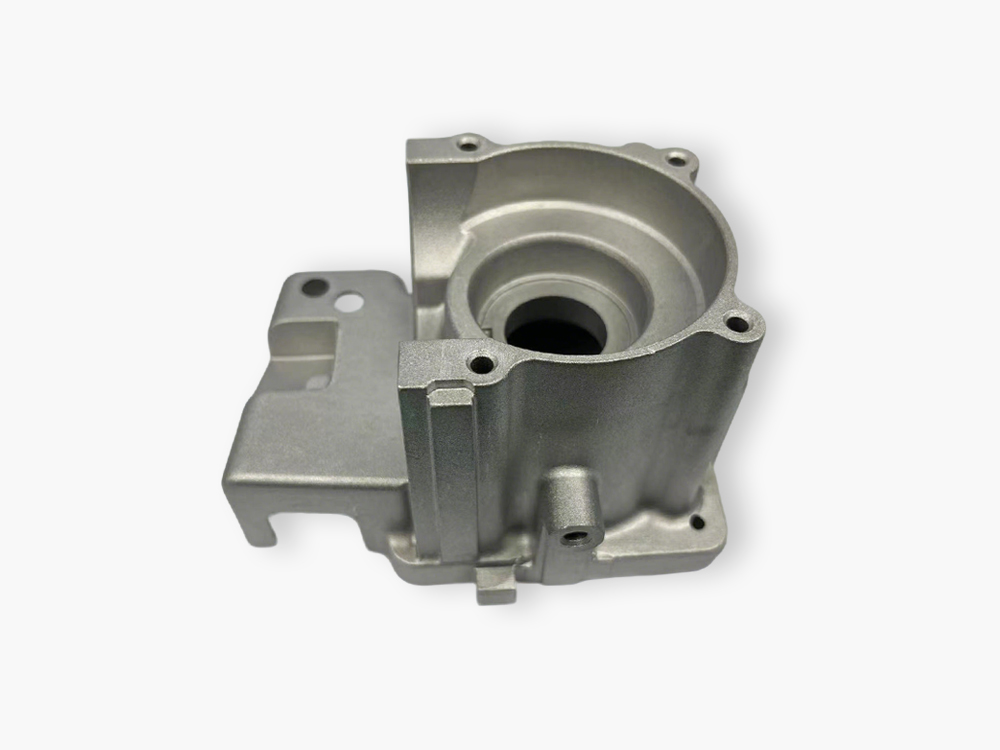
Consider an aluminum housing weighing 250g with moderate complexity. Here is a realistic cost comparison based on our production experience:
| Cost Element | Gravity (A356) | HPDC (ADC12) |
|---|---|---|
| Tooling cost | $5,000 | $12,000 |
| Cycle time | 3 min | 45 sec |
| Unit cost @ 1,000 pcs | $8.50 | $15.20 (tooling heavy) |
| Unit cost @ 10,000 pcs | $4.80 | $3.20 |
| Unit cost @ 100,000 pcs | $4.20 | $1.80 |
The crossover point — where HPDC becomes cheaper than gravity — sits around 5,000-8,000 units for most part geometries. Below that, gravity's lower tooling cost wins. Above that, HPDC's faster cycle time dominates.
Frequently Asked Questions
What is the difference between gravity and high pressure die casting?
Is gravity casting better than die casting?
Can high pressure die castings be heat treated?
What volume makes HPDC cost-effective?
Not sure which process to use?
Send us your part design with volume estimates. We run both gravity and HPDC on the same floor and will recommend the most cost-effective process for your specific requirements.
Related: Aluminum vs Zinc Die Casting · Custom Die Casting OEM Guide · Aluminum Die Casting Parts · Manufacturing Capabilities